the unbearable notice is; that you've to make up your mind to be the difference and not the other way round else people will misjudge you even though you're not that person.
I. Prologue of Perfidy MTN, once heralded as the golden child of telecommunications in Africa, now stands accused in the court of public accountability.
Cloaked in branding brilliance and armed with influencer backed deception, they market connectivity but deliver captivity.
Their creed is not connection, but consumption of wallets, of trust, of digital dignity.
II. The Great Data Mirage How does 1GB vanish like mist in the Harmattan sun? MTN claims usage; we claim daylight robbery.
Background Data Drain: Users report hemorrhaging megabytes even while idle ghost apps, or ghost billing?
Stealthy Auto Renewals:
A cunning trapdoor packages renew without prompt, often seconds before expiry, charging the user even if balance is insufficient, plunging them into silent debt.
Night Data Shell Game: Night plans supposedly valid from midnight till dawn but access throttled or denied until 2am.
Fraud disguised as fair use.
“I’ve just subscribed for the 33th time after first subscribing #9000 for 45GB 30Days plan in the same month👹”
Another Concerned User Layers Issue As A Classified Fraud;
III. The Unholy Tariffs Data pricing on MTN is not just high; it’s high handed.
Biased Bandwidth Economics: MTN Nigeria’s average price per gigabyte towers above what #MTN charges in South Africa or #Ghana.
Same brand, same servers different rates?
That’s regional exploitation, not localization.

Punitive PAYG Billing: Accidentally fall out of a bundle and your airtime vanishes in seconds with no warning.
Billing at “standard rates” is code for sanctioned theft.
IV. The Customer Care Masquerade You dial 180 and enter purgatory.
Bots Before Humans: Conversations go in loops.
You’re passed from chatbot to cold line like a hot potato in a dead zone
“We’ll escalate this issue” becomes a mantra of delay problems disappearing into a black hole of broken promises.
Agents Without Authority: Even when you reach a rep, they lack the mandate to reverse charges or correct wrongs.
You’re stuck in bureaucratic limbo.
V. Network Tyranny They boast
“Everywhere you go” but what they deliver is “Nowhere you flow.”
InsiderNotes
Intentional Throttling? Peak hours see speeds drop to a crawl.
Meanwhile, premium users whisper tales of smoother streams.
Are we witnessing a class system in the cloud?
Selective Congestion: Some apps (read: high bandwidth or competitor friendly ones) mysteriously lag.
Others tied to MTN partners? Lightning-fast.
VI. The Final Accusation: Digital Colonialism This isn’t just about poor service.
It’s about gatekeeping access in the digital economy.
“MTN’s grip on infrastructure gives it a monopoly on our online lives”
A Concerned User Complains Bitterly;
They shape what’s fast, what’s slow, what’s possible while raking in billions from the very economies they throttle.
This is more than profit seeking; it’s a subtle form of control of a 21st-century telecom tyranny masquerading as connectivity.
VII. Epilogue: The People’s Verdict We do not seek pity, only parity.
We demand transparency, fairness, and a fundamental reset of digital ethics.
Until then, let the people rise switch providers, expose shady practices, and rewire the narrative.
This treatise shall be carved not in stone but in tweets, blogs, and viral threads.
U.S. Secretary of State Marco Rubio delivers remarks alongside Democratic Republic of the Congo Foreign Minister Thérèse Kayikwamba Wagner (L) and Rwandan Foreign Minister Olivier Nduhungirehe during a Declaration of Principles signing ceremony at the State Department in Washington on April 25. Kevin Dietsch/Getty Images
Of the three Gulf states that U.S. President Donald Trump visited last week, the United Arab Emirates struck some of the most spectacular deals.
Pledges between the two countries amounted to more than $200 billion, and following restrictions under former President Joe Biden the UAE will enjoy expanded access to advanced U.S. artificial intelligence chips.
Lifting these controls is a dangerous error, Alasdair Phillips Robins and Sam Winter Levy warn: Without them, the United States is
“placing the most important technology of the 21st century at the whims of autocratic regimes with sophisticated surveillance systems [and] expanding ties to China.”
InsiderNotes
The nexus between China and the UAE is especially apparent in Africa, where Emirati businesses are making green energy investments using Chinese technology and minerals.
The United States, meanwhile, looks set to retreat from the continent, with cuts to the U.S. Agency for International Development and Trump’s tariffs pushing African nations to form new alliances.
Through the transactional lens that Trump is fond of,
Curtis Bell and Christopher Faulkner, of the U.S. Naval War College, write.
But the authors argue that U.S. Africa policy can still prioritize tangible returns through investments that build enduring partnerships, not through quick exits or one-sided gains.
Trump will have the chance to follow that advice as he meets with South African President Cyril Ramaphosa in Washington on May 21.
South Africa is the United States’ largest trading partner in a region that is an important strategic gateway into Africa, yet Ramaphosa and Trump have not gotten off to a good start.
In fact, the diplomaticrelationship between the United States and South Africa has reached its lowest point since the latter’s transition to democracy in 1994, Imraan Buccus, a senior research associate at South Africa’s Auwal Socio Economic Research Institute, writes.
Much of the blame can be attributed to a Feb. 7 executive order awarding refugee status to Afrikaners that South Africa’s foreign ministry described as based on a “campaign of misinformation and propaganda.”
Ramaphosa has said that his country would not be “bullied” by Trump, but as he looks to reset relations and strike a much needed trade deal, the stakes for his meeting at the White House this week are high.
A Global Citizen from Nigeria, Jeremiah, reminisced on how the $Twitter crackdown impacted the community:
“The sudden ban of Twitter, now referred to as X, several years ago sent shockwaves through communities, significantly affecting not only individuals’ ability to connect and share but also disrupting businesses and revenue streams dependent on the platform.”
He added: “It highlighted the interconnectedness of individuals and businesses in the digital realm, where disruptions to online platforms can have far-reaching consequences on livelihoods.”
In 2024 Senegal is experiencing Nigeria’s history, as civil society organizations are taking the Senegalese government to the ECOWAS court regarding internet shutdowns that took place in June, July, and August 2023 as presidential elections were meant to be en route and popular opposition leader (and fierce critic of President Macky Sall) Ousmane Sonk was criminally charged and held in custody.
The blackouts not only limited the right to access information and the freedom of expression of everyday citizens, but it also limited the work of journalists on the ground.
Speaking to Global Citizen on the internet blackout in Senegal, the African head of the International Federation of Journalists, Louis Thomasi said: “Political interference is really putting a dent in qualitative journalism.
If you look at what’s happening in Africa all over, it is now a norm that during election periods, the internet will be cut off.
Even yesterday again [13 Feb. 2024] in Dakar, in Senegal, the internet was cut off.”
“It’s a deliberate attempt to suppress freedom of expression and media freedom in general,”
Louis Thomasi/African head of the International Federation of Journalists
Internet shutdowns and crimes against humanity
We’ve already mentioned that there’s an ongoing war in Sudan and the country has had its internet cut off several times in the face of the civil war.
Sudanese Global Citizen, Mazen, explains what having online access means to them: “Nowadays, the Internet means life.
It makes you aware and connected with the world.”
Internet blackouts in the country have heavily impacted people’s lives, but their impacts are a lot worse than you can imagine.
The loss of the internet has also meant that conflict-related atrocities can continue without being reported.
Advocacy organization, Access Now, has consistently kept tabs on the violent impacts of shutdowns in Sudan.
The organization noted that in 2021, the day before a pro-democracy protest was to take place, the internet was cut off along with phone and SMS services.
The protest continued regardless.
With citizens having no ability to transmit information inside or outside of Sudan, authorities took the opportunity to crack down physically on protesters.
At least 17 people were killed, and 250 people were injured as a result.
“The internet blackouts are doing their job and providing cover for the military’s violent takeover and hijacking of a possible democratic future for Sudan,”
“I have experienced natural disasters such as earthquakes, social unrest causing violent protests, terrorist attacks, all sorts of events that caused or forced involuntary internet shutdowns,”
“The one thing I missed the most in any of those instances was critical services and the ability to connect with my loved ones. This is what the internet means to me.”
Rwandan Global Citizen Gabriel
It’s futile to deny the importance of online access to people across the continent.
However, for as long as the internet exists, there will be ways to exploit it for the use of harm towards everyday citizens in African countries, and around the world.
Since 2011, the United Nations has called for universal internet access as a human right, however, this has not been implemented across countries despite the growing call for it
Right now what Global Citizens can do is remain informed about internet shutdowns and their impacts on communities, and spread the word about them so that their impacts do not go unnoticed and underreported.
As Sudan experiences a civil war where one of the most severe hunger crises of 2023 (and 2024 so far) is ongoing, access to humanitarian aid is both dire and scarce, and innocent lives are being scraped off the planet every day authorities added insult to injury by shutting the internet down when citizens needed it most.
It was mid-February 2024, almost a year into the ongoing violence, when Sudan’s internet would be disrupted for around 10 days.
While the current civil war has been ongoing for over a year, violence and conflict have clung to Sudan’s back on and off for years, and throughout, internet shutdowns have been the norm.
“Because of the internet shutdown, we are unable to communicate with our volunteers, we are unable to buy food, medicine and deliver these services to those in need.
Most of our soup kitchens in the greater Khartoum are cut off and therefore not working.”
A civilian expressed: “Due to war, using online banking apps for transactions has gained popularity given the lack of liquidity.
Now, however, we are almost starving because of this shutdown, as we can’t even buy food and medicine.
All my interactions, including business and online courses, have come to a stop too.”
Whether or not access to the internet should be considered a human right is no longer up for debate: it should be.
The internet has become a vital part of the engine that propels the world forward, and to block someone’s access to it is to block someone’s access to their already existing human rights.
Access to education, food, employment, health, and humanitarian aid, are all within the Universal Declaration of Human Rights and because the internet has overwhelmingly become the means by which we access these rights, it should suffice that access to the internet itself should be a human right.
So when an entire region or nation has been denied the right to access the internet due to political agendas that are not always in the best interest of the people, we should be worried as a global society.
Internet shutdowns across the African continent are not only frustrating, but they are increasingly harmful.
Here’s what more you should know:
What are internet shutdowns?
We’re not talking about an outage here.
An outage is when an error or accident occurs and the internet goes off as a result, for instance in times of extreme weather where infrastructure is destroyed, or in the case of maintenance repairs.
A shutdown, on the other hand, is the deliberate turning off of the internet to control a population or the information flow surrounding a situation, and is often orchestrated by some form of authority.
Egypt’s authorities at the time caught on to the fact that demonstrators were using the internet to mobilize and multiply the protest movement, and so they shut off the internet directly impacting access to an open civic space for the right to protest and speak freely.
While it wasn’t the first internet shutdown in history, because of the magnitude of the Arab Spring protests, the world opened its eyes to how internet shutdowns can be weaponized.
A similar thing happened in the last African monarchy-state, eSwatini, in 2021, when pro-democracy and anti-police brutality protests erupted, the state shut down the internet citing “security reasons”, depriving children of their education, businesses of their income, and citizens alike of their free speech.
If it’s still not clear why these shutdowns are a bad thing, a Global Citizen from Ghana, who wished to stay anonymous, broke it down for us: “The internet means Information, which means power in the hands of the people.
The reason governments like to impose restrictions is so the information flow can be stagnant, robbing people of their power to be seen and heard.”
They can either rely on what’s called a routing disruption, which is to stop the transmission of information altogether, meaning people using the internet can’t connect to it, and information being sent will not find its destination.
This is largely what we’ve seen across the continent, particularly in the case of Sudan and eSwatini.
Global Citizen
The second is called packet filtering, where parts of the internet or specific sites are shut down, or specific content is targeted, for instance, Nigeria blocking access to Twitter in 2021.
In retaliation (or what the government referred to as protecting the state from “undermining Nigeria’s corporate existence”) the government banned Twitter for the entire country.
At the time, Human Rights Watch and other organizations raised alarm about the impact of freedom of expression and an open civic space, however, these calls were ignored by Buhari’s government.
What’s more is that any use of Twitter, including by journalists and media houses, was deemed “unpatriotic”, and could result in persecution.
We’ll continue the rest of the discussion in our next blog, subscribe to be the first to be notified when it drops.
A new way to launch apps and certain iOS features is hidden right behind your screen.
Quickly: Try to turn on your iPhone’s flashlight. If it took you longer than two seconds, you’re probably missing out on one of the iPhone’s best hidden features.
Though the iPhone’s Settings menus harbor many hidden gems, including one that can protect it from thieves, they’re so numerous and buried you’d be forgiven for mostly ignoring them.
Still, those who wish to turn their phone into the fastest flasher in the West needn’t look too hard.
Open Settings, scroll down to “Accessibility,” find “Touch,”
Scroll all the way down and tap “Back Tap.”
You’ll see two options: “Double Tap” and “Triple Tap.”
Each lets you tell your phone to do something when you tap its back twice or three times.
I use the trick for my flashlight, so I can quickly find things in the dark closet under my stairs, but you can customize the taps to do tasks like launch the camera, take a screenshot or mute your ringer.
If you have found uses for Siri beyond reeling off the population of Belgium, you can tap for the voice assistant too.
INSIDERNOTES
You can do even more powerful things with the help of Apple’s “Shortcuts” app.
It lets you create custom automations that you can trigger with the taps.
Open the app, tap the plus arrow to create a new shortcut, then add as many steps as you want.
When you return to your “Back Tap” settings, you’ll see all your saved automations as options.
“My favorite customization allows me to use Shazam, the app that helps identify any song you encounter while walking around, by just triple tapping the back of my phone”
a trick that lets you turn the back of your phone into an app launchpad
I’ve also made one that just starts playing the most recent episode of my favorite podcast and one that tells me the next event I have scheduled in my calendar.
Really, the possibilities are endless.
One small limit: Since you can only tap two ways, you can only use this feature to do two things.
And whatever you build, make sure you practice getting the tap to work before trying it in the wild.
Ensuring it consistently triggers requires finesse.
If you don’t have a case on your phone (you animal!) you can likely get it to work with just a gentle touch.
Those with thick cases might need to tap harder I’ve found it helps to use your fingernail.
A young man by the name AKPA JEREMIAH has disclosed how the economic hardship in his country turned him into Professional Content creator.
Initially, he was into graphics and cinematography, directing sessions of shootings and coverages.
When asked of how he had made the decision on budging from what seemed like a stagnation into a whole new life and to this exquisite experience through a fostering career he said
“No one except God knows what we have sacrificed together for the sake of success in life”
Akpa Jeremiah
Mr. Akpa Jeremiah also stated that all went alright until he felt something like a weight was behind dragging him backward and that made him really felt stagnated despite all his competency.
It’s probably not fair to characterize what happened to him as life handing him a lemon.
“However, the one good thing about being stuck in bed is that you’ve got plenty of time on your hands”
Tristan James Jr.
He went further stressing that;
"It is unfortunate that we have not gotten there even after our sincere services but we still believe in God and the future is bright."
And when asked about his financial status quo as to whether it was part (played a huge role) of his ambitions that made him go scrambling and a pursuer of many odigie on humanitarian efforts turned into a career.
That has been the order of work in today’s world people thriving so hard tryna bring in a good value and endless decisionmaking assistance sprouting to the societal life, and it should’ve been easier that way.
“We decided not to do Ev!| To make money rather we work hard with sincererity” He continues…
JTF
How it all started
I started content creation in the earliest dwindles of 2020 without any help or advice or encouragement either.
Since then, I have struggled and faced many challenges along the line (with few of non lesser successes) and, God has never failed me and I have never given up on anything that patches the tires of mine running wheels.
“I have not made money from my Contents but consistently working hard and believing I will get there soon”
INSIDERNOTES
The digital world today, has generated a common value and leverage to the masses who had nothing to borrow for.
We tried to delve more deeper as to what had birthed this sensational urge to succeed in to a different field.
“What inspired me to start content creation is that I found out it is the easiest way I could express my feelings/rights to the world and equally teach them”
Akpa Jeremiah quoted;
And also exposing how people think, react, behave, and some of the things that could happen in the future or have already happened in the past.
You just had a total of 150K viewers and above now on YouTube being one of the greatest medium for developers especially in this erring age, how does it feel like knowing that you’re on the right path to achieving success?
YouTube Achievements for Akpa Jeremiah
On YouTube after just a short while of beginning this journey.
Well, let me start first by thanking each and everyone of you who is supporting me in one way or the other.
Often the road towards achieving success are filled with many obstacles hindrances and distractions but, one must be ready to overcome those columns of difficulties ignoring their lustful appetites of failures which are seen as distractions and staying focused.
I appreciate your comments, likes, views & shares, it all makes sense and is the reason that am here where I’m today.
I wouldn’t have gotten here if it weren’t for you people, I cannot do this without you, and also, don’t give up on me and please continue to support and share my Contents.
UMB
God bless you all forever amen!
Contact Us via Social Media;
Prime:Comedy, Modelling & DOP
Youtube:@Akpa Jeremiah
Facebook:@Akpa Jeremiah
IG:@Akpa_Jeremiah1
WhatsApp:@+2348116765809
A question for you: have you heard about Zambia’s escalating HIV crisis? No?
Well what about Angola experiencing one of the most intense droughts in its history, have you heard anything about that?
If not, it’s not surprising, because nor have a lot of people.
Despite the world having this wonderful access to information technology where news and stories can be shared globally with just the click of a button, some of the most crucial stories and events are going overlooked.
lobal media attention can be both fickle and fleeting and, often depending on where a crisis is happening or who the people are being impacted, the threat to lives and the urgent action needed can often go unnoticed or underreported.
This in turn, can affect the political and humanitarian attention that each crisis receives.
Humanitarian agency CARE International released a report this month called,
The report dives into the crises that are impacting millions of people yet received the least media coverage of the past year they found that all of them are on the African continent
CARE’s research compares the coverage of these crises to the coverage of major pop culture moments, and the results are… revealing.
In Malawi, for instance, 5.4 million people are facing an acute hunger crisis as a result of tropical storms such as Cyclone Ana with 2,330 articles written about the crisis.
That might sound like quite a lot — until you compare it with the 217,529 articles written about the Chris Rock/Will Smith incident at last year’s Oscars.
That’s almost 93 times more articles than the hunger crisis in Malawi.
According to CARE, the main reason these humanitarian crises don’t get more attention is because they often don’t suit the criteria of being compelling enough news, which, according to experts CARE consulted for the report,
“prioritize dramatic, timely, familiar, unambiguous, and easy to explain stories, which are assumed to resonate with their target audiences.”
InsiderNotes
But now more than ever, as the climate crisis wreaks havoc, the refugee and displacement crisis is the worst it’s been in decades, the global food crisis leaves millions going hungry every day, and conflict is raging across countries and continents we can all play a part in making sure all crises get the attention they need.
And how do we do that? We asked Emily Janoch, Senior Director for Thought Leadership, Knowledge Management, and learning at CARE USA.
“As an individual, diversify your news sources.
Look at what you consume, click on, and share.
If that hasn’t covered one of these crises, start thinking about why, and who might be covering those issues,” she said.
“Also look at who is telling the story,” she added. “Is it someone who is impacted by the crisis?
Does it show the people involved as humans who can act and who deserve better? Or does it only treat them (especially women) as victims?”
This is a result of rising temperatures, with CARE reporting that there’s potential for these droughts to be more frequent due to climate change.
The droughts are causing climate migration, and have impacted food insecurity resulting in 3.8 million people not having enough to eat.
It also doesn’t help that Angola is also one of the countries with the highest food price increases as a result of the war in Ukraine.
2. Malawi: Cyclones, Cholera & Hunger
Health workers treat cholera patients at the Bwaila Hospital in Lilongwe central Malawi on Jan. 11, 2023.
Malawi’s cholera outbreak has now claimed more than 1,000 lives by Tuesday, Jan. 25, 2023 according to the country’s health minister, who warned that some cultural beliefs and hostility towards health workers are slowing down response efforts.
We’ve mentioned that 5.4 million people in Malawi are experiencing an acute hunger crisis as a result of damaging cyclones.
We also need to mention that Malawi’s health care system is under strain due to rising HIV cases and intense cholera outbreaks, seen as a result of not enough access to clean drinking water.
3. Central African Republic: Conflict & Climate Change
One in two people in the Central African Republic don’t have enough to eat.
The changing weather conditions have impacted the soil that the country’s food grows from, while storms and floods have destroyed thousands of homes and left 10,000 children without schools to attend.
The country has also experienced unceasing conflict since 2013, which has resulted in a severe refugee crisis with over 740,000 people seeking refuge across the borders and 500,000 people experiencing internal displacement.
4. Zambia: Increased Poverty, HIV & GBV
More than half the Zambian population lives in extreme poverty — meaning living on less than $1.90 a day and the country is experiencing some of the worst malnutrition rates in the world as a result of economic instability and the climate crisis affecting agriculture.
Meanwhile, more than 10% of people have recently been infected with HIV and, in 2021, around 19,000 people died of AIDS in the country.
Gender-based violence is also highly prevalent in the country, particularly following the #COVID19 pandemic and lockdowns that also saw economic hardship increase across the country.
5. Chad: Unrest & Floods
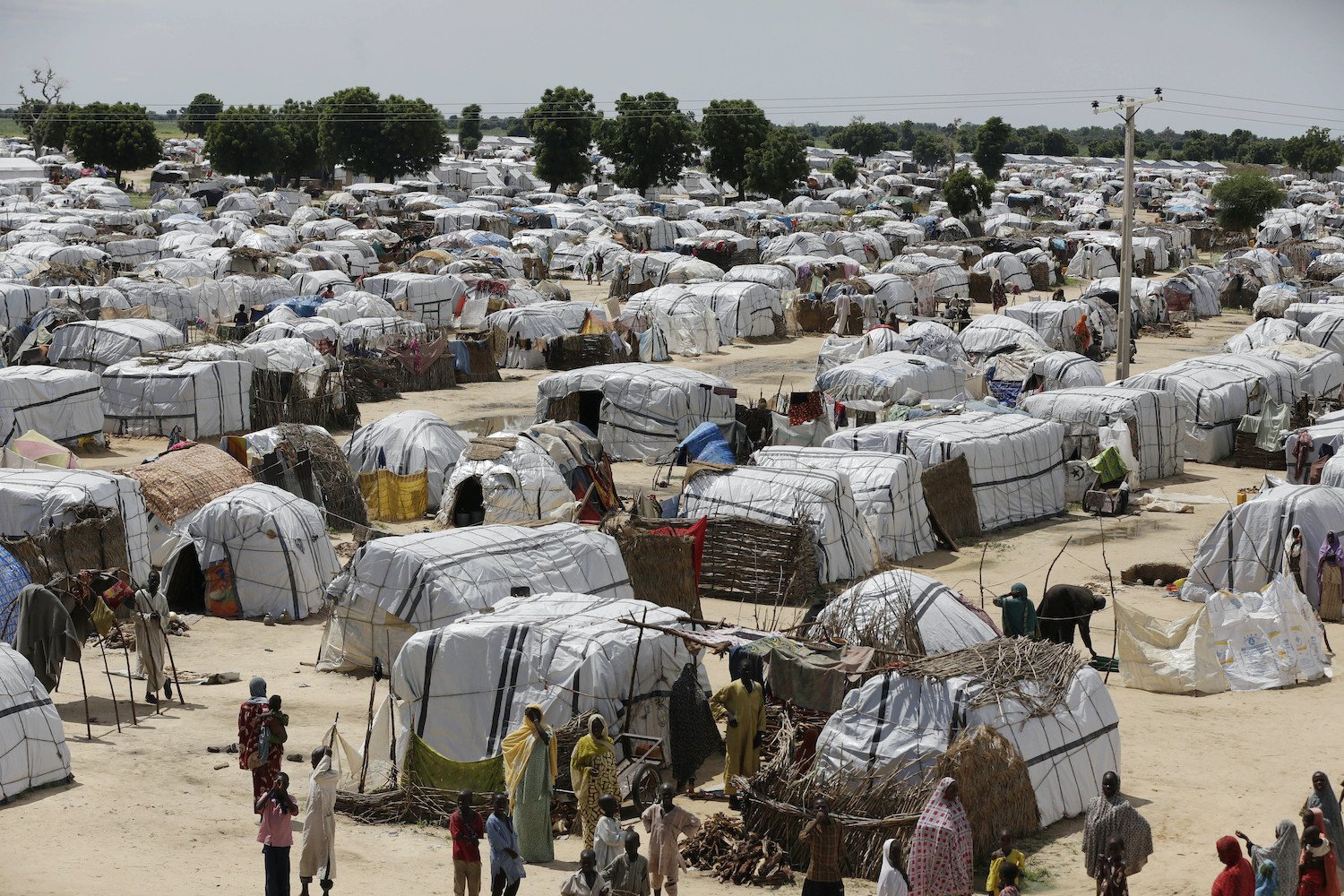
A top view of one of the biggest camp for people displaced by Islamist extremists in Maiduguri, Nigeria on Aug. 28, 2016.
Droughts, flooding and a shrinking Lake Chad caused in part by climate change is fueling conflict and migration in the region and needs to better addressed, a report said Thursday, Jan. 19, 2023.
Armed conflicts and insurgency have remained a major issue in the Sahel region of North Africa for several years, and right now, 6.1 million people in the region are in need of humanitarian aid as a result.
Over 70% of Burundi’s people live below the poverty line, and 1.8 million people are in need of humanitarian assistance due to the lack of safe drinking water and inadequate access to health care.
Climate migration has also been a major issue, with 85,000 people being forced to leave their homes following extreme flooding.
6. Burundi: Economic Crisis & Natural Disaster
Over 70% of Burundi’s people live below the poverty line, and 1.8 million people are in need of humanitarian assistance due to the lack of safe drinking water and inadequate access to health care.
Climate migration has also been a major issue, with 85,000 people being forced to leave their homes following extreme flooding.
A vendor counts her money after making a sale in Harare, Thursday ,June, 2, 2022. Rampant inflation is making it increasingly difficult for people in Zimbabwe to make ends meet.
Since the start of Russia’s war in Ukraine, official statistics show that Zimbabwe’s inflation rate has shot up from 66% to more than 130%.
The country’s finance minister says the impact of the Ukraine war is heaping problems on the already fragile economy.
High inflation and economic instability mean more than half the Zimbabwean population is living in extreme poverty.
The climate crisis, including intense drought periods followed by heavy rainfall, have impacted food production and food security, resulting in food shortages and insecurity across the country.
8. Mali: Conflict & Climate Crisis
Ongoing violence and two coups in 2020 and 2021 have led to citizens fleeing the country in large numbers resulting in 2.5 million children dropping out of school, and exposing women and girls to the threat of sexual violence.
The climate crisis has also hit Mali hard, with floods and droughts contributing to crop failure and increasing malnutrition and hunger in the country.
Cameroon has faced crisis after crisis over the last decade, and currently 3.9 million people are in need of emergency humanitarian assistance that’s around 14% of the country.
There has been ongoing conflict and political unrest since 2016, resulting in 3,000 schools closing down, and citizens becoming internally displaced this despite the fact that there is already a large influx of refugees entering Cameroon to escape violence in the neighboring Central African Republic.
Water and sanitation is also a major issue, with 1.8 million people unable to access clean water.
10. Niger: Hunger & Lack of Development
“In general, Niger is a country of records: one of the hottest countries, it has the highest fertility rate, and the highest population growth in the world,”
The Report Highlights.
Yet, despite these records, little to no investment has been made into the country’s development and climate adaptation.
Natural disasters such as droughts, together with ongoing conflict and insurgency, have led to food instability 4.4 million people are acutely food insecure, and half the country’s children under the age of 5 are chronically malnourished.
The COP28 climate summit in Dubai, November 2023. Here’s what you should know.
Many countries had their representatives at the COP28, and still yet are with less or zero knowledge about what really went down well, here’s a brief recap if you fall into this category just a two minute read.
Flooding in India, Cameroon, and Libya. Extreme heat across the US, Europe, and Asia.
A cyclone in Myanmar. A tropical storm hitting Japan, Guam, the Philippines, and Taiwan. The list goes on.
This is not exactly the kind of sentence you’d expect from a qualified climate expert, a group that prefers the more austere language of hard facts.
Yet, these days, “climate scientists are struggling for words,” writes climate scientist Katharine Hayhoe.
Instead, she’s started replying to questions about the latest extreme weather event or report about how dire things are with: “I am running out of original things to say.”
This year’s COP is a significant milestone: the first assessment of how countries are faring against emissions cutting commitments made at Paris in 2015 (known as the Paris agreement).
When the Paris agreement was signed in 2015, it was agreed that every five years countries would return with more ambitious plans to reduce their greenhouse gas emissions and tackle global warming.
The #COVID19 pandemic caused COP to be canceled in 2020, making COP26 in Glasgow, Scotland, in 2021, one of the “big COPs.”
The “small COPs,” held in the intervening years, tend to focus on laying the groundwork for negotiations.
COPs usually open with a ceremonial opening meeting.
This is then followed by days of world leaders on stage talking about climate change, generally concentrating either on what their countries intend to do about it or on the dire consequences they are experiencing.
The remaining days have themes such as finance and energy and see politicians and business leaders stepping up to announce various new promises, pledges, coalitions, and projects.
But outside the doors, activists usually rage against superficial commitments and rally against political inaction.
This time, there’s been significant outrage after it was leaked to the Guardian that the UAE’s state oil company has been able to read emails to and from the COP28 climate summit office and was consulted on how to respond to a media inquiry.
Remind me, what was agreed at Paris?
Under the landmark Paris agreement at COP21 in 2015, nations committed to holding global heating to well below 2 degrees Celsius above pre industrial levels, and preferably limiting warming to 1.5 degrees.
Though the deal is legally binding, the commitments that countries have made to cut their emissions are not, unless they are enshrined into national or regional legislation.
INSIDERNOTES
Who takes part?
The attendees at COP are dignitaries and Heads of State and Government as well as tens of thousands of government delegates and representatives of civil society, intergovernmental organizations, NGOs, and the media.
There are 197 parties which are broadly organized in five regional groups: Africa, Asia, Eastern Europe, Latin America and the Caribbean, and Western Europe and Other States (including Australia, Canada, and the US).
At the cluster of COP side events, climate change leaders, experts, and influencers gather to share their stories and solutions at panel discussions, exhibits, cultural events, and more.
What happened at COP27?
After two weeks of fraught negotiations, a “historic pact” was struck at COP27 in which developed countries, which are historically responsible for the climate emergency, agreed to provide climate finance to help poorer countries experiencing climate-related disasters, known as a loss and damage fund.
Alok Sharma, the UK President of COP26, was more scathing about how the conference fared.
“I said in Glasgow that the pulse of 1.5 degrees was weak. Unfortunately, it remains on life support,” he said.
What do we want to happen at COP28?
An End to Fossil Fuels
That means support for the Fossil Fuel Non-Proliferation Treaty from world leaders to ensure a Just Transition away from fossil fuels, an end to fossil fuel subsidies, and robust taxing of remaining fossil fuel production.
Cough Up the Climate Finance
Now isn’t the time for baby steps, it’s time to go big: fund a Just Transition in all countries, help countries adapt to climate change, and fund loss and damage.
Protect Climate Activists and Environmental Defenders
Almost 2,000 environmental activists have been killed over the past decade.
We need a human rights approach to all aspects of climate action.
It is a premium smartwatch with exciting set of features including multisport tracker, AI fitness exercise coach, GPS and more.
In this quick smartwatch review, we take a close look at its features:
AmazFit Active smartwatch has a 1.75-inch HD AMOLED display with resolution of 454 * 454 pixels and pixel density of 341 ppi. You get over 100 colorful watch faces to choose from.
It is a lightweight device weighing just 24 grams with aluminium middle frame and silicone straps. The one with Lavender Purple and vegan leather strap weighs 27 grams.
Like other health and fitness trackers, AmazFit Active comes with various trackers. It is capable of tracking 24 * 7 heart rate levels, blood oxygen saturation levels and stress level monitors.
You can sync data with Zepp app and get complete insights about your health metrics.
It also supports over 120 sports modes. It auto detects seven sports.
One of the attractive features of this wearable is that it has built-in GPS.
Thanks to its circularly-polarized antenna, it is capable of tracking every twist and turn with exceptional accuracy.
The smartwatch calculates a unique Readiness score based on heart rate, sleep breathing activity and temperature to provide insights about overall well-being.
“It also has pre-installed Amazon Alexa as your smart assistant”
INSIDER
Battery Life and Bluetooth Calling
In terms of battery life, it runs for up to two weeks on a single charge with typical usage and with continuous GPS usage, it is rated to run for about 16 hours.
“With battery saver, it runs for up to a month”
INSIDER ACCORDING TO USERS EXPERIENCE
Thanks to the Bluetooth connectivity, you can easily make and receive phone calls. It also supports music storage for phone-free playback.
Price and Availability
AmazFit Active smartwatch comes in Lavender Purple, Midnight Black and Petal Link colors.
It is priced at ₹12,999/- in India and is available for purchase at Amazon and the Amazfit website.
For virtual events it allows a meeting place where all those attending individual sessions, panels, tracks or exhibit booths in a Shindig-enabled event, to navigate to a single shared experience and meet up, just as they might if the event were in person.
One of the key additional differentiators of this feature is that all the private conversations can go on while the participants are also able to peruse and interact with the conference program directory, discussing with friends and colleagues what session, panel, track, or booth they might attend together next while jointly exploring the full conference guide.
Addressing the clamoring need for better virtual and hybrid event networking, Shindig today introduces a patented virtual lobby functionality; a virtual experience where event attendees can mingle, network and conduct private business on the platform.
“The innovation is designed for both virtual events and hybrid events”
TRUSTANJAMESJR
For hybrid events the function adds two critical new elements.
First, it provides a venue for in-person guests to engage with online participants freely on their mobile phones, critically uniting both audiences together for purposes of private conversation.
Second, it helps event hosts avoid “dead air” in their livestreams and provides opportunities for the online audience to engage during breaks required between the in-person sessions, which otherwise would cause the online audience to be lost and otherwise leave the event.
In the 2021 Event Tech Innovation Report, the EventMB publication cited ‘the biggest challenge for planners in virtual events is how to keep attendees engaged’.
Virtual events also promise to play a significant role in hybrid events, as they can allow in-person attendees to take advantage of the opportunity to engage with the potentially larger audience attending online, and vice versa.
In response to this need, Steve Gottlieb, CEO & Founder of Shindig, Inc. said, “while many platforms claim that one-on-one appointments, speed dating or text interactions are the same as networking, those just don’t compare to real life behavior people want
“And just like an in-person event lobby, the Shindig lobby is perfect for sponsor messaging, video displays, dynamic CTA’s and other activities that can be facilitated in a conference reception space”
The Seven Husbands of Evelyn Hugo is a historical fiction novel by American author Taylor Jenkins Reid and published by Atria Books in 2017.
The novel tells the story of the fictional Old Hollywood star Evelyn Hugo, who at the age of 79 decides to give a final interview to an unknown journalist, Monique Grant.
“Taylor Jenkins Reid” is an American essayist and author who majors on the genre of fiction. She is the highly acclaimed author of tear jerking, romantic books such as One True Love, Maybe in Another Life, After I Do, and Forever, Interrupted.
“Evelyn reveals she has no interest in giving an interview for Vivant”
INSIDERNOTES
According to Reid, Evelyn Hugo was loosely based in part on actresses Elizabeth Taylor, who was married eight times to seven different men, and Ava Gardner, who revealed the secrets of her life to a journalist which was eventually published as Ava Gardner: The Secret Conversations.
Monique Grant, a reporter for Vivant magazine, has been individually selected to interview Evelyn Hugo, a reclusive former star, who is auctioning some of her famous gowns to raise money for a breast cancer charity.
Monique is confused as to why Evelyn has chosen her, but goes to Evelyn’s apartment to meet her.
“Evelyn is 14 when she marries her first husband, Ernie Diaz, in order to reach Hollywood and escape her abusive father in Hell’s Kitchen”
MONIQUEGRANT
She falls in love with and marries actor Don Adler, but in the following months, Don begins to abuse Evelyn when pressure is placed on his career.
In an adaptation of Little Women, Evelyn, now 21, stars opposite Celia St. James. Evelyn is initially jealous of Celia’s talent, but the two quickly form a bond. At a party, Evelyn is told that Celia is a lesbian.
21’s birthday was on Friday, and he celebrated with a major Freaknik-themed bash in the ATL. You might’ve seen the awesome fire red pickup truck Thug gifted to his homey — but what you didn’t know, until now, is the whip cost $150k!!!
Young Thug is about that big spender lifestyle — especially when it comes to his pal 21 Savage … who just hit 29, and YT went all out for his very pricey gift … some very expensive wheels.
Roadshow International — a luxury car dealership in Atlanta — tells TMZ … the truck itself is a Dodge Hellcat TRX, new models of which can range anywhere from $60k to $72k right off the lot.
“It also has a “21” emblazoned across the door”
TRISTANJAMESJR
But, watch this video showing all the truck’s features and you’ll see why Thug paid way more than that.
Not just that, but the interior bears 21 Savage’s face too … a rendering of himself is stitched right into the upholstery of some of the seats — so there’s no question whose ride this is.
Herm, who owns Roadshow Int’l, says he had 3 days to work on the truck, and sure enough … he got it done in time for the big birthday party. Talk about a good friend, and talk about some nice nice things.
Music star Davido and his former lover, Chioma Rowland, have gotten members of the online community talking as they were spotted again after the festivities of their son’s birthday parties.
A photo making the rounds online captured Davido and Chioma posing together alongside their son inside a church. The parents seemed to have visited a branch of the popular Redeemed Christian Church of God (RCCG).
Davido carried Ifeanyi while Chioma posed just beside him for the photo. As expected, many Nigerians in the online community could not stop talking with some people suggesting that Chioma is still in love with the father of her child.
“The photo sparked reactions from members of the online community with some noting that Chioma still loves the singer”
INSIDERNOTES
Here are some of the highlights from post comments and likes, 👇👇👇
salemchad said: “The way she stood next to him shows she’s still in love with him. And then the color combo.”
bibii___m said: “Chioma still loves Davido….it’s so obvious.” titilayyyo said: “Who else notice chef chi is very happy.”
floxylaah said: “Davido please come back to Chioma I love you both together.”
isaaction4u said: “Be like say them done come back together.”
miss.ifeyinwa said: “It’s the matching orange for me.”
Where to start is to download the e-Naira app from google store place or apple.
Note that after requesting the app, you may be asked to verify your identity by entering your passcode or by using Touch ID or Face ID.
From the Home screen, tap the App store. If the e-Naira Speed Wallet app isn’t available on your home screen, swipe left to access the App Library.
“33 banks fully integrated and live on the platform”
CBN
To install apps, you must sign in with your Apple ID or create one.
To browse the App Store, tap Apps. To search for apps by name, tap search (at the bottom) then type e-Naira Speed Wallet’s app.
When the app appears, tap the app. Tap GET, then tap INSTALL. Once successful downloaded, launch the e-Naira Speed Wallet.
“Over 120 merchants successfully registered”
CBN
Click on “Signup” to originate the onboarding process. Select your Relationship bank/e-Naira Partner. Enter mobile number and create password.
Enter the following: First name, Surname, Date of birth, State of Origin, Account number tied to your Bank, and BVN.
On successful validation, of the above details, a wallet activation mail is sent to the email address tied to your BVN.
“Tax base’ll increase as more businesses move to formal sector, Buhari enthuses”
INSIDERNOTES
Go to registered mailbox and confirm receipt of email. Click on “Active Wallet” to confirm your email and activate your speed e-Naira Wallet.
Enter your surname and password to login to the e-Naira Speed Wallet. To Fund the e-Naira Wallet, log in to your bank Mobile/Internet Banking platform and initiate the transfer to your wallet.
And your wallet will be credited with the amount requested from your account to your wallet.
However, Luno disclosed that the withdrawal and depositing of funds for Nigerian users will be done through a third-party platform.
“We believe that this is the safest and easiest-to-use solution currently available to our customers in Nigeria and look forward to you experiencing it for yourselves.”
INSIDERNOTES
Luno warns users that it “does not set the price of bitcoin or any cryptocurrencies, we only facilitate transactions between customers.
The return of Naira deposits and withdrawals may cause significant price volatility, with the release of pent-up customer demand to buy and sell cryptocurrency causing unusual market behaviour that could last for several weeks,” Luno said.
You will be able to deposit and withdraw funds to and from the Luno platform using vouchers purchased and redeemed through a trusted third party provider.
“Representation of cryptocurrency Bitcoin is placed on PC motherboard in this illustration taken, June 29, 2021. Representation of cryptocurrency Bitcoin is placed on PC motherboard in this illustration taken, June 29, 2021.”




 45'MEDIA