Categories
3d Adult AI Bill Gates Breaking News China Daily Climate Action Covid19 Currency Digital Marketing E+commerce Ethnophilosophical FOSSIL FUEL GLOBAL CITIZEN 45'MEDIA Global Modernization. IMF Information insidernotes MEDIOQ recipe technology Teen UN wordpressmedia world health organization

Dangote Refinery Finally Begins Oil Production

Tristan James Jr

The world’s single train refinery, the Dangote Refinery, has made an essential move by issuing tenders to sell its first two fuel cargoes for export in Nigeria.

The development is an essential step for the newly launched refinery, which has generated a buzz in the industry.

A Reuters report quotes three sources saying that the first cargo of 94,000 metric tons of sulphur straight run fuel oil, which Dangote has awarded to Nigeria, is due to load at the end of this week. Before 25th February 2024.

The second tender is for about 70,000 tons of naphtha, which three other sources told Reuters, with the tender started on February 05, 2024.

The development comes after reports emerged that the refinery was preparing to deliver its first fuel cargoes to the domestic market in early weeks today.

“Significant oil marketers in Nigeria had registered with Dangote Refinery to lift and distribute petroleum products from the $20 billion facility”

INSIDERNOTES

The Petroleum Products Outlets Owners Association of Nigeria said that PETROAN has been in talks with the refinery management holding on a conclusion to supply products from the facility as soon as possible.

The report outlined the seven significant marketers, including 11 Plc, Conoil Plc, AA Rano, Ardova Plc, MRS Oil Nigeria Plc, OVH Energy Marketing Limited, Total Nigeria Plc and NNPC Retail.

Adeola Yusuf, Energy Policy expert and Lead of Platforms Africa said the development is good and did say that the move will affect local pricing positive.

In another report the Port Harcourt refinery is set to begin operations after receiving 745,000 barrels of crude oil from #Shell Petroleum Development Company Limited.

The crude oil supply is the first to be made in the past few years due to the poor state of the plant, which called for rehabilitation and testing to ensure readiness for sustainable operations.

Port Harcourt refinery begins production after years of neglect Shell stated that the recommencement of crude oil supply from the BOGT to Port Harcourt Refinery is a significant achievement and a game changer for the industry and Nigeria.

The intensive preparations, partnerships, and dedication of both teams involved were responsible for overcoming challenges and ensuring safe and efficient supply operations.

According to Shell, the move will support the government’s plan of a steady supply of petroleum products to the downstream market and other associated benefits to Nigeria’s economy like the #150naira sale back from October, 7th, 2023.

FG gives oil firms in Nigeria strict orders on Dangote, other refineries as reported that the Nigerian Upstream Petroleum Regulatory Commission (NUPRC) has ordered oil companies in Nigeria to supply about 934,000 barrels of crude oil daily to local refineries for the next seven months beginning from January, 1st, 2024.

The initiative is part of Nigeria’s efforts to ensure regular supply to local refiners for domestic consumption.

About 12 local refineries are expected to begin production in the coming weeks, including the 960,000 capacity Dangote refinery and Nigeria’s four refineries in Port Harcourt, 2 in Warri, and 3 in Kaduna.

The economic hardship in Nigeria has proven on over time that “while the seething nectar we drink inn harms no one else but ourselves” every institution from every sector is detrimental to this scourgerous failure.

Don't Forget To #FollowShareLikeComment
Categories
3d Adult AI Bill Gates Breaking News China Daily Climate Action Covid19 Digital Marketing E+commerce Ethnophilosophical GLOBAL CITIZEN 45'MEDIA Global Modernization. IMF MEDIOQ Modern Art UN

3 Types of Overthinking & How to Overcome Them

TRISTAN JAMES JR.

There’s no shortage of situations to overthink in today’s work world.

Whether it’s fretting over the implications of a new market trend, agonizing about the tone of an email to a major client, or losing sleep over an employee’s reaction to feedback, the opportunities for leaders to get trapped in their own heads are endless.

As we have access to more information and higher demands than ever before, it’s no surprise that half to nearly three quarters of adults confess to thinking too much.

After coaching professionals at some of the world’s top companies for over a decade, I’ve observed a common pattern:

Some people who appear outwardly successful tend to overcomplicate everything, layering unnecessary complexity into their decisions, and deliberating far longer than needed.

This tendency is particularly pronounced among a group I refer to as Sensitive Strivers those who are hardwired to process the world around them more deeply and are often their own toughest critics.

Constantly churning thoughts can be exhausting, and if left unchecked, overthinking can contribute to anxiety and burnout.

There’s far-reaching consequences for organizations, too. When individuals or entire teams habitually overthink, it creates a bottleneck. Decision-making slows, opportunities are missed, and a culture of risk-aversion can take hold, stifling business growth.

Clearly, there’s a pressing need for more effective solutions to overcome overthinking in the workplace.

But to truly tackle this issue, it’s important to first acknowledge and understand that there are actually three forms of overthinking: rumination, future tripping, and overanalyzing.

Armed with this knowledge, it’s possible to develop targeted strategies that lead to meaningful and lasting change for workers and the organizations that employ them.

Here’s how to spot and handle each of the three types of overthinking. 

Rumination 

Rumination is best described as a mental loop where you dwell on past events, particularly negative or distressing ones.

Those who ruminate are often caught in a whirlpool of regret, guilt, and “woulda, shoulda, coulda” scenarios.

They review what went wrong, often blaming themselves.

A key aspect of rumination is its orientation towards the past and getting stuck there.

Signs to watch out for:

  • You fixate on negative feedback. 
  • You often bring up past failures, setbacks, or slip-ups in conversation with others.
  • You’re overly cautious, perhaps double or triple-checking your work, because you want to avoid mistakes.

How to address it:  

Counterintuitively, it can be helpful to schedule “worry time.”

Instead of letting rumination overrun your entire day, confine it to a manageable slot usually no more than 15 to 30 minutes.

Choose a time of day that works for you (just not right before bed) and pick a specific place for your worry time.

It could be a particular chair, room, or even a spot in a park.

Divide your worries into two categories: those you can control and those you cannot.

For worries within your control, brainstorm possible actions or solutions.

For example, if you’re worried about meeting a deadline, your action steps could include saying no to another commitment.

Each time an uncontrollable worry arises, try visualization.

Imagine placing the worry in a balloon and releasing it into the sky.

By setting aside a designated time to address these thoughts, you’re not in a constant battle to push them away. You’re simply postponing them to a more convenient time.

If rumination crops up outside your designated worry time, gently remind yourself, “Not now, I’ll tackle this later,” which helps bring greater awareness and control to your thought patterns.

Future tripping

Instead of being trapped in the past, those who are future tripping are concerned about what lies ahead.

While some degree of anticipation is beneficial, future tripping can escalate to the point where it holds you back.

The uncertainty of what might happen, the potential for failure, and the fear of the unknown can make it a challenging form of overthinking. 

Signs to watch out for:

  • You spend excessive energy planning for every possible scenario to feel prepared for any eventuality. 
  • You find it hard to celebrate your successes because you’re always thinking about what’s next.
  • You often feel restless or agitated, driven by thoughts of outstanding to-do items.

How to address it: 

Use your ability to look forward to your advantage.

Mentally projecting yourself into the future, beyond the point of your current worries.

For example, Caelin, a marketing manager, is overwhelmed with the launch of a new product.

The deadline is tight, expectations are high, and his team is under significant pressure.

He’s concerned about the campaign strategy, the team’s workload, and potential customer reactions.

Caelin finds a quiet conference room during his lunch break.

He closes his eyes and pictures himself five years from now. He’s in a more senior role, reflecting on his career path.

From this future perspective, Caelin realizes that the product launch was just one of many projects he handled. He’s able to put it in perspective.

While it’s important, it’s not a defining moment of his career.

He recalls how some aspects didn’t go as planned, but also how the team adapted and learned from the experience.

This strategy, known as temporal distancing, can reduce the immediacy and intensity of your concerns, helping you focus on the present with a calmer, more balanced mindset.

You can also choose to practice “selective ignorance” by reducing your exposure to unnecessary stressors.

Be intentional about the information you consume, especially from news sources and social media.

Identify triggers that escalate your future-tripping, such as updates about constant market fluctuations and industry predictions or constantly checking KPI dashboards or financial accounts.

If certain updates or data do not impact your day to day work or decision-making, they might not be necessary.

Prioritize information that you can act upon.

Overanalyzing

While rumination and future tripping are bound by time one looking back and the other looking forward overanalyzing is centered on depth.

It involves diving incredibly deep into a topic, thought, or situation, often to the point of excess.

While this can sometimes lead to profound insights, more often than not, it results in getting bogged down in details that might not be particularly relevant. 

Signs to watch out for:

  • You procrastinate or delay taking action to research further. 
  • You frequently seek out others’ approval or confirmation, because you lack confidence in your own analysis. 
  • You have difficulty distinguishing between high-priority and low-priority tasks, leading to a backlog of decisions. 

How to address it:

Instead of striving for the perfect choice, aim for one that is “good enough” with an approach known as satisficing.

Once a decision meets your established criteria and is satisfactory, you should go ahead with it, even if a potentially better option might exist.

Compare this to maximizers, who examine every option and keep searching for better alternatives, deals, or outcomes to their own detriment.

Of the two decision making types, maximizers are more prone to overanalyzing, less likely to feel happy with the results of their decisions, and more likely to negatively compare themselves to others.

Key decision criteria principles, guidelines, or requirements help you prioritize the most important variables weighing into a decision.

Your decision criteria can be professional or personal.

For example, let’s say you’re trapped in analysis paralysis around whether or not to offer a new feature for your product or service.

Your decision criteria could include: cost, profitability, effort, risk level, or impact.

Now let’s say, you’re trying to make a personal decision, like whether to move for a new job.

You might consider criteria like how well the role fits your strengths, the salary, or whether the role aligns with your future aspirations.

Select three criteria at most, with one that outranks the others.

If you’re in a group decision making situation, have everyone brainstorm and agree on the criteria together.

It’s important to remember that the goal is not to eliminate all deep thinking, but rather to prevent it from spiraling into the unproductive kind.

Identifying the type of overthinking you or your team is dealing with is the first step in breaking free from its grasp and more crucial than ever when the demand for quick yet thoughtful decision-making is high.

Melody Wilding, LMSW is an executive coach and author of Trust Yourself: Stop Overthinking and Channel Your Emotions for Success at Work. Get a free copy of Chapter One here.

Don’t Forget To #FollowShareLikeComment

FB@TRISTANJAMESJR/LIKEHOJBLOG
IG@TRISTANJAMESJR/LIKEHOJB45
LINKEDIN@TRISTANJAMESJR
X@TEEJAE45/LIKEHOJB
WHATSAPP@09068311978

Categories
3d Adult AI Bill Gates Breaking News China Daily Climate Action Covid19 Digital Marketing E+commerce Ethnophilosophical GLOBAL CITIZEN 45'MEDIA Global Modernization. IMF MEDIOQ Modern Art UN

3 Types of Overthinking & How to Overcome Them

TRISTAN JAMES JR.

There’s no shortage of situations to overthink in today’s work world.

Whether it’s fretting over the implications of a new market trend, agonizing about the tone of an email to a major client, or losing sleep over an employee’s reaction to feedback, the opportunities for leaders to get trapped in their own heads are endless.

As we have access to more information and higher demands than ever before, it’s no surprise that half to nearly three quarters of adults confess to thinking too much.

After coaching professionals at some of the world’s top companies for over a decade, I’ve observed a common pattern:

Some people who appear outwardly successful tend to overcomplicate everything, layering unnecessary complexity into their decisions, and deliberating far longer than needed.

This tendency is particularly pronounced among a group I refer to as Sensitive Strivers those who are hardwired to process the world around them more deeply and are often their own toughest critics.

Constantly churning thoughts can be exhausting, and if left unchecked, overthinking can contribute to anxiety and burnout.

There’s far-reaching consequences for organizations, too. When individuals or entire teams habitually overthink, it creates a bottleneck. Decision-making slows, opportunities are missed, and a culture of risk-aversion can take hold, stifling business growth.

Clearly, there’s a pressing need for more effective solutions to overcome overthinking in the workplace.

But to truly tackle this issue, it’s important to first acknowledge and understand that there are actually three forms of overthinking: rumination, future tripping, and overanalyzing.

Armed with this knowledge, it’s possible to develop targeted strategies that lead to meaningful and lasting change for workers and the organizations that employ them.

Here’s how to spot and handle each of the three types of overthinking. 

Rumination 

Rumination is best described as a mental loop where you dwell on past events, particularly negative or distressing ones.

Those who ruminate are often caught in a whirlpool of regret, guilt, and “woulda, shoulda, coulda” scenarios.

They review what went wrong, often blaming themselves.

A key aspect of rumination is its orientation towards the past and getting stuck there.

Signs to watch out for:

  • You fixate on negative feedback. 
  • You often bring up past failures, setbacks, or slip-ups in conversation with others.
  • You’re overly cautious, perhaps double or triple-checking your work, because you want to avoid mistakes.

How to address it:  

Counterintuitively, it can be helpful to schedule “worry time.”

Instead of letting rumination overrun your entire day, confine it to a manageable slot usually no more than 15 to 30 minutes.

Choose a time of day that works for you (just not right before bed) and pick a specific place for your worry time.

It could be a particular chair, room, or even a spot in a park.

Divide your worries into two categories: those you can control and those you cannot.

For worries within your control, brainstorm possible actions or solutions.

For example, if you’re worried about meeting a deadline, your action steps could include saying no to another commitment.

Each time an uncontrollable worry arises, try visualization.

Imagine placing the worry in a balloon and releasing it into the sky.

By setting aside a designated time to address these thoughts, you’re not in a constant battle to push them away. You’re simply postponing them to a more convenient time.

If rumination crops up outside your designated worry time, gently remind yourself, “Not now, I’ll tackle this later,” which helps bring greater awareness and control to your thought patterns.

Future tripping

Instead of being trapped in the past, those who are future tripping are concerned about what lies ahead.

While some degree of anticipation is beneficial, future tripping can escalate to the point where it holds you back.

The uncertainty of what might happen, the potential for failure, and the fear of the unknown can make it a challenging form of overthinking. 

Signs to watch out for:

  • You spend excessive energy planning for every possible scenario to feel prepared for any eventuality. 
  • You find it hard to celebrate your successes because you’re always thinking about what’s next.
  • You often feel restless or agitated, driven by thoughts of outstanding to-do items.

How to address it: 

Use your ability to look forward to your advantage.

Mentally projecting yourself into the future, beyond the point of your current worries.

For example, Caelin, a marketing manager, is overwhelmed with the launch of a new product.

The deadline is tight, expectations are high, and his team is under significant pressure.

He’s concerned about the campaign strategy, the team’s workload, and potential customer reactions.

Caelin finds a quiet conference room during his lunch break.

He closes his eyes and pictures himself five years from now. He’s in a more senior role, reflecting on his career path.

From this future perspective, Caelin realizes that the product launch was just one of many projects he handled. He’s able to put it in perspective.

While it’s important, it’s not a defining moment of his career.

He recalls how some aspects didn’t go as planned, but also how the team adapted and learned from the experience.

This strategy, known as temporal distancing, can reduce the immediacy and intensity of your concerns, helping you focus on the present with a calmer, more balanced mindset.

You can also choose to practice “selective ignorance” by reducing your exposure to unnecessary stressors.

Be intentional about the information you consume, especially from news sources and social media.

Identify triggers that escalate your future-tripping, such as updates about constant market fluctuations and industry predictions or constantly checking KPI dashboards or financial accounts.

If certain updates or data do not impact your day to day work or decision-making, they might not be necessary.

Prioritize information that you can act upon.

Overanalyzing

While rumination and future tripping are bound by time one looking back and the other looking forward overanalyzing is centered on depth.

It involves diving incredibly deep into a topic, thought, or situation, often to the point of excess.

While this can sometimes lead to profound insights, more often than not, it results in getting bogged down in details that might not be particularly relevant. 

Signs to watch out for:

  • You procrastinate or delay taking action to research further. 
  • You frequently seek out others’ approval or confirmation, because you lack confidence in your own analysis. 
  • You have difficulty distinguishing between high-priority and low-priority tasks, leading to a backlog of decisions. 

How to address it:

Instead of striving for the perfect choice, aim for one that is “good enough” with an approach known as satisficing.

Once a decision meets your established criteria and is satisfactory, you should go ahead with it, even if a potentially better option might exist.

Compare this to maximizers, who examine every option and keep searching for better alternatives, deals, or outcomes to their own detriment.

Of the two decision making types, maximizers are more prone to overanalyzing, less likely to feel happy with the results of their decisions, and more likely to negatively compare themselves to others.

Key decision criteria principles, guidelines, or requirements help you prioritize the most important variables weighing into a decision.

Your decision criteria can be professional or personal.

For example, let’s say you’re trapped in analysis paralysis around whether or not to offer a new feature for your product or service.

Your decision criteria could include: cost, profitability, effort, risk level, or impact.

Now let’s say, you’re trying to make a personal decision, like whether to move for a new job.

You might consider criteria like how well the role fits your strengths, the salary, or whether the role aligns with your future aspirations.

Select three criteria at most, with one that outranks the others.

If you’re in a group decision making situation, have everyone brainstorm and agree on the criteria together.

It’s important to remember that the goal is not to eliminate all deep thinking, but rather to prevent it from spiraling into the unproductive kind.

Identifying the type of overthinking you or your team is dealing with is the first step in breaking free from its grasp and more crucial than ever when the demand for quick yet thoughtful decision-making is high.

Melody Wilding, LMSW is an executive coach and author of Trust Yourself: Stop Overthinking and Channel Your Emotions for Success at Work. Get a free copy of Chapter One here.

Don’t Forget To #FollowShareLikeComment

FB@TRISTANJAMESJR/LIKEHOJBLOG
IG@TRISTANJAMESJR/LIKEHOJB45
LINKEDIN@TRISTANJAMESJR
X@TEEJAE45/LIKEHOJB
WHATSAPP@09068311978

Categories
3d Adult AI Bill Gates Breaking News China Daily Climate Action Covid19 Currency Digital Marketing E+commerce Exchange GLOBAL CITIZEN 45'MEDIA Global Modernization. horoscope IMF Information insidernotes Modern Art UN wordpressmedia

10 Countries Facing Underreported Crises You Need to Know About in 2023

GLOBAL CITIZEN 45'MEDIA

A question for you: have you heard about Zambia’s escalating HIV crisis? No?

Well what about Angola experiencing one of the most intense droughts in its history, have you heard anything about that?

If not, it’s not surprising, because nor have a lot of people.

Despite the world having this wonderful access to information technology where news and stories can be shared globally with just the click of a button, some of the most crucial stories and events are going overlooked.

lobal media attention can be both fickle and fleeting and, often depending on where a crisis is happening or who the people are being impacted, the threat to lives and the urgent action needed can often go unnoticed or underreported.

This in turn, can affect the political and humanitarian attention that each crisis receives.

Humanitarian agency CARE International released a report this month called,

 Breaking the Silence: The 10 most underreported humanitarian crises of 2022.

The report dives into the crises that are impacting millions of people yet received the least media coverage of the past year they found that all of them are on the African continent

CARE’s research compares the coverage of these crises to the coverage of major pop culture moments, and the results are… revealing. 

In Malawi, for instance, 5.4 million people are facing an acute hunger crisis as a result of tropical storms such as Cyclone Ana with 2,330 articles written about the crisis.

That might sound like quite a lot — until you compare it with the 217,529 articles written about the Chris Rock/Will Smith incident at last year’s Oscars.

That’s almost 93 times more articles than the hunger crisis in Malawi. 

According to CARE, the main reason these humanitarian crises don’t get more attention is because they often don’t suit the criteria of being compelling enough news, which, according to experts CARE consulted for the report,

“prioritize dramatic, timely, familiar, unambiguous, and easy to explain stories, which are assumed to resonate with their target audiences.” 

InsiderNotes

But now more than ever, as the climate crisis wreaks havoc, the refugee and displacement crisis is the worst it’s been in decades, the global food crisis leaves millions going hungry every day, and conflict is raging across countries and continents we can all play a part in making sure all crises get the attention they need.

And how do we do that? We asked Emily Janoch, Senior Director for Thought Leadership, Knowledge Management, and learning at CARE USA.

“As an individual, diversify your news sources.

Look at what you consume, click on, and share.

If that hasn’t covered one of these crises, start thinking about why, and who might be covering those issues,” she said.

“Also look at who is telling the story,” she added. “Is it someone who is impacted by the crisis?

Does it show the people involved as humans who can act and who deserve better? Or does it only treat them (especially women) as victims?”

Let’s start with learning more about 10 of the world’s crises we need to keep talking about and get involved in taking action to help by heading to the Global Citizen app and taking our “Neglected Crises: Raise Your Voice” challenge.

1. Angola: Drought, Hunger & Displacement

Southern Angola is experiencing its most damaging drought in 40 years.

This is a result of rising temperatures, with CARE reporting that there’s potential for these droughts to be more frequent due to climate change.

The droughts are causing climate migration, and have impacted food insecurity resulting in 3.8 million people not having enough to eat.

It also doesn’t help that Angola is also one of the countries with the highest food price increases as a result of the war in Ukraine.

2. Malawi: Cyclones, Cholera & Hunger

An image taken from a slight distance of healthcare workers in protective gear assisting at least one person visible in the image with their child. The worker furthest from the camera stands near an IV drip.

Health workers treat cholera patients at the Bwaila Hospital in Lilongwe central Malawi on Jan. 11, 2023.

Malawi’s cholera outbreak has now claimed more than 1,000 lives by Tuesday, Jan. 25, 2023 according to the country’s health minister, who warned that some cultural beliefs and hostility towards health workers are slowing down response efforts.

We’ve mentioned that 5.4 million people in Malawi are experiencing an acute hunger crisis as a result of damaging cyclones.

We also need to mention that Malawi’s health care system is under strain due to rising HIV cases and intense cholera outbreaks, seen as a result of not enough access to clean drinking water. 

3. Central African Republic: Conflict & Climate Change

One in two people in the Central African Republic don’t have enough to eat.

The changing weather conditions have impacted the soil that the country’s food grows from, while storms and floods have destroyed thousands of homes and left 10,000 children without schools to attend.

The country has also experienced unceasing conflict since 2013, which has resulted in a severe refugee crisis with over 740,000 people seeking refuge across the borders and 500,000 people experiencing internal displacement.

4. Zambia: Increased Poverty, HIV & GBV

More than half the Zambian population lives in extreme poverty — meaning living on less than $1.90 a day and the country is experiencing some of the worst malnutrition rates in the world as a result of economic instability and the climate crisis affecting agriculture.

Meanwhile, more than 10% of people have recently been infected with HIV and, in 2021, around 19,000 people died of AIDS in the country.

Gender-based violence is also highly prevalent in the country, particularly following the #COVID19 pandemic and lockdowns that also saw economic hardship increase across the country.

5. Chad: Unrest & Floods

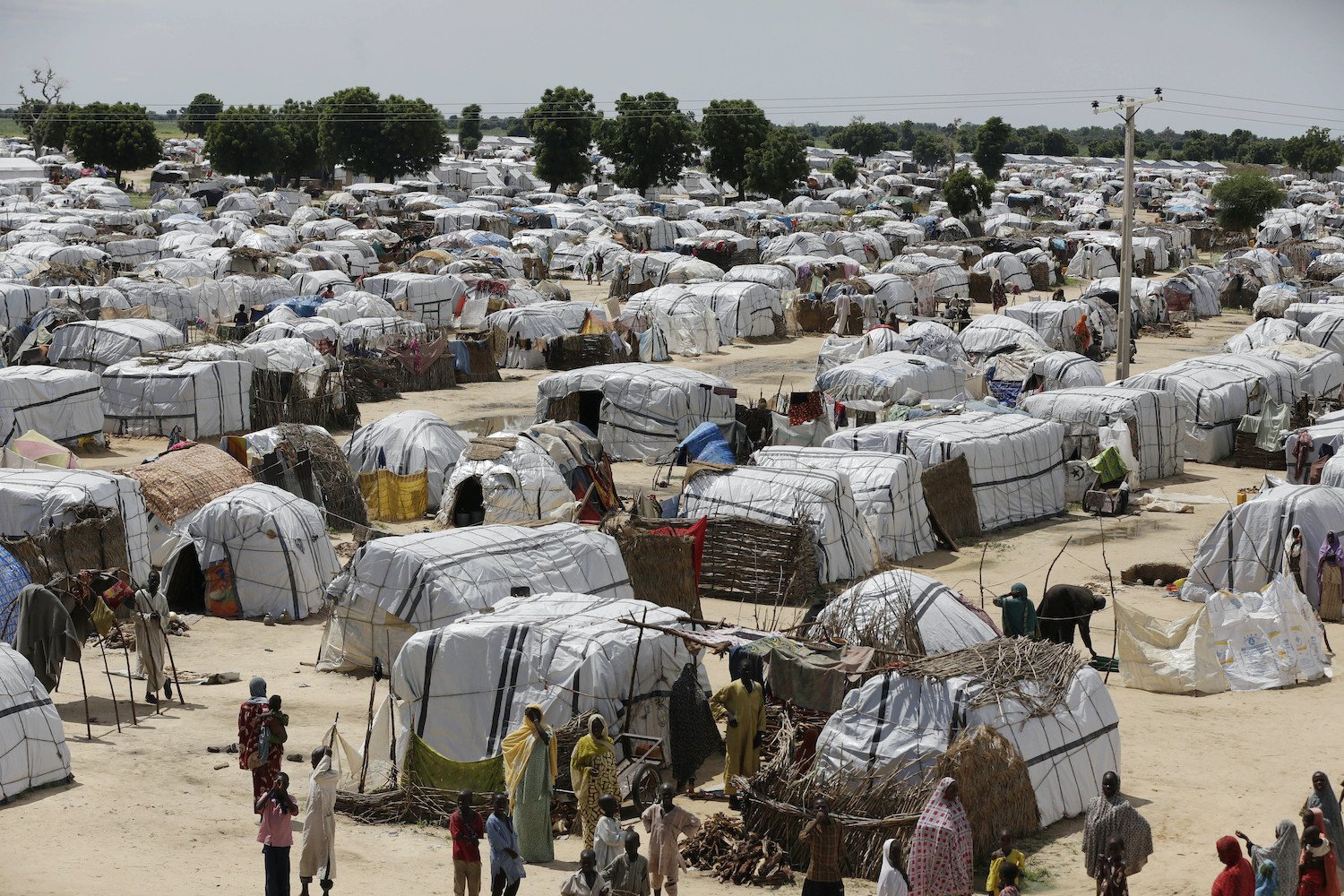
A top view of one of the biggest camp for people displaced by Islamist extremists in Maiduguri, Nigeria on Aug. 28, 2016.

Droughts, flooding and a shrinking Lake Chad caused in part by climate change is fueling conflict and migration in the region and needs to better addressed, a report said Thursday, Jan. 19, 2023.

Armed conflicts and insurgency have remained a major issue in the Sahel region of North Africa for several years, and right now, 6.1 million people in the region are in need of humanitarian aid as a result.

Chad is also experiencing serious blows from the impacts of climate change, as irregular rainfall has impacted agriculture, increasing malnutrition and hunger, and extended rain periods resulting in catastrophic flooding. 

6. Burundi: Economic Crisis & Natural Disaster

Over 70% of Burundi’s people live below the poverty line, and 1.8 million people are in need of humanitarian assistance due to the lack of safe drinking water and inadequate access to health care.

Climate migration has also been a major issue, with 85,000 people being forced to leave their homes following extreme flooding.

6. Burundi: Economic Crisis & Natural Disaster

Over 70% of Burundi’s people live below the poverty line, and 1.8 million people are in need of humanitarian assistance due to the lack of safe drinking water and inadequate access to health care.

Climate migration has also been a major issue, with 85,000 people being forced to leave their homes following extreme flooding.

7. Zimbabwe: Climate Shocks & Increased Poverty Rates

A vendor counts her money after making a sale in Harare, Thursday ,June, 2, 2022. Rampant inflation is making it increasingly difficult for people in Zimbabwe to make ends meet.

Since the start of Russia’s war in Ukraine, official statistics show that Zimbabwe’s inflation rate has shot up from 66% to more than 130%.

The country’s finance minister says the impact of the Ukraine war is heaping problems on the already fragile economy.

High inflation and economic instability mean more than half the Zimbabwean population is living in extreme poverty.

The climate crisis, including intense drought periods followed by heavy rainfall, have impacted food production and food security, resulting in food shortages and insecurity across the country.

8. Mali: Conflict & Climate Crisis

Ongoing violence and two coups in 2020 and 2021 have led to citizens fleeing the country in large numbers resulting in 2.5 million children dropping out of school, and exposing women and girls to the threat of sexual violence.

The climate crisis has also hit Mali hard, with floods and droughts contributing to crop failure and increasing malnutrition and hunger in the country. 

9. Cameroon: Displacement, Conflict & Economic Instability

Cameroon has faced crisis after crisis over the last decade, and currently 3.9 million people are in need of emergency humanitarian assistance that’s around 14% of the country.

There has been ongoing conflict and political unrest since 2016, resulting in 3,000 schools closing down, and citizens becoming internally displaced this despite the fact that there is already a large influx of refugees entering Cameroon to escape violence in the neighboring Central African Republic.

Water and sanitation is also a major issue, with 1.8 million people unable to access clean water. 

10. Niger: Hunger & Lack of Development

“In general, Niger is a country of records: one of the hottest countries, it has the highest fertility rate, and the highest population growth in the world,”

The Report Highlights.

Yet, despite these records, little to no investment has been made into the country’s development and climate adaptation.

Natural disasters such as droughts, together with ongoing conflict and insurgency, have led to food instability 4.4 million people are acutely food insecure, and half the country’s children under the age of 5 are chronically malnourished. 

Now you’re done reading, don’t forget to head to the Global Citizen app and take our “Neglected Crises: Raise Your Voice” challenge to learn more about these crises, quiz yourself on what you’ve learned, and take our pledge to play your part in making sure all the world’s crises get the attention they need and deserve.

Don't Forget To #FollowShareLikeComment 

FB@TRISTANJAMESJR/LIKEHOJBLOG
IG@TRISTANJAMESJR/LIKEHOJB45
LINKEDIN@TRISTANJAMESJR
X@TEEJAE45/LIKEHOJB
WHATSAPP@09068311978
Categories
3d Adult Covid19 Digital Marketing Entertainment Ethnophilosophical Global Modernization. hd horoscope insidernotes kitchen Modern Art music music lyrics Netflix poetry recipe technology Teen Travel wordpressmedia world health organization WWE

8 Questions That’ll Tell You If You Should Use Social Media or Not

Underwritten by Tristan James Jr.

 has become one of the primary sources of  and connectivity with everyone. Social media includes everything from entertainment, news, podcasts and advertising to  and networking.

The list is, however, not limited to these activities only. People connect through live streaming platforms such as Discord, Twitch, Instagram Live, LinkedIn Live, Facebook and YouTube Live.

It goes without saying that scrolling through social media and posting parts of our lives have become familiar or “normal”. It’s funny to compare social media as the “new normal” for people.

“Are you willing to shift your company’s culture”?

INSIDERNOTES

Google is exponentially effective in providing and creating an excellent working environment for its employees. For example, the “Google way” of motivating the workforce is to put its employees first, rather than exclusively rely on their results.

Google regularly shares the journey of its new and long-time employees through storytelling on LinkedIn. They have regular blogs on how their employees work and what motivates them to work. When employees quit Google, they share that they often regard their journey as a rewarding one.

Through its regular social media posts and blog articles, Google has shifted its company’s culture. These posts also provide a public relations tactic since they openly provide their internal relations to the public. This tactic is effective in creating consumer trust in the Google brand.

“Do you want to build your business through authentic personal branding”?

INSIDERNOTES

The first question is critical to consider since personal branding is essential in recognizing a company and its products or services. Personal branding has become a smart way to “market” yourself and create brand awareness.

Consider the example of Elon Musk. When you think of Musk, you immediately think of his electronic automobile company Tesla. You might also think of his space vehicular company SpaceX.

Musk’s personal branding “game” is strong, and his online presence is vital. A single tweet from him on which cryptocurrency to watch influences crypto investors to rush and buy those cryptos.

Read more…..👇👇👇

https://www.entrepreneur.com/article/384826

Categories
3d Adult Covid19 Digital Marketing Entertainment Ethnophilosophical Global Modernization. hd horoscope insidernotes Modern Art music Netflix poetry technology Teen Travel wordpressmedia world health organization

Kanye West finally own a Diamond-certified song

Underwritten by Tristan James Jr.

Kanye West has earned his first ever Diamond certification, with ‘Stronger’ surpassing the 10 million sales mark earlier this week.

Released in 2007 from West’s third album ‘Graduation’, the track has reached the milestone 14 years later.

Tracks need to surpass 10 million sales to be certified Diamond according to the RIAA

INSIDERNOTES

Sharing the news via Twitter, Def Jam Records said: “Kanye West’s ‘Stronger’ is now @RIAA certified DIAMOND! Congratulations to Yeezy and the entire team.”

Earlier this year, it was revealed just 58 songs have been certified Diamond, which is the Recording Industry Association of America highest honour and is worth the equivalent of ten Platinum plaques.

“West also recently announced he is looking at expanding his empire of fashion and music”

INSIDERNOTES

Lil Nas X’s ‘Old Town Road’ was the fastest song to ever earn the classification while tracks by Justin Bieber (‘Baby’, ‘Sorry’), Eminem (‘Not Afraid’, ‘Lose Yourself’), Lady Gaga (‘Poker Face’, ‘Bad Romance’) and Drake (‘God’s Plan’) have also achieved the milestone.

Meanwhile, it’s been announced that an “intimate” new documentary about West, titled jeen-yuhs, is coming to Netflix next year.

Read more related stories…

Kanye West urinates on Grammy Award, says Prince and Michael Jackson were victims of music industry

“I definitely think I’ve created my own path but it’s the people who allowed me to understand that I can do that, who laid the blueprint”

KANYEWEST

In other news, Tyler, The Creator recently thanked artists like West for paving the way for him in a speech after the rapper won the inaugural Rock the Bells Cultural Influence Award at the 2021 BET Hip Hop Awards.

It promises to showcase “both his formative days trying to break through and his life today as a global brand and artist”.

West also recently announced he is looking at expanding his empire of fashion and music. It

Categories
3d Adult Covid19 Digital Marketing Entertainment etnophilosofical Global Modernization. hd horoscope insidernotes Modern Art Netflix recipe Teen Travel wordpressmedia world health organization

Air passengers fleeced by ‘rogue operators’ as PCR tests fail to arrive

Underwritten by Tristan James Jr.

Air passengers to the UK have spent at least £500m on PCR Covid-19 tests from private companies since mid+May, a Guardian analysis has found, only for the NHS to be saddled with extra costs when firms fail to deliver them.

Concern is mounting that the system for testing travellers is on the brink of collapse, with Heathrow airport calling on Wednesday for the government to allow people to use cheaper lateral flow tests instead.

Travellers have reported having to call the NHS testing hotline on 119 for free taxpayer-funded kits after PCR tests they had paid for did not arrive.

“The government must also introduce robust accreditation for all test providers listed on its website, to prevent travellers being ripped off when trying to buy something as essential as a test.”

INSIDERNOTES

we have a small favour to ask. Since we started publishing 200 years ago, tens of millions have placed their trust in the Guardian’s high-impact journalism, turning to us in moments of crisis, uncertainty, solidarity and hope.

More than 1.5 million readers in 180 countries have recently taken the step to support us financially – keeping us open to all and fiercely independent.

With no shareholders or billionaire owner, we can set our own agenda and provide trustworthy journalism that’s free from commercial and political influence, offering a counterweight to the spread of misinformation.

“When it’s never mattered more, we can investigate and challenge without fear or favour.”

INSIDERNOTES

Unlike many others, Guardian journalism is available for everyone to read, regardless of what they can afford to pay.

We do this because we believe in information equality. This way, everyone can keep track of global events, understand their impact on people and communities, and become inspired to take meaningful action.

Follow us on: IG_@Likeh Oj, Facebook_@Likeh Oj, Twitter_@Likeh Ojb, Email_@likehoj.direct@gmail.com, WhatsApp_+2348124415816

Categories
3d Adult Covid19 Entertainment etnophilosofical Global Modernization. horoscope insidernotes Modern Art Netflix poetry technology Teen wordpressmedia world health organization

ANCIENT PROTO-MATH FOUND IN BABYLONIAN TABLET

Underwritten by Tristan James Jr.

Mansfield, a senior lecturer of mathematics at the University of New South Wales Sydney, had suspected the tablet was real. He came across records of its excavation and began the hunt.

Word got around about what he was looking for, and then the email came. He knew what he had to do: travel to Turkey and examine it at the museum.

Hidden within this tablet is not only the oldest known display of applied geometry but a new ancient understanding of triangles. It could rewrite what we know about the history of mathematics, Mansfield argues.

“These findings were published Wednesday in the journal Foundations of Science.”

INVERSE

The way we understand trigonometry harks back to ancient Greek astronomers,” Mansfield tells Inverse.

“I like to think of the Babylonian understanding of right triangles as an unexpected prequel, which really is an independent story because the Babylonians weren’t using it to measure the stars, they were using it to measure the ground.”

Years before discovering this latest tablet, dubbed Si.427, Mansfield was hot on the trail of another ancient Babylonian “document:” Plimpton 322.

“While the location of this artifact was known (it’s located at Columbia University) its true purpose was not.”

INVERSE

Like Si.427, which dates back to roughly 1900 to 1600 BCE, Plimpton 322 is covered in geometric markings — riddles academics have tried to decipher for years.

While the reigning theory was that these markings were a kind of teacher’s cheat code for Babylonian homework problems, Mansfield and colleagues were not convinced.

Follow us on: IG_@Likeh Oj, Facebook_@Likeh Oj, Twitter_@Likeh Ojb, Email_@likehoj.direct@gmail.com, WhatsApp_+2348124415816

Categories
3d Adult Covid19 Digital Marketing Entertainment Ethnophilosophical Global Modernization. hd insidernotes kitchen Modern Art music poetry technology Teen wordpressmedia world health organization

Who are these new Housemates? Do they have what it takes to overcome these challenges?

Underwritten by Tristan James Jr.

QUEEN

Full name: Queen Mercy Atang

Queen, 26, is a philanthropist and aspiring politician. She hails from Akwa Ibom State and has a mom she adores and three beautiful siblings that she loves.

She is a Tansian University graduate and an international beauty queen.

Queen describes herself as “beautiful, courageous, and fearless” and reckons being raised by a single mother taught her a lot about life.

An ambitious and driven person who values everyone around her, she considers herself a true leader and an excellent communicator who is very calculating, loyal, and peaceful.

Watch profile video below,

https://africamagic.dstv.com/video/meet-queen-bbnaija

Categories
3d Adult Covid19 Digital Marketing Entertainment Ethnophilosophical Global Modernization. hd horoscope insidernotes kitchen Modern Art music Netflix poetry recipe technology Teen wordpressmedia world health organization

Space Jam 2 Secretly Criticizes 3D Looney Tunes – Theory & Issues Explained

Underwritten by Tristan James Jr.

Space Jam: A New Legacy gave the Looney Tunes a makeover by turning them into 3D/CGI versions, but was the movie secretly criticizing the use of CGI through the Looney Tunes?

The Looney Tunes have gone through a variety of adventures since their debut in 1930, but in 1996 they went through a one-of-a-kind adventure in space in Joe Pytka’s Space Jam.

The movie brought together two different worlds unlikely to cross paths in the real world: the Looney Tunes and professional basketball, this by having Michael Jordan leading the Tune Squad in a life-changing basketball game.

“The biggest, most noticeable change that has sparked a lot of debate among critics and viewers is how Space Jam 2 digitized the Looney Tunes and gave them a 3D/CGI look, which was justified in the story.”

SCREENRANT

The biggest, most noticeable change that has sparked a lot of debate among critics and viewers is how Space Jam 2 digitized the Looney Tunes and gave them a 3D/CGI look, which was justified in the story.

The Looney Tunes spend the first two acts in their traditional looks, but when the time comes for the big game to start, the villain of the story and leader of the opposing team, Al-G Rhythm (Don Cheadle), gives them a makeover to fit with the digital look of everything else.

Bugs Bunny and company are understandably horrified when they see themselves in 3D form, but could this be a sneaky way from the writers of Space Jam 2 to criticize the use of CGI in recent years?

“However, given a big issue surrounding the animation crew behind Space Jam 2, this theory now seems unlikely.”

INSIDERNOTES

In an unexpected (and unprofessional) movie from Warner Bros., the studio didn’t credit the whole 2D animation team, and this issue was quickly pointed out by some of the animators, most notably Dave Alvarez.

In response to this, and in a failed attempt to make up for the “mistake”, Warner Bros. shared the names of the whole 2D animation crew and their “gratitude” to them via the official Space Jam 2 Twitter and Instagram accounts, which only drew more backlash. 

Follow us on: IG_@Likeh Oj, Facebook_@Likeh Oj, Twitter_@Likeh Ojb, Email_@likehoj.direct@gmail.com, WhatsApp_+2348124415816

Categories
3d Adult Covid19 Entertainment Ethnophilosophical Global Modernization. hd horoscope insidernotes kitchen Modern Art music music lyrics Netflix poetry technology Teen wordpressmedia world health organization

Kanye West urinates on Grammy Award, says Prince and Michael Jackson were victims of music industry

Underwritten by Tristan James Jr.

In other messages West claimed that he’s the “only person” who can speak on the issue of masters ownership without being cancelled (HotNewHipHop notes that some artists have managed to buy back their masters, including Jay-ZFrank Ocean, and Rihanna).

In Tweets, he compared himself to Moses and the music industry to a “modern day slave ship”. EMI (owned by Sony/ATV) has controlled the rights to West’s work since 2003.

“Let’s get it big bro … you and Michael passed so we can live”

KANYEWEST

The artist also claimed that Universal won’t tell him how much his masters cost “because they know I can afford to buy them”.

He then went on to say he will stop at nothing, and proceeded to share PDFs of his apparent contracts.

“We used to diss Michael Jackson the media made us call him crazy…then they killed him,”

KANYEWEST

Yesterday, the billionaire rapper claimed that artists have no control of their actual music after signing a deal, writing: “When you sign a music deal you sign away your rights.

Without the masters you can’t do anything with your own music. Someone else controls where it’s played and when it’s played. Artists have nothing accept the fame, touring and merch.”

Follow us on: IG_@Likeh Oj, Facebook_@Likeh Oj, Twitter_@Likeh Ojb, Email_@likehoj.direct@gmail.com, WhatsApp_+2348124415816

Design a site like this with WordPress.com
Get started