Categories
3d Adult AI Bill Gates Breaking News China Daily Climate Action Covid19 Currency Digital Marketing E+commerce ECOSYSTEM Entertainment Ethnophilosophical etnophilosofical Exchange FOSSIL FUEL gamers GLOBAL CITIZEN 45'MEDIA Global Modernization. hd horoscope IMF Information insidernotes kitchen MEDIOQ Modern Art Movies music music lyrics Netflix technology Teen

Africa’s Internet Shutdowns: Where, Why, and How Do They Happen?

45’MEDIA Continue Reading:

A Global Citizen from Nigeria, Jeremiah, reminisced on how the $Twitter crackdown impacted the community:

“The sudden ban of Twitter, now referred to as X, several years ago sent shockwaves through communities, significantly affecting not only individuals’ ability to connect and share but also disrupting businesses and revenue streams dependent on the platform.” 

He added: “It highlighted the interconnectedness of individuals and businesses in the digital realm, where disruptions to online platforms can have far-reaching consequences on livelihoods.” 

Eventually the Economic Community Of West African States (ECOWAS) court found the government in violation of freedom of expression, and ordered the country to never ban the website again.

In 2024 Senegal is experiencing Nigeria’s history, as civil society organizations are taking the Senegalese government to the ECOWAS court regarding internet shutdowns that took place in June, July, and August 2023 as presidential elections were meant to be en route and popular opposition leader (and fierce critic of President Macky Sall) Ousmane Sonk was criminally charged and held in custody.

The country saw another internet blackout in Feb. 2024 around the time of the country’s elections.

The blackouts not only limited the right to access information and the freedom of expression of everyday citizens, but it also limited the work of journalists on the ground.

The government went so far as to suspend the license of a broadcaster during the election period in Feb. 2024.

Speaking to Global Citizen on the internet blackout in Senegal, the African head of the International Federation of Journalists, Louis Thomasi said: “Political interference is really putting a dent in qualitative journalism.

If you look at what’s happening in Africa all over, it is now a norm that during election periods, the internet will be cut off.

Even yesterday again [13 Feb. 2024] in Dakar, in Senegal, the internet was cut off.”

“It’s a deliberate attempt to suppress freedom of expression and media freedom in general,”

Louis Thomasi/African head of the International Federation of Journalists

Internet shutdowns and crimes against humanity

We’ve already mentioned that there’s an ongoing war in Sudan and the country has had its internet cut off several times in the face of the civil war.

Sudanese Global Citizen, Mazen, explains what having online access means to them: “Nowadays, the Internet means life.

It makes you aware and connected with the world.”

Internet blackouts in the country have heavily impacted people’s lives, but their impacts are a lot worse than you can imagine.

The loss of the internet has also meant that conflict-related atrocities can continue without being reported.

Advocacy organization, Access Now, has consistently kept tabs on the violent impacts of shutdowns in Sudan.

The organization noted that in 2021, the day before a pro-democracy protest was to take place, the internet was cut off along with phone and SMS services.

The protest continued regardless.

With citizens having no ability to transmit information inside or outside of Sudan, authorities took the opportunity to crack down physically on protesters.

At least 17 people were killed, and 250 people were injured as a result. 

“The internet blackouts are doing their job and providing cover for the military’s violent takeover and hijacking of a possible democratic future for Sudan,”

Marwa Fatfta, MENA Policy Manager at Access Now, said of the situation.

What can we do? 

“I have experienced natural disasters such as earthquakes, social unrest causing violent protests, terrorist attacks, all sorts of events that caused or forced involuntary internet shutdowns,”

“The one thing I missed the most in any of those instances was critical services and the ability to connect with my loved ones. This is what the internet means to me.”

Rwandan Global Citizen Gabriel

It’s futile to deny the importance of online access to people across the continent.

However, for as long as the internet exists, there will be ways to exploit it for the use of harm towards everyday citizens in African countries, and around the world.

Since 2011, the United Nations has called for universal internet access as a human right, however, this has not been implemented across countries despite the growing call for it

Right now what Global Citizens can do is remain informed about internet shutdowns and their impacts on communities, and spread the word about them so that their impacts do not go unnoticed and underreported.

You can also follow organizations like Access Now, the Internet Society Foundation, and the Keep it on Coalition (hosted by Access Now) to stay informed.

Categories
3d Adult AI Bill Gates Breaking News China Daily Climate Action Covid19 Currency Digital Marketing E+commerce Ethnophilosophical FOSSIL FUEL GLOBAL CITIZEN 45'MEDIA Global Modernization. IMF Information insidernotes MEDIOQ recipe technology Teen UN wordpressmedia world health organization

Dangote Refinery Finally Begins Oil Production

Tristan James Jr

The world’s single train refinery, the Dangote Refinery, has made an essential move by issuing tenders to sell its first two fuel cargoes for export in Nigeria.

The development is an essential step for the newly launched refinery, which has generated a buzz in the industry.

A Reuters report quotes three sources saying that the first cargo of 94,000 metric tons of sulphur straight run fuel oil, which Dangote has awarded to Nigeria, is due to load at the end of this week. Before 25th February 2024.

The second tender is for about 70,000 tons of naphtha, which three other sources told Reuters, with the tender started on February 05, 2024.

The development comes after reports emerged that the refinery was preparing to deliver its first fuel cargoes to the domestic market in early weeks today.

“Significant oil marketers in Nigeria had registered with Dangote Refinery to lift and distribute petroleum products from the $20 billion facility”

INSIDERNOTES

The Petroleum Products Outlets Owners Association of Nigeria said that PETROAN has been in talks with the refinery management holding on a conclusion to supply products from the facility as soon as possible.

The report outlined the seven significant marketers, including 11 Plc, Conoil Plc, AA Rano, Ardova Plc, MRS Oil Nigeria Plc, OVH Energy Marketing Limited, Total Nigeria Plc and NNPC Retail.

Adeola Yusuf, Energy Policy expert and Lead of Platforms Africa said the development is good and did say that the move will affect local pricing positive.

In another report the Port Harcourt refinery is set to begin operations after receiving 745,000 barrels of crude oil from #Shell Petroleum Development Company Limited.

The crude oil supply is the first to be made in the past few years due to the poor state of the plant, which called for rehabilitation and testing to ensure readiness for sustainable operations.

Port Harcourt refinery begins production after years of neglect Shell stated that the recommencement of crude oil supply from the BOGT to Port Harcourt Refinery is a significant achievement and a game changer for the industry and Nigeria.

The intensive preparations, partnerships, and dedication of both teams involved were responsible for overcoming challenges and ensuring safe and efficient supply operations.

According to Shell, the move will support the government’s plan of a steady supply of petroleum products to the downstream market and other associated benefits to Nigeria’s economy like the #150naira sale back from October, 7th, 2023.

FG gives oil firms in Nigeria strict orders on Dangote, other refineries as reported that the Nigerian Upstream Petroleum Regulatory Commission (NUPRC) has ordered oil companies in Nigeria to supply about 934,000 barrels of crude oil daily to local refineries for the next seven months beginning from January, 1st, 2024.

The initiative is part of Nigeria’s efforts to ensure regular supply to local refiners for domestic consumption.

About 12 local refineries are expected to begin production in the coming weeks, including the 960,000 capacity Dangote refinery and Nigeria’s four refineries in Port Harcourt, 2 in Warri, and 3 in Kaduna.

The economic hardship in Nigeria has proven on over time that “while the seething nectar we drink inn harms no one else but ourselves” every institution from every sector is detrimental to this scourgerous failure.

Don't Forget To #FollowShareLikeComment
Categories
3d Adult AI Bill Gates Breaking News China Daily Climate Action Covid19 Digital Marketing E+commerce Ethnophilosophical GLOBAL CITIZEN 45'MEDIA Global Modernization. IMF MEDIOQ Modern Art UN

3 Types of Overthinking & How to Overcome Them

TRISTAN JAMES JR.

There’s no shortage of situations to overthink in today’s work world.

Whether it’s fretting over the implications of a new market trend, agonizing about the tone of an email to a major client, or losing sleep over an employee’s reaction to feedback, the opportunities for leaders to get trapped in their own heads are endless.

As we have access to more information and higher demands than ever before, it’s no surprise that half to nearly three quarters of adults confess to thinking too much.

After coaching professionals at some of the world’s top companies for over a decade, I’ve observed a common pattern:

Some people who appear outwardly successful tend to overcomplicate everything, layering unnecessary complexity into their decisions, and deliberating far longer than needed.

This tendency is particularly pronounced among a group I refer to as Sensitive Strivers those who are hardwired to process the world around them more deeply and are often their own toughest critics.

Constantly churning thoughts can be exhausting, and if left unchecked, overthinking can contribute to anxiety and burnout.

There’s far-reaching consequences for organizations, too. When individuals or entire teams habitually overthink, it creates a bottleneck. Decision-making slows, opportunities are missed, and a culture of risk-aversion can take hold, stifling business growth.

Clearly, there’s a pressing need for more effective solutions to overcome overthinking in the workplace.

But to truly tackle this issue, it’s important to first acknowledge and understand that there are actually three forms of overthinking: rumination, future tripping, and overanalyzing.

Armed with this knowledge, it’s possible to develop targeted strategies that lead to meaningful and lasting change for workers and the organizations that employ them.

Here’s how to spot and handle each of the three types of overthinking. 

Rumination 

Rumination is best described as a mental loop where you dwell on past events, particularly negative or distressing ones.

Those who ruminate are often caught in a whirlpool of regret, guilt, and “woulda, shoulda, coulda” scenarios.

They review what went wrong, often blaming themselves.

A key aspect of rumination is its orientation towards the past and getting stuck there.

Signs to watch out for:

  • You fixate on negative feedback. 
  • You often bring up past failures, setbacks, or slip-ups in conversation with others.
  • You’re overly cautious, perhaps double or triple-checking your work, because you want to avoid mistakes.

How to address it:  

Counterintuitively, it can be helpful to schedule “worry time.”

Instead of letting rumination overrun your entire day, confine it to a manageable slot usually no more than 15 to 30 minutes.

Choose a time of day that works for you (just not right before bed) and pick a specific place for your worry time.

It could be a particular chair, room, or even a spot in a park.

Divide your worries into two categories: those you can control and those you cannot.

For worries within your control, brainstorm possible actions or solutions.

For example, if you’re worried about meeting a deadline, your action steps could include saying no to another commitment.

Each time an uncontrollable worry arises, try visualization.

Imagine placing the worry in a balloon and releasing it into the sky.

By setting aside a designated time to address these thoughts, you’re not in a constant battle to push them away. You’re simply postponing them to a more convenient time.

If rumination crops up outside your designated worry time, gently remind yourself, “Not now, I’ll tackle this later,” which helps bring greater awareness and control to your thought patterns.

Future tripping

Instead of being trapped in the past, those who are future tripping are concerned about what lies ahead.

While some degree of anticipation is beneficial, future tripping can escalate to the point where it holds you back.

The uncertainty of what might happen, the potential for failure, and the fear of the unknown can make it a challenging form of overthinking. 

Signs to watch out for:

  • You spend excessive energy planning for every possible scenario to feel prepared for any eventuality. 
  • You find it hard to celebrate your successes because you’re always thinking about what’s next.
  • You often feel restless or agitated, driven by thoughts of outstanding to-do items.

How to address it: 

Use your ability to look forward to your advantage.

Mentally projecting yourself into the future, beyond the point of your current worries.

For example, Caelin, a marketing manager, is overwhelmed with the launch of a new product.

The deadline is tight, expectations are high, and his team is under significant pressure.

He’s concerned about the campaign strategy, the team’s workload, and potential customer reactions.

Caelin finds a quiet conference room during his lunch break.

He closes his eyes and pictures himself five years from now. He’s in a more senior role, reflecting on his career path.

From this future perspective, Caelin realizes that the product launch was just one of many projects he handled. He’s able to put it in perspective.

While it’s important, it’s not a defining moment of his career.

He recalls how some aspects didn’t go as planned, but also how the team adapted and learned from the experience.

This strategy, known as temporal distancing, can reduce the immediacy and intensity of your concerns, helping you focus on the present with a calmer, more balanced mindset.

You can also choose to practice “selective ignorance” by reducing your exposure to unnecessary stressors.

Be intentional about the information you consume, especially from news sources and social media.

Identify triggers that escalate your future-tripping, such as updates about constant market fluctuations and industry predictions or constantly checking KPI dashboards or financial accounts.

If certain updates or data do not impact your day to day work or decision-making, they might not be necessary.

Prioritize information that you can act upon.

Overanalyzing

While rumination and future tripping are bound by time one looking back and the other looking forward overanalyzing is centered on depth.

It involves diving incredibly deep into a topic, thought, or situation, often to the point of excess.

While this can sometimes lead to profound insights, more often than not, it results in getting bogged down in details that might not be particularly relevant. 

Signs to watch out for:

  • You procrastinate or delay taking action to research further. 
  • You frequently seek out others’ approval or confirmation, because you lack confidence in your own analysis. 
  • You have difficulty distinguishing between high-priority and low-priority tasks, leading to a backlog of decisions. 

How to address it:

Instead of striving for the perfect choice, aim for one that is “good enough” with an approach known as satisficing.

Once a decision meets your established criteria and is satisfactory, you should go ahead with it, even if a potentially better option might exist.

Compare this to maximizers, who examine every option and keep searching for better alternatives, deals, or outcomes to their own detriment.

Of the two decision making types, maximizers are more prone to overanalyzing, less likely to feel happy with the results of their decisions, and more likely to negatively compare themselves to others.

Key decision criteria principles, guidelines, or requirements help you prioritize the most important variables weighing into a decision.

Your decision criteria can be professional or personal.

For example, let’s say you’re trapped in analysis paralysis around whether or not to offer a new feature for your product or service.

Your decision criteria could include: cost, profitability, effort, risk level, or impact.

Now let’s say, you’re trying to make a personal decision, like whether to move for a new job.

You might consider criteria like how well the role fits your strengths, the salary, or whether the role aligns with your future aspirations.

Select three criteria at most, with one that outranks the others.

If you’re in a group decision making situation, have everyone brainstorm and agree on the criteria together.

It’s important to remember that the goal is not to eliminate all deep thinking, but rather to prevent it from spiraling into the unproductive kind.

Identifying the type of overthinking you or your team is dealing with is the first step in breaking free from its grasp and more crucial than ever when the demand for quick yet thoughtful decision-making is high.

Melody Wilding, LMSW is an executive coach and author of Trust Yourself: Stop Overthinking and Channel Your Emotions for Success at Work. Get a free copy of Chapter One here.

Don’t Forget To #FollowShareLikeComment

FB@TRISTANJAMESJR/LIKEHOJBLOG
IG@TRISTANJAMESJR/LIKEHOJB45
LINKEDIN@TRISTANJAMESJR
X@TEEJAE45/LIKEHOJB
WHATSAPP@09068311978

Categories
3d Adult AI Bill Gates Breaking News China Daily Climate Action Covid19 Digital Marketing E+commerce Ethnophilosophical GLOBAL CITIZEN 45'MEDIA Global Modernization. IMF MEDIOQ Modern Art UN

3 Types of Overthinking & How to Overcome Them

TRISTAN JAMES JR.

There’s no shortage of situations to overthink in today’s work world.

Whether it’s fretting over the implications of a new market trend, agonizing about the tone of an email to a major client, or losing sleep over an employee’s reaction to feedback, the opportunities for leaders to get trapped in their own heads are endless.

As we have access to more information and higher demands than ever before, it’s no surprise that half to nearly three quarters of adults confess to thinking too much.

After coaching professionals at some of the world’s top companies for over a decade, I’ve observed a common pattern:

Some people who appear outwardly successful tend to overcomplicate everything, layering unnecessary complexity into their decisions, and deliberating far longer than needed.

This tendency is particularly pronounced among a group I refer to as Sensitive Strivers those who are hardwired to process the world around them more deeply and are often their own toughest critics.

Constantly churning thoughts can be exhausting, and if left unchecked, overthinking can contribute to anxiety and burnout.

There’s far-reaching consequences for organizations, too. When individuals or entire teams habitually overthink, it creates a bottleneck. Decision-making slows, opportunities are missed, and a culture of risk-aversion can take hold, stifling business growth.

Clearly, there’s a pressing need for more effective solutions to overcome overthinking in the workplace.

But to truly tackle this issue, it’s important to first acknowledge and understand that there are actually three forms of overthinking: rumination, future tripping, and overanalyzing.

Armed with this knowledge, it’s possible to develop targeted strategies that lead to meaningful and lasting change for workers and the organizations that employ them.

Here’s how to spot and handle each of the three types of overthinking. 

Rumination 

Rumination is best described as a mental loop where you dwell on past events, particularly negative or distressing ones.

Those who ruminate are often caught in a whirlpool of regret, guilt, and “woulda, shoulda, coulda” scenarios.

They review what went wrong, often blaming themselves.

A key aspect of rumination is its orientation towards the past and getting stuck there.

Signs to watch out for:

  • You fixate on negative feedback. 
  • You often bring up past failures, setbacks, or slip-ups in conversation with others.
  • You’re overly cautious, perhaps double or triple-checking your work, because you want to avoid mistakes.

How to address it:  

Counterintuitively, it can be helpful to schedule “worry time.”

Instead of letting rumination overrun your entire day, confine it to a manageable slot usually no more than 15 to 30 minutes.

Choose a time of day that works for you (just not right before bed) and pick a specific place for your worry time.

It could be a particular chair, room, or even a spot in a park.

Divide your worries into two categories: those you can control and those you cannot.

For worries within your control, brainstorm possible actions or solutions.

For example, if you’re worried about meeting a deadline, your action steps could include saying no to another commitment.

Each time an uncontrollable worry arises, try visualization.

Imagine placing the worry in a balloon and releasing it into the sky.

By setting aside a designated time to address these thoughts, you’re not in a constant battle to push them away. You’re simply postponing them to a more convenient time.

If rumination crops up outside your designated worry time, gently remind yourself, “Not now, I’ll tackle this later,” which helps bring greater awareness and control to your thought patterns.

Future tripping

Instead of being trapped in the past, those who are future tripping are concerned about what lies ahead.

While some degree of anticipation is beneficial, future tripping can escalate to the point where it holds you back.

The uncertainty of what might happen, the potential for failure, and the fear of the unknown can make it a challenging form of overthinking. 

Signs to watch out for:

  • You spend excessive energy planning for every possible scenario to feel prepared for any eventuality. 
  • You find it hard to celebrate your successes because you’re always thinking about what’s next.
  • You often feel restless or agitated, driven by thoughts of outstanding to-do items.

How to address it: 

Use your ability to look forward to your advantage.

Mentally projecting yourself into the future, beyond the point of your current worries.

For example, Caelin, a marketing manager, is overwhelmed with the launch of a new product.

The deadline is tight, expectations are high, and his team is under significant pressure.

He’s concerned about the campaign strategy, the team’s workload, and potential customer reactions.

Caelin finds a quiet conference room during his lunch break.

He closes his eyes and pictures himself five years from now. He’s in a more senior role, reflecting on his career path.

From this future perspective, Caelin realizes that the product launch was just one of many projects he handled. He’s able to put it in perspective.

While it’s important, it’s not a defining moment of his career.

He recalls how some aspects didn’t go as planned, but also how the team adapted and learned from the experience.

This strategy, known as temporal distancing, can reduce the immediacy and intensity of your concerns, helping you focus on the present with a calmer, more balanced mindset.

You can also choose to practice “selective ignorance” by reducing your exposure to unnecessary stressors.

Be intentional about the information you consume, especially from news sources and social media.

Identify triggers that escalate your future-tripping, such as updates about constant market fluctuations and industry predictions or constantly checking KPI dashboards or financial accounts.

If certain updates or data do not impact your day to day work or decision-making, they might not be necessary.

Prioritize information that you can act upon.

Overanalyzing

While rumination and future tripping are bound by time one looking back and the other looking forward overanalyzing is centered on depth.

It involves diving incredibly deep into a topic, thought, or situation, often to the point of excess.

While this can sometimes lead to profound insights, more often than not, it results in getting bogged down in details that might not be particularly relevant. 

Signs to watch out for:

  • You procrastinate or delay taking action to research further. 
  • You frequently seek out others’ approval or confirmation, because you lack confidence in your own analysis. 
  • You have difficulty distinguishing between high-priority and low-priority tasks, leading to a backlog of decisions. 

How to address it:

Instead of striving for the perfect choice, aim for one that is “good enough” with an approach known as satisficing.

Once a decision meets your established criteria and is satisfactory, you should go ahead with it, even if a potentially better option might exist.

Compare this to maximizers, who examine every option and keep searching for better alternatives, deals, or outcomes to their own detriment.

Of the two decision making types, maximizers are more prone to overanalyzing, less likely to feel happy with the results of their decisions, and more likely to negatively compare themselves to others.

Key decision criteria principles, guidelines, or requirements help you prioritize the most important variables weighing into a decision.

Your decision criteria can be professional or personal.

For example, let’s say you’re trapped in analysis paralysis around whether or not to offer a new feature for your product or service.

Your decision criteria could include: cost, profitability, effort, risk level, or impact.

Now let’s say, you’re trying to make a personal decision, like whether to move for a new job.

You might consider criteria like how well the role fits your strengths, the salary, or whether the role aligns with your future aspirations.

Select three criteria at most, with one that outranks the others.

If you’re in a group decision making situation, have everyone brainstorm and agree on the criteria together.

It’s important to remember that the goal is not to eliminate all deep thinking, but rather to prevent it from spiraling into the unproductive kind.

Identifying the type of overthinking you or your team is dealing with is the first step in breaking free from its grasp and more crucial than ever when the demand for quick yet thoughtful decision-making is high.

Melody Wilding, LMSW is an executive coach and author of Trust Yourself: Stop Overthinking and Channel Your Emotions for Success at Work. Get a free copy of Chapter One here.

Don’t Forget To #FollowShareLikeComment

FB@TRISTANJAMESJR/LIKEHOJBLOG
IG@TRISTANJAMESJR/LIKEHOJB45
LINKEDIN@TRISTANJAMESJR
X@TEEJAE45/LIKEHOJB
WHATSAPP@09068311978

Categories
3d Adult AI Bill Gates Breaking News China Daily Climate Action Covid19 Currency Digital Marketing E+commerce Exchange GLOBAL CITIZEN 45'MEDIA Global Modernization. horoscope IMF Information insidernotes Modern Art UN wordpressmedia

10 Countries Facing Underreported Crises You Need to Know About in 2023

GLOBAL CITIZEN 45'MEDIA

A question for you: have you heard about Zambia’s escalating HIV crisis? No?

Well what about Angola experiencing one of the most intense droughts in its history, have you heard anything about that?

If not, it’s not surprising, because nor have a lot of people.

Despite the world having this wonderful access to information technology where news and stories can be shared globally with just the click of a button, some of the most crucial stories and events are going overlooked.

lobal media attention can be both fickle and fleeting and, often depending on where a crisis is happening or who the people are being impacted, the threat to lives and the urgent action needed can often go unnoticed or underreported.

This in turn, can affect the political and humanitarian attention that each crisis receives.

Humanitarian agency CARE International released a report this month called,

 Breaking the Silence: The 10 most underreported humanitarian crises of 2022.

The report dives into the crises that are impacting millions of people yet received the least media coverage of the past year they found that all of them are on the African continent

CARE’s research compares the coverage of these crises to the coverage of major pop culture moments, and the results are… revealing. 

In Malawi, for instance, 5.4 million people are facing an acute hunger crisis as a result of tropical storms such as Cyclone Ana with 2,330 articles written about the crisis.

That might sound like quite a lot — until you compare it with the 217,529 articles written about the Chris Rock/Will Smith incident at last year’s Oscars.

That’s almost 93 times more articles than the hunger crisis in Malawi. 

According to CARE, the main reason these humanitarian crises don’t get more attention is because they often don’t suit the criteria of being compelling enough news, which, according to experts CARE consulted for the report,

“prioritize dramatic, timely, familiar, unambiguous, and easy to explain stories, which are assumed to resonate with their target audiences.” 

InsiderNotes

But now more than ever, as the climate crisis wreaks havoc, the refugee and displacement crisis is the worst it’s been in decades, the global food crisis leaves millions going hungry every day, and conflict is raging across countries and continents we can all play a part in making sure all crises get the attention they need.

And how do we do that? We asked Emily Janoch, Senior Director for Thought Leadership, Knowledge Management, and learning at CARE USA.

“As an individual, diversify your news sources.

Look at what you consume, click on, and share.

If that hasn’t covered one of these crises, start thinking about why, and who might be covering those issues,” she said.

“Also look at who is telling the story,” she added. “Is it someone who is impacted by the crisis?

Does it show the people involved as humans who can act and who deserve better? Or does it only treat them (especially women) as victims?”

Let’s start with learning more about 10 of the world’s crises we need to keep talking about and get involved in taking action to help by heading to the Global Citizen app and taking our “Neglected Crises: Raise Your Voice” challenge.

1. Angola: Drought, Hunger & Displacement

Southern Angola is experiencing its most damaging drought in 40 years.

This is a result of rising temperatures, with CARE reporting that there’s potential for these droughts to be more frequent due to climate change.

The droughts are causing climate migration, and have impacted food insecurity resulting in 3.8 million people not having enough to eat.

It also doesn’t help that Angola is also one of the countries with the highest food price increases as a result of the war in Ukraine.

2. Malawi: Cyclones, Cholera & Hunger

An image taken from a slight distance of healthcare workers in protective gear assisting at least one person visible in the image with their child. The worker furthest from the camera stands near an IV drip.

Health workers treat cholera patients at the Bwaila Hospital in Lilongwe central Malawi on Jan. 11, 2023.

Malawi’s cholera outbreak has now claimed more than 1,000 lives by Tuesday, Jan. 25, 2023 according to the country’s health minister, who warned that some cultural beliefs and hostility towards health workers are slowing down response efforts.

We’ve mentioned that 5.4 million people in Malawi are experiencing an acute hunger crisis as a result of damaging cyclones.

We also need to mention that Malawi’s health care system is under strain due to rising HIV cases and intense cholera outbreaks, seen as a result of not enough access to clean drinking water. 

3. Central African Republic: Conflict & Climate Change

One in two people in the Central African Republic don’t have enough to eat.

The changing weather conditions have impacted the soil that the country’s food grows from, while storms and floods have destroyed thousands of homes and left 10,000 children without schools to attend.

The country has also experienced unceasing conflict since 2013, which has resulted in a severe refugee crisis with over 740,000 people seeking refuge across the borders and 500,000 people experiencing internal displacement.

4. Zambia: Increased Poverty, HIV & GBV

More than half the Zambian population lives in extreme poverty — meaning living on less than $1.90 a day and the country is experiencing some of the worst malnutrition rates in the world as a result of economic instability and the climate crisis affecting agriculture.

Meanwhile, more than 10% of people have recently been infected with HIV and, in 2021, around 19,000 people died of AIDS in the country.

Gender-based violence is also highly prevalent in the country, particularly following the #COVID19 pandemic and lockdowns that also saw economic hardship increase across the country.

5. Chad: Unrest & Floods

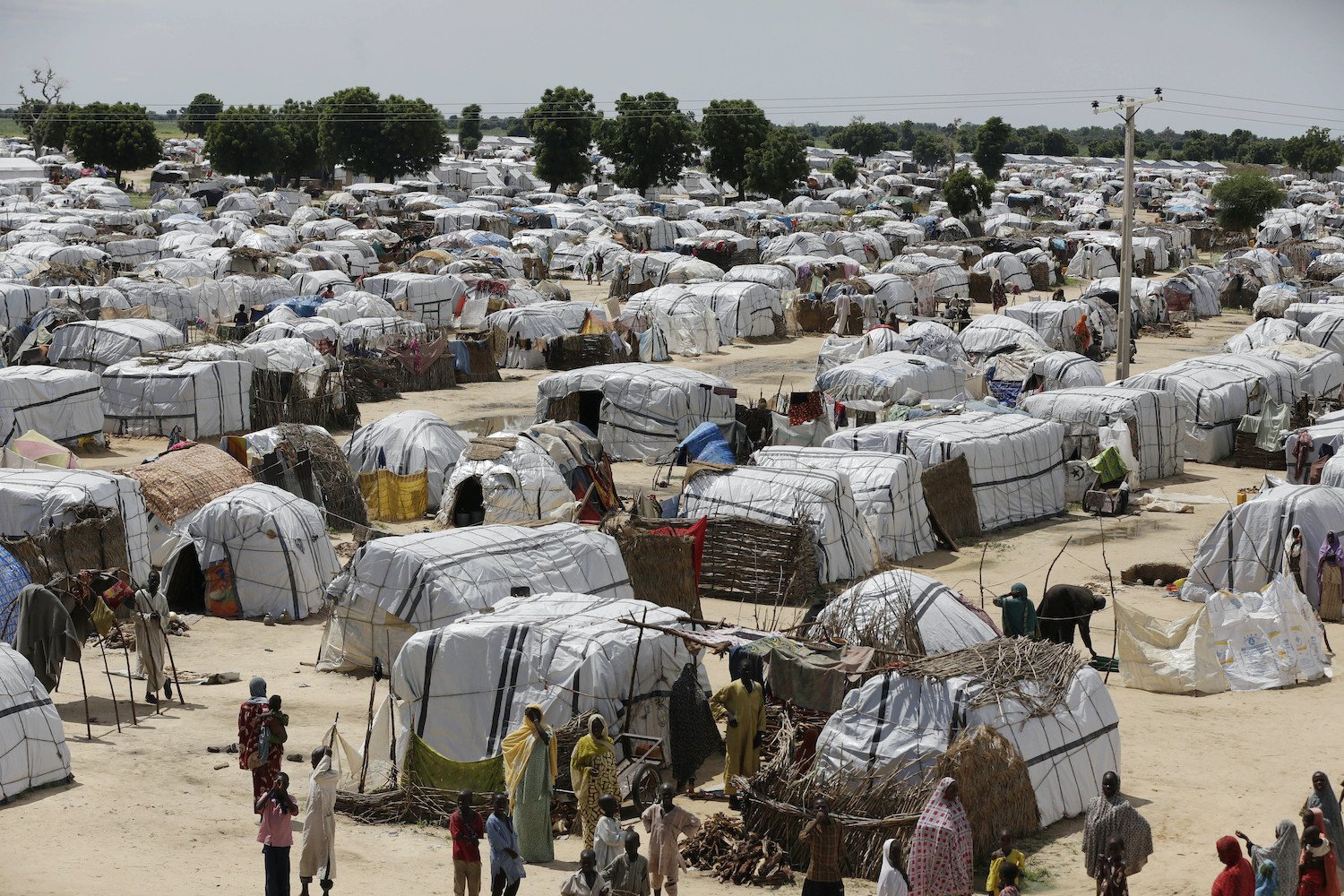
A top view of one of the biggest camp for people displaced by Islamist extremists in Maiduguri, Nigeria on Aug. 28, 2016.

Droughts, flooding and a shrinking Lake Chad caused in part by climate change is fueling conflict and migration in the region and needs to better addressed, a report said Thursday, Jan. 19, 2023.

Armed conflicts and insurgency have remained a major issue in the Sahel region of North Africa for several years, and right now, 6.1 million people in the region are in need of humanitarian aid as a result.

Chad is also experiencing serious blows from the impacts of climate change, as irregular rainfall has impacted agriculture, increasing malnutrition and hunger, and extended rain periods resulting in catastrophic flooding. 

6. Burundi: Economic Crisis & Natural Disaster

Over 70% of Burundi’s people live below the poverty line, and 1.8 million people are in need of humanitarian assistance due to the lack of safe drinking water and inadequate access to health care.

Climate migration has also been a major issue, with 85,000 people being forced to leave their homes following extreme flooding.

6. Burundi: Economic Crisis & Natural Disaster

Over 70% of Burundi’s people live below the poverty line, and 1.8 million people are in need of humanitarian assistance due to the lack of safe drinking water and inadequate access to health care.

Climate migration has also been a major issue, with 85,000 people being forced to leave their homes following extreme flooding.

7. Zimbabwe: Climate Shocks & Increased Poverty Rates

A vendor counts her money after making a sale in Harare, Thursday ,June, 2, 2022. Rampant inflation is making it increasingly difficult for people in Zimbabwe to make ends meet.

Since the start of Russia’s war in Ukraine, official statistics show that Zimbabwe’s inflation rate has shot up from 66% to more than 130%.

The country’s finance minister says the impact of the Ukraine war is heaping problems on the already fragile economy.

High inflation and economic instability mean more than half the Zimbabwean population is living in extreme poverty.

The climate crisis, including intense drought periods followed by heavy rainfall, have impacted food production and food security, resulting in food shortages and insecurity across the country.

8. Mali: Conflict & Climate Crisis

Ongoing violence and two coups in 2020 and 2021 have led to citizens fleeing the country in large numbers resulting in 2.5 million children dropping out of school, and exposing women and girls to the threat of sexual violence.

The climate crisis has also hit Mali hard, with floods and droughts contributing to crop failure and increasing malnutrition and hunger in the country. 

9. Cameroon: Displacement, Conflict & Economic Instability

Cameroon has faced crisis after crisis over the last decade, and currently 3.9 million people are in need of emergency humanitarian assistance that’s around 14% of the country.

There has been ongoing conflict and political unrest since 2016, resulting in 3,000 schools closing down, and citizens becoming internally displaced this despite the fact that there is already a large influx of refugees entering Cameroon to escape violence in the neighboring Central African Republic.

Water and sanitation is also a major issue, with 1.8 million people unable to access clean water. 

10. Niger: Hunger & Lack of Development

“In general, Niger is a country of records: one of the hottest countries, it has the highest fertility rate, and the highest population growth in the world,”

The Report Highlights.

Yet, despite these records, little to no investment has been made into the country’s development and climate adaptation.

Natural disasters such as droughts, together with ongoing conflict and insurgency, have led to food instability 4.4 million people are acutely food insecure, and half the country’s children under the age of 5 are chronically malnourished. 

Now you’re done reading, don’t forget to head to the Global Citizen app and take our “Neglected Crises: Raise Your Voice” challenge to learn more about these crises, quiz yourself on what you’ve learned, and take our pledge to play your part in making sure all the world’s crises get the attention they need and deserve.

Don't Forget To #FollowShareLikeComment 

FB@TRISTANJAMESJR/LIKEHOJBLOG
IG@TRISTANJAMESJR/LIKEHOJB45
LINKEDIN@TRISTANJAMESJR
X@TEEJAE45/LIKEHOJB
WHATSAPP@09068311978
Categories
AI Bill Gates China Daily Currency Digital Marketing E+commerce Global Modernization. IMF technology wordpressmedia world health organization

The Road Ahead Teaches A Turning Point In 2024

You Are Not Alone

Bill Gates Inside Notes

January 15, 2024  11 minute read

When you think back on 2023, how will you remember it?

For me, this will always be the year I became a grandparent.

It will be the year I spent a lot of precious time with loved ones whether on the pickleball court or over a rousing game of Settlers of Catan.

And 2023 marked the first time I used artificial intelligence for work and other serious reasons, not just to mess around and create parody song lyrics for my friends.

This year gave us a glimpse of how AI will shape the future, and as 2023 comes to a close, I’m thinking more than ever about the world today’s young people will inherit.

In last year’s letter, I wrote about how the prospect of becoming a grandparent made me reflect on the world my granddaughter will be born into.

Now I’m thinking more about the world she will inherit and what it will be like decades from now, when her generation is in charge.

I can begin to picture it: the tools she will use, the ways she will stay in touch with her loved ones, the problems these innovations will help solve.

We now have a better sense of what types of jobs AI will be able to do by itself and which ones it will serve as a copilot for.

And it’s clearer than ever how AI can be used to improve access to education, mental health, and more.

It motivates me to make sure this technology helps reduce and doesn’t contribute to the awful inequities we see around the world.

I’ve always been a firm believer in the power of innovation to offer every child an equal chance to survive and thrive. AI is no exception.

Of course, AI is far from the only defining feature of 2023.

We are just at the beginning of this transition right now.

This is an exciting and confusing time, and if you haven’t figured out how to make the best use of AI yet, you are not alone.

I thought I would use AI tools for the foundation’s strategy reviews this year, which require reading hundreds of pages of briefing materials that an AI could accurately summarize for me.

But old habits are hard to break, and I ended up preparing for them the same way I always do.

Millions continue to experience unbearable grief as a result of Russia’s war on Ukraine and in the aftermath of the war in Ethiopia.

My heart is broken for the continued suffering of Israelis and Palestinians, as well as for the people of Sudan.

At the same time, more people are being forced to endure hardship as a result of more frequent extreme weather events caused by climate change.

And families around the world continue to be hit hard by rising inflation and slow economic growth.

There’s no question these are challenging times, but I remain optimistic about the future. The speed of innovation has never been faster.

We’re making big strides on tough problems like Alzheimer’s, obesity, and sickle cell disease that will improve the lives of millions of people.

My friend the late Hans Rosling used to say that

“things can be bad and getting better.”

INSIDERNOTES

It’s a good reminder that progress is not only possible but happening every day.

The team at CAPRISA in South Africa is using data to improve treatments for patients infected with both HIV and tuberculosis.

That’s why I remain dedicated to making sure that, even in the face of setbacks, the world continues to do more to help the poorest people.

I do the bulk of this work through the Gates Foundation, where my colleagues remain dedicated to improving global health, education, gender equality, and more.

While I could write a thousand pages about the incredible work they’re doing with our partners, this letter focuses on just a few of the most exciting breakthroughs.

I also write about why I’m optimistic about the world’s climate progress.

Most of my climate and energy work is done through Breakthrough Energy, although the Gates Foundation is helping people in low- and middle income countries adapt to a warming world.

I also continue to privately fund research into other areas like Alzheimer’s disease.

And I still get to advise Microsoft, which gives me insight into what’s coming down the pipeline and how it can be used to make the world a more equitable place.

I’m lucky that my work gives me insight into all the ways the world is getting better.

The challenges we face feel a lot less daunting when you understand what exactly it will take to tackle them.

In this letter, I will share just a few reasons I am optimistic about the year ahead.

I hope they make you as excited about all the progress to come as I am.

AI Is About To Supercharge The Innovation Pipeline.

My work has always been rooted in a core idea: Innovation is the key to progress.

It’s why I started Microsoft, and it’s why Melinda and I started the Gates Foundation more than two decades ago.

Innovation is the reason our lives have improved so much over the last century.

From electricity and cars to medicine and planes, innovation has made the world better.

Today, we are far more productive because of the IT revolution.

The most successful economies are driven by innovative industries that evolve to meet the needs of a changing world.

My favorite innovation story, though, starts with one of my favorite statistics: Since 2000, the world has cut in half the number of children who die before the age of five.

How did we do it? One key reason was innovation.

Scientists came up with new ways to make vaccines that were faster and cheaper but just as safe.

They developed new delivery mechanisms that worked in the world’s most remote places, which made it possible to reach more kids.

And they created new vaccines that protect children from deadly diseases like rotavirus.

In a world with limited resources, you have to find ways to maximize impact. Innovation is the key to getting the most out of every dollar spent.

And artificial intelligence is about to accelerate the rate of new discoveries at a pace we’ve never seen before.

One of the biggest impacts so far is on creating new medicines.

Drug discovery requires combing through massive amounts of data, and AI tools can speed up that process significantly.

Some companies are already working on cancer drugs developed this way.

But a key priority of the Gates Foundation in AI is ensuring these tools also address health issues that disproportionately affect the world’s poorest, like AIDS, TB, and malaria.

“We’re taking a hard look at the wide array of AI innovation in the pipeline right now and working with our partners to use these technologies to improve lives in low- and middle income countries”

Bill Gates

In the fall, I traveled to Senegal to meet with some of the incredible researchers doing this work and to celebrate the 20th anniversary of the foundation’s Grand Challenges initiative.

When we first launched Grand Challenges the Gates Foundation’s flagship innovation program it had a single goal: Identify the biggest problems in health and give grants to local researchers who might solve them.

We asked innovators from developing countries how they would address health challenges in their communities, and then we gave them the support to make it happen.

Many of the people I met in Senegal were taking on the first-ever AI Grand Challenge.

The foundation didn’t have AI projects in mind when we first set that goal back in 2003, but I’m always inspired by how brilliant scientists are able to take advantage of the latest technology to tackle big problems.

It was great to learn from Amrita Mahale about how the team at ARMMAN is developing an AI chatbot to improve health outcomes for pregnant women.

Much of their work is in the earliest stages of development there’s a good chance we won’t see any of them used widely in 2024 or even 2025.

Some might not even pan out at all. The work that will be done over the next year is setting the stage for a massive technology boom later this decade.

Still, it’s impressive to see how much creativity is being brought to the table. Here is a small sample of some of the most ambitious questions currently being explored:

  • Can AI combat antibiotic resistance? Antibiotics are magical in their ability to end infection, but if you use them too often, pathogens can learn how to ignore them. This is called antimicrobial resistance, or AMR, and it is a huge issue around the world especially in Africa, which has the highest mortality rates from AMR. Nana Kofi Quakyi from the Aurum Institute in Ghana is working on an AI-powered tool that helps health workers prescribe antibiotics without contributing to AMR. The tool will comb through all the available information including local clinical guidelines and health surveillance data about which pathogens are currently at risk of developing resistance in the area—and make suggestions for the best drug, dosage, and duration.
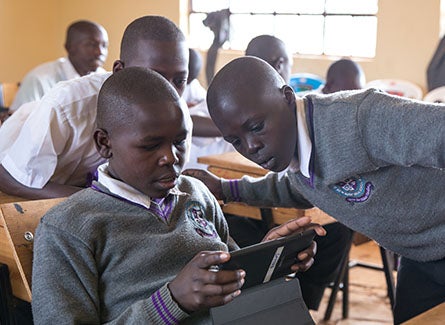
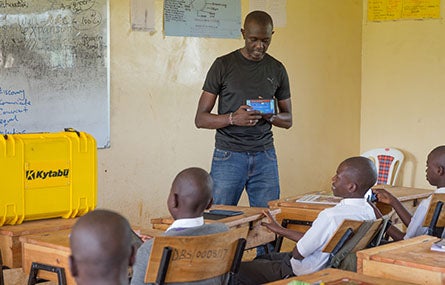
  • Can AI bring personalized tutors to every student? The AI education tools being piloted today are mind-blowing because they are tailored to each individual learner. Some of them like Khanmigo and MATHia are already remarkable, and they’ll only get better in the years ahead. One of the things that excites me the most about this type of technology is the possibility of localizing it to every student, no matter where they live. For example, a team in Nairobi is working on Somanasi, an AI-based tutor that aligns with the curriculum in Kenya. The name means “learn together” in Swahili, and the tutor has been designed with the cultural context in mind so it feels familiar to the students who use it.
Students interact with an AI tutor in a classroom in Nairobi, Kenya.
  • Can AI help treat high-risk pregnancies? A woman dies in childbirth every two minutes. That’s a horrifying statistic, but I’m hopeful that AI can help. Last year, I wrote about how AI-powered ultrasounds could help identify pregnancy risks. This year, I was excited to meet some of the researchers at ARMMAN, who hope to use artificial intelligence to improve the odds for new mothers in India. Their large language model will one day act as a copilot for health workers treating high-risk pregnancies. It can be used in both English and Telugu, and the coolest part is that it automatically adjusts to the experience level of the person using it whether you’re a brand-new nurse or a midwife with decades of experience.
  • Can AI help people assess their risk for HIV? For many people, talking to a doctor or nurse about their sexual history can be uncomfortable. But this information is super important for assessing risk for diseases like HIV and prescribing preventive treatments. A new South African chatbot aims to make HIV risk assessment a lot easier. It acts like an unbiased and nonjudgmental counselor who can provide around-the-clock advice. Sophie Pascoe and her team are developing it specifically with marginalized and vulnerable populations in mind—populations that often face stigma and discrimination when seeking preventive care. Their findings suggest that this innovative approach may help more women understand their own risk and take action to protect themselves.
  • Could AI make medical information easier to access for every health worker? When you’re treating a critical patient, you need quick access to their medical records to know if they’re allergic to a certain drug or have a history of heart problems. In places like Pakistan, where many people don’t have any documented medical history, this is a huge problem. Maryam Mustafa’s team is working on a voice-enabled mobile app that would make it a lot easier for maternal health workers in Pakistan to create medical records. It asks a series of prompts about a patient and uses the responses to fill out a standard medical record. Arming health workers with more data will hopefully improve the country’s pregnancy outcomes, which are among the worst in the world.
Tonee Ndungu whose team is developing Somanasi shows off the latest version of their personalized education tutor.

We can learn a lot from global health about how to make AI more equitable.

The main lesson is that the product must be tailored to the people who will use it.

The medical information app I mentioned is a great example: It’s common for people in Pakistan to send voice notes to one another instead of sending a text or email.

So, it makes sense to create an app that relies on voice commands rather than typing out long queries.

And the project is being designed in Urdu, which means there won’t be any translation issues.

If we make smart investments now, AI can make the world a more equitable place.

It can reduce or even eliminate the lag time between when the rich world gets an innovation and when the poor world does.

Don’t Forget To #FollowShareLikeComment

FB@TRISTANJAMESJR/LIKEHOJBLOG
IG@TRISTANJAMESJR/LIKEHOJB45
LINKEDIN@TRISTANJAMESJR
X@TEEJAE45/LIKEHOJB
WHATSAPP@09068311978

Categories
3d Adult Covid19 Currency Digital Marketing E+commerce Entertainment Ethnophilosophical Exchange Global Modernization. hd horoscope insidernotes kitchen Modern Art music music lyrics Netflix poetry recipe Soccer technology Teen Travel wordpressmedia world health organization WWE

YOUNG THUGI HAD TO GO CRAZY FOR 21 SAVAGE’S BDAY… $150k Custom Truck!!!

Underwritten by Tristan James Jr.

21’s birthday was on Friday, and he celebrated with a major Freaknik-themed bash in the ATL. You might’ve seen the awesome fire red pickup truck Thug gifted to his homey — but what you didn’t know, until now, is the whip cost $150k!!!

Young Thug is about that big spender lifestyle — especially when it comes to his pal 21 Savage … who just hit 29, and YT went all out for his very pricey gift … some very expensive wheels.

Roadshow International — a luxury car dealership in Atlanta — tells TMZ … the truck itself is a Dodge Hellcat TRX, new models of which can range anywhere from $60k to $72k right off the lot.

“It also has a “21” emblazoned across the door”

TRISTANJAMESJR

But, watch this video showing all the truck’s features and you’ll see why Thug paid way more than that.

Not just that, but the interior bears 21 Savage’s face too … a rendering of himself is stitched right into the upholstery of some of the seats — so there’s no question whose ride this is.

Herm, who owns Roadshow Int’l, says he had 3 days to work on the truck, and sure enough … he got it done in time for the big birthday party. Talk about a good friend, and talk about some nice nice things.

The truck is plastered with dagger logos”

INSIDERNOTES

Have some nice things for you, 🕜💤👉 https://www.tmz.com/2021/10/26/rob-gronkowski-mojo-muhtadi-to-give-brady-fan-crypto-beyond-protocol/

And don’t forget to subscribe to our private chan”” @likehoj or http://www.likehojb.home.blog

You can also share our posts by reposting, https://likehojb.home.blog/2021/10/27/likehojb-do-it-now-13/

Categories
3d Adult Covid19 Digital Marketing Entertainment Global Modernization. hd horoscope Modern Art music music lyrics poetry technology Teen Travel wordpressmedia

Lil Durk reveals how many tickets sold to his joint tour with Lil Baby, proving DJ Akademiks very wrong.

Underwritten by Tristan James Jr.

Showing off a plaque for the tour with a music executive, Lil Durk updated his Instagram Stories and explained why DJ Akademiks was incorrect in assuming that he and Baby wouldn’t be able to sell out arenas.

He reported that the tour was not selling very many tickets, but that was obviously a very premature report because Lil Durk and the others have officially finished their leg of performances, and they’re revealing how much money was earned and how many tickets were sold.

Did you manage to get tickets to the Back Outside tour? If you were one of the 250,000 people that attended one of the concerts, let us know if it was worth it in the comments.

“Bankroll Freddie also performed on select dates”

INSIDERNOTES

Before the Back Outside tour kicked off, media personality DJ Akademiks was already doubting that Lil Durk and Lil Baby would be able to sell out concert halls and other venues.

Design a site like this with WordPress.com
Get started