Categories
Gaza General Assembly Secretary General Security Council Sustainable Development Ukraine UN80 United Nations Veto Initiative Western European Group

Germany’s Annalena Baerbock elected President of the 80th General Assembly!

Re’Written by: Tristan James Jr.

Former German foreign minister Annalena Baerbock was elected President of the General Assembly’s 80th session on Monday.

Write in candidate Helga Schmid (also from Germany) received seven.

Her appointment comes as the regional group that includes Western Europe takes its turn at the helm of the world body.

She assumes the role at a challenging time, with ongoing conflicts, faltering development goals, mounting financial pressures, and the upcoming selection of the next Secretary General.

Ms. Baerbock received 167 votes following the secret ballot.

Fourteen delegations abstained

She becomes the first woman from the Western European group to hold the post and the fifth woman overall to lead the General Assembly.

The presidency rotates among the world body’s five regional groups.

At 44 years, Ms. Baerbock is also one of the youngest leaders to secure the top job.
United Nations

InsiderNotes!

Crucial juncture
Ms. Baerbock’s election comes at a critical juncture for the multilateral system, spearheaded by the United Nations.

With the Security Council deadlocked especially on moves to help end the wars in Ukraine and Gaza the Assembly has become a vital forum for diplomatic engagement and consensus building, even without binding authority on peace and security issues.

As conflicts rage, the Assembly has passed a series of resolutions calling for ceasefires, humanitarian access and the protection of civilians.

Many now see the Assembly as an essential platform for accountability and maintaining international focus on intractable crises, especially through the “Veto Initiative” adopted in 2022 which ensures that issues blocked by permanent members on the Security Council are debated in the Assembly as a priority.

A power wielded by the five permanent members China, France, Russia, the United Kingdom, and the United States a veto (or negative vote) can block Council action even when all other members support a motion.

Pledge to be an honest broker
In her acceptance speech, President elect Baerbock acknowledged the current global challenges and pledged to serve as “an honest broker and a unifier” for all 193 Member States, emphasising her theme of

“Better Together.”

She outlined three priorities for her presidency: making the Organization more efficient and effective; advancing the 2030 Agenda for Sustainable Development; and making the Assembly a;

truly inclusive forum”.

She called for a UN that embraces everyone.

I see the diversity of the General Assembly as our strength.

This is the place where all nations come together and where every country has a seat and a voice.”

She also highlighted the importance of promoting gender equality, multilingualism, and engagement with civil society and youth.

UN80 initiative
Ms. Baerbock also touched on the UN80 initiative, which was launched by SecretaryGeneral António Guterres in March.

The UN80 Initiative should not be a mere cost cutting exercise,”

She said, stressing the need for bold ambition and readiness to take difficult decisions.

Our common goal is a strong, focused, nimble and fit for purpose organization. One that is capable of realising its core objectives we need a United Nations that delivers on peace, development and justice.”

A career defined by multilateralism
In congratulating Ms. Baerbock, current President Philemon Yang described her as a leader defined by

an unwavering commitment to multilateralism”, 
praising her
Better Together

A Vision of Gold.

Mr. Yang, who steered the Assembly through a year marked by the Summit of the Future and persistent global crises, expressed confidence in her ability to build trust and foster dialogue across divides.

Secretary General António Guterres said Mr. Yang’s successor was taking the gavel amid a “difficult and uncertain moment for the multilateral system,” noting she was only the fifth woman to lead the body.

The UN chief warned that “conflicts, climate catastrophe, poverty and inequality continue to challenge the human family,” and called on the Assembly to unite in forging common solutions.

The world parliamentThe General Assembly remains the UN’s most representative body, where each Member State has an equal voice and an equal say in decisions.

The General Assembly remains the UN’s most representative body, where each Member State has an equal voice and an equal say in decisions.

While its resolutions are non binding, the GA as the acronym goes in New York helps define global diplomatic norms, convenes dialogues on worldwide challenges and holds the Security Council to account.

The 80th session, starting 9 September, is expected to be pivotal not only for sheer number and intensity of crises ongoing but for advancing long term reforms, including the UN80 initiative and the selection of the next Secretary General before his term ends in 2026.

All Rights Reserved: Vibhu Mishra UN Affairs
Subscribe to be the first to receive any of our latest updates.

097135

Categories
AI APIB Breaking News Climate Action COIAB COP30 Digital Marketing ECOSYSTEM Federica Fragapane GLOBAL CITIZEN 45'MEDIA IMF MEDIOQ Mohamad Waked News Letters South America Women Empowerment

Why Indigenous Land Rights Are Key to Protecting the Amazon

Here’s why defending the land rights of Indigenous Peoples protects our planet.

Although Mendes later directed the removal of the proposal to permit mining from the commission’s discussions, Indigenous representatives  including Maurício Terena from APIB expressed concern that this was not a definitive victory but a possible tactic to wear down opposition, fearing the issue could return.

Still, the fight continues.

Groups like COIAB and APIB are pushing back, building strong national and international alliances.

Dinaman Tuxa, APIB Coordinator, stated, “COP30 will be a unique moment, because we will be able to project our messages onto the international stage.

“We want the government to commit to a demarcation policy and to confront these issues more decisively in defense of Indigenous peoples’ rights.”

He added…

And there are victories too after 37 years of legal struggle, the Guarani Mbya people in São Paulo finally won recognition of part of their ancestral land a reminder that persistence and tireless advocacy can deliver justice.

Why This Matters to Everyone!

The Amazon absorbs up to 2 billion tons of CO₂ annually about 5% of global emissions.

But when Indigenous land is taken, deforestation accelerates and carbon storage collapses.

Losing the Amazon would release massive amounts of greenhouse gases, trigger feedback loops, disrupt rainfall patterns across continents, and jeopardize global food systems.

The consequences extend far beyond South America.

Biodiversity is also at risk.

The Amazon is home to 1 in 10 known species on Earth, many of which exist nowhere else.

Destroying these ecosystems risks losing cures for diseases and vital ecological balance.

The Amazon is a global treasure.

But without the Indigenous Peoples and local communities who have protected it for millennia, it will not survive.

The fight for Indigenous land rights is not just about justice it’s about the fate of Indigenous Peoples and the rest of the planet period.

Categories
3d Agricultural Development Programs AI Climate Action Digital Marketing ECOSYSTEM FOSSIL FUEL Global Modernization. IMF kitchen Potato recipe UN

Today is the International Day of Potato 🥔!

Potatoes are also a climate friendly crop

About 2/3 of the world’s population consumes potatoes as its staple food and nearly 50% of potatoes are used as the household staple food or vegetable.

#Potatoes provide accessible and nutritious food and improved livelihoods in rural and other areas where natural resources, especially arable land and water are limited and inputs are opulent.

The crop’s versatility and ability to grow in a variety of conditions make it an advantageous crop choice.
Potatoes are also a climate friendly crop, as they produce low levels of greenhouse gas emissions in comparison to other crops.


Potatoes are also a climate friendly crop, as they produce low levels of greenhouse gas emissions in comparison to other crops.


In the past decade, the global production of potatoes has increased by 10%, leading to growth in employment and income, but more work still needs to be done to harness the full potential of the crop to end hunger and malnutrition globally.

There are over 5,000 improved varieties of potatoes many of which are unique to their original location in Latin America

The 150 wild relatives of the cultivated potato show a wide genetic variation with a range of traits, including the ability to adapt to different production environments, resistance to pests and diseases, and different tuber characteristics.

  • Drop a 🥔, If potato is your favourite vegetable.
Watch this movie and let’s have your opinion expecting all ya’ feedback👍
Watch this another amazing skit coming from one of the OG’s in the industry.
Categories
AI Bill Gates Breaking News China Daily Climate Action Covid19 Data Exchange Rate Digital Marketing E+commerce ECOSYSTEM Exchange Global Modernization. IMF MTN technology Telecommunications UN wordpressmedia

A DIABOLIC TREATISE AGAINST THE HOUSE OF #MTN :

Where Gold Is Tarnished and Trust is Taxed


I. Prologue of Perfidy MTN, once heralded as the golden child of telecommunications in Africa, now stands accused in the court of public accountability.

Cloaked in branding brilliance and armed with influencer backed deception, they market connectivity but deliver captivity.

Their creed is not connection, but consumption of wallets, of trust, of digital dignity.

II. The Great Data Mirage
How does 1GB vanish like mist in the Harmattan sun? MTN claims usage; we claim daylight robbery.

Background Data Drain: Users report hemorrhaging megabytes even while idle ghost apps, or ghost billing?

Stealthy Auto Renewals:

A cunning trapdoor packages renew without prompt, often seconds before expiry, charging the user even if balance is insufficient, plunging them into silent debt.

Night Data Shell Game: Night plans supposedly valid from midnight till dawn but access throttled or denied until 2am.

Fraud disguised as fair use.

“I’ve just subscribed for the 33th time after first subscribing #9000 for 45GB 30Days plan in the same month👹”

Another Concerned User Layers Issue As A Classified Fraud;


III. The Unholy Tariffs Data pricing on MTN is not just high; it’s high handed.

Biased Bandwidth Economics: MTN Nigeria’s average price per gigabyte towers above what #MTN charges in South Africa or #Ghana.

Same brand, same servers different rates?

That’s regional exploitation, not localization.

Punitive PAYG Billing: Accidentally fall out of a bundle and your airtime vanishes in seconds with no warning.

Billing at “standard rates” is code for sanctioned theft.

IV. The Customer Care Masquerade
You dial 180 and enter purgatory.

Bots Before Humans: Conversations go in loops.

You’re passed from chatbot to cold line like a hot potato in a dead zone


“We’ll escalate this issue” becomes a mantra of delay problems disappearing into a black hole of broken promises.

Agents Without Authority: Even when you reach a rep, they lack the mandate to reverse charges or correct wrongs.

You’re stuck in bureaucratic limbo.

V. Network Tyranny They boast

“Everywhere you go” but what they deliver is “Nowhere you flow.”

InsiderNotes


Intentional Throttling? Peak hours see speeds drop to a crawl.

Meanwhile, premium users whisper tales of smoother streams.

Are we witnessing a class system in the cloud?

Selective Congestion: Some apps (read: high bandwidth or competitor friendly ones) mysteriously lag.

Others tied to MTN partners? Lightning-fast.

VI. The Final Accusation: Digital Colonialism This isn’t just about poor service.

It’s about gatekeeping access in the digital economy.


“MTN’s grip on infrastructure gives it a monopoly on our online lives”

A Concerned User Complains Bitterly;


They shape what’s fast, what’s slow, what’s possible while raking in billions from the very economies they throttle.

This is more than profit seeking; it’s a subtle form of control of a 21st-century telecom tyranny masquerading as connectivity.

VII. Epilogue: The People’s Verdict
We do not seek pity, only parity.

We demand transparency, fairness, and a fundamental reset of digital ethics.

Until then, let the people rise switch providers, expose shady practices, and rewire the narrative.

This treatise shall be carved not in stone but in tweets, blogs, and viral threads.

@MTN must be held accountable.

The signal is clear: Enough is enough.

Categories
3d Adult AI Bill Gates Breaking News China Daily Climate Action Covid19 Currency Digital Marketing E+commerce ECOSYSTEM Entertainment Ethnophilosophical etnophilosofical Exchange FOSSIL FUEL gamers GLOBAL CITIZEN 45'MEDIA Global Modernization. hd horoscope IMF Information insidernotes kitchen MEDIOQ Modern Art Movies music music lyrics Netflix technology Teen

Africa’s Internet Shutdowns: Where, Why, and How Do They Happen?

45’MEDIA Continue Reading:

A Global Citizen from Nigeria, Jeremiah, reminisced on how the $Twitter crackdown impacted the community:

“The sudden ban of Twitter, now referred to as X, several years ago sent shockwaves through communities, significantly affecting not only individuals’ ability to connect and share but also disrupting businesses and revenue streams dependent on the platform.” 

He added: “It highlighted the interconnectedness of individuals and businesses in the digital realm, where disruptions to online platforms can have far-reaching consequences on livelihoods.” 

Eventually the Economic Community Of West African States (ECOWAS) court found the government in violation of freedom of expression, and ordered the country to never ban the website again.

In 2024 Senegal is experiencing Nigeria’s history, as civil society organizations are taking the Senegalese government to the ECOWAS court regarding internet shutdowns that took place in June, July, and August 2023 as presidential elections were meant to be en route and popular opposition leader (and fierce critic of President Macky Sall) Ousmane Sonk was criminally charged and held in custody.

The country saw another internet blackout in Feb. 2024 around the time of the country’s elections.

The blackouts not only limited the right to access information and the freedom of expression of everyday citizens, but it also limited the work of journalists on the ground.

The government went so far as to suspend the license of a broadcaster during the election period in Feb. 2024.

Speaking to Global Citizen on the internet blackout in Senegal, the African head of the International Federation of Journalists, Louis Thomasi said: “Political interference is really putting a dent in qualitative journalism.

If you look at what’s happening in Africa all over, it is now a norm that during election periods, the internet will be cut off.

Even yesterday again [13 Feb. 2024] in Dakar, in Senegal, the internet was cut off.”

“It’s a deliberate attempt to suppress freedom of expression and media freedom in general,”

Louis Thomasi/African head of the International Federation of Journalists

Internet shutdowns and crimes against humanity

We’ve already mentioned that there’s an ongoing war in Sudan and the country has had its internet cut off several times in the face of the civil war.

Sudanese Global Citizen, Mazen, explains what having online access means to them: “Nowadays, the Internet means life.

It makes you aware and connected with the world.”

Internet blackouts in the country have heavily impacted people’s lives, but their impacts are a lot worse than you can imagine.

The loss of the internet has also meant that conflict-related atrocities can continue without being reported.

Advocacy organization, Access Now, has consistently kept tabs on the violent impacts of shutdowns in Sudan.

The organization noted that in 2021, the day before a pro-democracy protest was to take place, the internet was cut off along with phone and SMS services.

The protest continued regardless.

With citizens having no ability to transmit information inside or outside of Sudan, authorities took the opportunity to crack down physically on protesters.

At least 17 people were killed, and 250 people were injured as a result. 

“The internet blackouts are doing their job and providing cover for the military’s violent takeover and hijacking of a possible democratic future for Sudan,”

Marwa Fatfta, MENA Policy Manager at Access Now, said of the situation.

What can we do? 

“I have experienced natural disasters such as earthquakes, social unrest causing violent protests, terrorist attacks, all sorts of events that caused or forced involuntary internet shutdowns,”

“The one thing I missed the most in any of those instances was critical services and the ability to connect with my loved ones. This is what the internet means to me.”

Rwandan Global Citizen Gabriel

It’s futile to deny the importance of online access to people across the continent.

However, for as long as the internet exists, there will be ways to exploit it for the use of harm towards everyday citizens in African countries, and around the world.

Since 2011, the United Nations has called for universal internet access as a human right, however, this has not been implemented across countries despite the growing call for it

Right now what Global Citizens can do is remain informed about internet shutdowns and their impacts on communities, and spread the word about them so that their impacts do not go unnoticed and underreported.

You can also follow organizations like Access Now, the Internet Society Foundation, and the Keep it on Coalition (hosted by Access Now) to stay informed.

Categories
Climate Action ECOSYSTEM Global Modernization. IMF MEDIOQ UN Women Empowerment

Empowering Women for Optimal Usage, Necessary?

45'MEDIA Latest News:
by Sai Educational Rural & Urban Development Society (SERUDS)

This project intends to give skills training in tailoring, embroidery, and fashion design courses for sustainable livelihoods to over 200 women.

With this vocational skills training, women will live with dignity by earning money themselves.

During this training, women will learn and develop skills in tailoring & embroidery to work on sarees and blouse pieces.

We provide sewing machines and tool kits to survive on their own and live with dignity.

Here Are The Challenges

Women are facing atrocities & harassment at work place and have no role in decision making due to lack of financial independence.

They are treated as second class citizens.

They are working as labourers in market yard, cleaners in hospitals, private enterprises & engaged in beedi (tobaaco) making, a hazardous profession.

Women charge lesser in terms of Economic digressions.

They stand a chance to hold the centre for anarchy in obligation.

They are socially & culturally ill-treated. They lack employable skills & sustainable and dignified livelihoods.

This tailoring & embroidery project intends to create economic development of women & break poverty.

Tailoring & embroidery training will provide self employment at their homes, can give them a daily income and can enable them to buy necessary medicines and make them capable to pay school fee for their growing children.

Investment in these women is a proven path to reduce poverty.

They are disadvantaged when it comes to employment, education, and work skills.

What Can We Do;

This tailoring & embroidery project intends to create economic development of #women & break poverty.

Tailoring & embroidery training will provide self employment at their homes, can give them a daily income and can enable them to buy necessary medicines and make them capable to pay school fee for their growing children.

Investment in these women is a proven path to reduce poverty.

INSIDERNOTES

Here Are The Solutions

The income of these women will be enhanced and they will be independent.

They need not depend on any one else.

With this skills training women will be self reliant and live happily.

mompreneurship is another level of independence and a leak to societal development.

The economic development of women will increase and they participate in decision making process.

They will teach these learnt skills to other woman who are in needy position.

Women all over the world not just in #India, deserves to be given the same measure of attention and proficient supplies as due to anyone promoting useful standards in the community, they deserve to be treated with respect & dignity, equity and not trials.

Donations to this project are eligible for a 50% match as part of the April 2024 Little by Little campaign! (while funds remain)

Get more of this click below 👇

https://www.globalgiving.org/dy/cart/view/gg.html?cmd=addItem&projid=15201&frequency=ONCE&vo_id=53549&vo=20

Categories
Climate Action ECOSYSTEM Global Modernization. IMF MEDIOQ UN Women Empowerment

Empowering Women for Optimal Usage, Necessary?

45'MEDIA Latest News:
by Sai Educational Rural & Urban Development Society (SERUDS)

This project intends to give skills training in tailoring, embroidery, and fashion design courses for sustainable livelihoods to over 200 women.

With this vocational skills training, women will live with dignity by earning money themselves.

During this training, women will learn and develop skills in tailoring & embroidery to work on sarees and blouse pieces.

We provide sewing machines and tool kits to survive on their own and live with dignity.

Here Are The Challenges

Women are facing atrocities & harassment at work place and have no role in decision making due to lack of financial independence.

They are treated as second class citizens.

They are working as labourers in market yard, cleaners in hospitals, private enterprises & engaged in beedi (tobaaco) making, a hazardous profession.

Women charge lesser in terms of Economic digressions.

They stand a chance to hold the centre for anarchy in obligation.

They are socially & culturally ill-treated. They lack employable skills & sustainable and dignified livelihoods.

This tailoring & embroidery project intends to create economic development of women & break poverty.

Tailoring & embroidery training will provide self employment at their homes, can give them a daily income and can enable them to buy necessary medicines and make them capable to pay school fee for their growing children.

Investment in these women is a proven path to reduce poverty.

They are disadvantaged when it comes to employment, education, and work skills.

What Can We Do;

This tailoring & embroidery project intends to create economic development of #women & break poverty.

Tailoring & embroidery training will provide self employment at their homes, can give them a daily income and can enable them to buy necessary medicines and make them capable to pay school fee for their growing children.

Investment in these women is a proven path to reduce poverty.

INSIDERNOTES

Here Are The Solutions

The income of these women will be enhanced and they will be independent.

They need not depend on any one else.

With this skills training women will be self reliant and live happily.

mompreneurship is another level of independence and a leak to societal development.

The economic development of women will increase and they participate in decision making process.

They will teach these learnt skills to other woman who are in needy position.

Women all over the world not just in #India, deserves to be given the same measure of attention and proficient supplies as due to anyone promoting useful standards in the community, they deserve to be treated with respect & dignity, equity and not trials.

Donations to this project are eligible for a 50% match as part of the April 2024 Little by Little campaign! (while funds remain)

Get more of this click below 👇

https://www.globalgiving.org/dy/cart/view/gg.html?cmd=addItem&projid=15201&frequency=ONCE&vo_id=53549&vo=20

Categories
3d Adult AI Bill Gates Breaking News China Daily Climate Action Covid19 Digital Marketing E+commerce ECOSYSTEM Entertainment Exchange Global Modernization. IMF Information MEDIOQ Modern Art technology UN wordpressmedia

The Secret iPhone Setting Every Owner Should Know

Tristan James Jr. 45’MEDIA

A new way to launch apps and certain iOS features is hidden right behind your screen.

Quickly: Try to turn on your iPhone’s flashlight. If it took you longer than two seconds, you’re probably missing out on one of the iPhone’s best hidden features.

Though the iPhone’s Settings menus harbor many hidden gems, including one that can protect it from thieves, they’re so numerous and buried you’d be forgiven for mostly ignoring them.

Still, those who wish to turn their phone into the fastest flasher in the West needn’t look too hard.

  • Open Settings, scroll down to “Accessibility,” find “Touch,”
  • Scroll all the way down and tap “Back Tap.”
  • You’ll see two options: “Double Tap” and “Triple Tap.”

Each lets you tell your phone to do something when you tap its back twice or three times.

I use the trick for my flashlight, so I can quickly find things in the dark closet under my stairs, but you can customize the taps to do tasks like launch the camera, take a screenshot or mute your ringer.

If you have found uses for Siri beyond reeling off the population of Belgium, you can tap for the voice assistant too. 

INSIDERNOTES

You can do even more powerful things with the help of Apple’s “Shortcuts” app.

It lets you create custom automations that you can trigger with the taps.

Open the app, tap the plus arrow to create a new shortcut, then add as many steps as you want.

When you return to your “Back Tap” settings, you’ll see all your saved automations as options. 

“My favorite customization allows me to use Shazam, the app that helps identify any song you encounter while walking around, by just triple tapping the back of my phone”

a trick that lets you turn the back of your phone into an app launchpad

I’ve also made one that just starts playing the most recent episode of my favorite podcast and one that tells me the next event I have scheduled in my calendar.

Really, the possibilities are endless.

One small limit: Since you can only tap two ways, you can only use this feature to do two things.

And whatever you build, make sure you practice getting the tap to work before trying it in the wild.

Ensuring it consistently triggers requires finesse.

If you don’t have a case on your phone (you animal!) you can likely get it to work with just a gentle touch.

Those with thick cases might need to tap harder I’ve found it helps to use your fingernail.

Don’t Forget To #FollowShareLikeComment

FB@TRISTANJAMESJR/LIKEHOJBLOG
IG@TRISTANJAMESJR/LIKEHOJB45
LINKEDIN@TRISTANJAMESJR
X@LIKEHOJB45/LIKEHOJB
WHATSAPP@09068311978
Categories
3d Adult AI Bill Gates Breaking News China Daily Climate Action Covid19 Digital Marketing E+commerce Ethnophilosophical GLOBAL CITIZEN 45'MEDIA Global Modernization. IMF MEDIOQ Modern Art UN

3 Types of Overthinking & How to Overcome Them

TRISTAN JAMES JR.

There’s no shortage of situations to overthink in today’s work world.

Whether it’s fretting over the implications of a new market trend, agonizing about the tone of an email to a major client, or losing sleep over an employee’s reaction to feedback, the opportunities for leaders to get trapped in their own heads are endless.

As we have access to more information and higher demands than ever before, it’s no surprise that half to nearly three quarters of adults confess to thinking too much.

After coaching professionals at some of the world’s top companies for over a decade, I’ve observed a common pattern:

Some people who appear outwardly successful tend to overcomplicate everything, layering unnecessary complexity into their decisions, and deliberating far longer than needed.

This tendency is particularly pronounced among a group I refer to as Sensitive Strivers those who are hardwired to process the world around them more deeply and are often their own toughest critics.

Constantly churning thoughts can be exhausting, and if left unchecked, overthinking can contribute to anxiety and burnout.

There’s far-reaching consequences for organizations, too. When individuals or entire teams habitually overthink, it creates a bottleneck. Decision-making slows, opportunities are missed, and a culture of risk-aversion can take hold, stifling business growth.

Clearly, there’s a pressing need for more effective solutions to overcome overthinking in the workplace.

But to truly tackle this issue, it’s important to first acknowledge and understand that there are actually three forms of overthinking: rumination, future tripping, and overanalyzing.

Armed with this knowledge, it’s possible to develop targeted strategies that lead to meaningful and lasting change for workers and the organizations that employ them.

Here’s how to spot and handle each of the three types of overthinking. 

Rumination 

Rumination is best described as a mental loop where you dwell on past events, particularly negative or distressing ones.

Those who ruminate are often caught in a whirlpool of regret, guilt, and “woulda, shoulda, coulda” scenarios.

They review what went wrong, often blaming themselves.

A key aspect of rumination is its orientation towards the past and getting stuck there.

Signs to watch out for:

  • You fixate on negative feedback. 
  • You often bring up past failures, setbacks, or slip-ups in conversation with others.
  • You’re overly cautious, perhaps double or triple-checking your work, because you want to avoid mistakes.

How to address it:  

Counterintuitively, it can be helpful to schedule “worry time.”

Instead of letting rumination overrun your entire day, confine it to a manageable slot usually no more than 15 to 30 minutes.

Choose a time of day that works for you (just not right before bed) and pick a specific place for your worry time.

It could be a particular chair, room, or even a spot in a park.

Divide your worries into two categories: those you can control and those you cannot.

For worries within your control, brainstorm possible actions or solutions.

For example, if you’re worried about meeting a deadline, your action steps could include saying no to another commitment.

Each time an uncontrollable worry arises, try visualization.

Imagine placing the worry in a balloon and releasing it into the sky.

By setting aside a designated time to address these thoughts, you’re not in a constant battle to push them away. You’re simply postponing them to a more convenient time.

If rumination crops up outside your designated worry time, gently remind yourself, “Not now, I’ll tackle this later,” which helps bring greater awareness and control to your thought patterns.

Future tripping

Instead of being trapped in the past, those who are future tripping are concerned about what lies ahead.

While some degree of anticipation is beneficial, future tripping can escalate to the point where it holds you back.

The uncertainty of what might happen, the potential for failure, and the fear of the unknown can make it a challenging form of overthinking. 

Signs to watch out for:

  • You spend excessive energy planning for every possible scenario to feel prepared for any eventuality. 
  • You find it hard to celebrate your successes because you’re always thinking about what’s next.
  • You often feel restless or agitated, driven by thoughts of outstanding to-do items.

How to address it: 

Use your ability to look forward to your advantage.

Mentally projecting yourself into the future, beyond the point of your current worries.

For example, Caelin, a marketing manager, is overwhelmed with the launch of a new product.

The deadline is tight, expectations are high, and his team is under significant pressure.

He’s concerned about the campaign strategy, the team’s workload, and potential customer reactions.

Caelin finds a quiet conference room during his lunch break.

He closes his eyes and pictures himself five years from now. He’s in a more senior role, reflecting on his career path.

From this future perspective, Caelin realizes that the product launch was just one of many projects he handled. He’s able to put it in perspective.

While it’s important, it’s not a defining moment of his career.

He recalls how some aspects didn’t go as planned, but also how the team adapted and learned from the experience.

This strategy, known as temporal distancing, can reduce the immediacy and intensity of your concerns, helping you focus on the present with a calmer, more balanced mindset.

You can also choose to practice “selective ignorance” by reducing your exposure to unnecessary stressors.

Be intentional about the information you consume, especially from news sources and social media.

Identify triggers that escalate your future-tripping, such as updates about constant market fluctuations and industry predictions or constantly checking KPI dashboards or financial accounts.

If certain updates or data do not impact your day to day work or decision-making, they might not be necessary.

Prioritize information that you can act upon.

Overanalyzing

While rumination and future tripping are bound by time one looking back and the other looking forward overanalyzing is centered on depth.

It involves diving incredibly deep into a topic, thought, or situation, often to the point of excess.

While this can sometimes lead to profound insights, more often than not, it results in getting bogged down in details that might not be particularly relevant. 

Signs to watch out for:

  • You procrastinate or delay taking action to research further. 
  • You frequently seek out others’ approval or confirmation, because you lack confidence in your own analysis. 
  • You have difficulty distinguishing between high-priority and low-priority tasks, leading to a backlog of decisions. 

How to address it:

Instead of striving for the perfect choice, aim for one that is “good enough” with an approach known as satisficing.

Once a decision meets your established criteria and is satisfactory, you should go ahead with it, even if a potentially better option might exist.

Compare this to maximizers, who examine every option and keep searching for better alternatives, deals, or outcomes to their own detriment.

Of the two decision making types, maximizers are more prone to overanalyzing, less likely to feel happy with the results of their decisions, and more likely to negatively compare themselves to others.

Key decision criteria principles, guidelines, or requirements help you prioritize the most important variables weighing into a decision.

Your decision criteria can be professional or personal.

For example, let’s say you’re trapped in analysis paralysis around whether or not to offer a new feature for your product or service.

Your decision criteria could include: cost, profitability, effort, risk level, or impact.

Now let’s say, you’re trying to make a personal decision, like whether to move for a new job.

You might consider criteria like how well the role fits your strengths, the salary, or whether the role aligns with your future aspirations.

Select three criteria at most, with one that outranks the others.

If you’re in a group decision making situation, have everyone brainstorm and agree on the criteria together.

It’s important to remember that the goal is not to eliminate all deep thinking, but rather to prevent it from spiraling into the unproductive kind.

Identifying the type of overthinking you or your team is dealing with is the first step in breaking free from its grasp and more crucial than ever when the demand for quick yet thoughtful decision-making is high.

Melody Wilding, LMSW is an executive coach and author of Trust Yourself: Stop Overthinking and Channel Your Emotions for Success at Work. Get a free copy of Chapter One here.

Don’t Forget To #FollowShareLikeComment

FB@TRISTANJAMESJR/LIKEHOJBLOG
IG@TRISTANJAMESJR/LIKEHOJB45
LINKEDIN@TRISTANJAMESJR
X@TEEJAE45/LIKEHOJB
WHATSAPP@09068311978

Categories
3d Adult AI Bill Gates Breaking News China Daily Climate Action Covid19 Digital Marketing E+commerce Ethnophilosophical GLOBAL CITIZEN 45'MEDIA Global Modernization. IMF MEDIOQ Modern Art UN

3 Types of Overthinking & How to Overcome Them

TRISTAN JAMES JR.

There’s no shortage of situations to overthink in today’s work world.

Whether it’s fretting over the implications of a new market trend, agonizing about the tone of an email to a major client, or losing sleep over an employee’s reaction to feedback, the opportunities for leaders to get trapped in their own heads are endless.

As we have access to more information and higher demands than ever before, it’s no surprise that half to nearly three quarters of adults confess to thinking too much.

After coaching professionals at some of the world’s top companies for over a decade, I’ve observed a common pattern:

Some people who appear outwardly successful tend to overcomplicate everything, layering unnecessary complexity into their decisions, and deliberating far longer than needed.

This tendency is particularly pronounced among a group I refer to as Sensitive Strivers those who are hardwired to process the world around them more deeply and are often their own toughest critics.

Constantly churning thoughts can be exhausting, and if left unchecked, overthinking can contribute to anxiety and burnout.

There’s far-reaching consequences for organizations, too. When individuals or entire teams habitually overthink, it creates a bottleneck. Decision-making slows, opportunities are missed, and a culture of risk-aversion can take hold, stifling business growth.

Clearly, there’s a pressing need for more effective solutions to overcome overthinking in the workplace.

But to truly tackle this issue, it’s important to first acknowledge and understand that there are actually three forms of overthinking: rumination, future tripping, and overanalyzing.

Armed with this knowledge, it’s possible to develop targeted strategies that lead to meaningful and lasting change for workers and the organizations that employ them.

Here’s how to spot and handle each of the three types of overthinking. 

Rumination 

Rumination is best described as a mental loop where you dwell on past events, particularly negative or distressing ones.

Those who ruminate are often caught in a whirlpool of regret, guilt, and “woulda, shoulda, coulda” scenarios.

They review what went wrong, often blaming themselves.

A key aspect of rumination is its orientation towards the past and getting stuck there.

Signs to watch out for:

  • You fixate on negative feedback. 
  • You often bring up past failures, setbacks, or slip-ups in conversation with others.
  • You’re overly cautious, perhaps double or triple-checking your work, because you want to avoid mistakes.

How to address it:  

Counterintuitively, it can be helpful to schedule “worry time.”

Instead of letting rumination overrun your entire day, confine it to a manageable slot usually no more than 15 to 30 minutes.

Choose a time of day that works for you (just not right before bed) and pick a specific place for your worry time.

It could be a particular chair, room, or even a spot in a park.

Divide your worries into two categories: those you can control and those you cannot.

For worries within your control, brainstorm possible actions or solutions.

For example, if you’re worried about meeting a deadline, your action steps could include saying no to another commitment.

Each time an uncontrollable worry arises, try visualization.

Imagine placing the worry in a balloon and releasing it into the sky.

By setting aside a designated time to address these thoughts, you’re not in a constant battle to push them away. You’re simply postponing them to a more convenient time.

If rumination crops up outside your designated worry time, gently remind yourself, “Not now, I’ll tackle this later,” which helps bring greater awareness and control to your thought patterns.

Future tripping

Instead of being trapped in the past, those who are future tripping are concerned about what lies ahead.

While some degree of anticipation is beneficial, future tripping can escalate to the point where it holds you back.

The uncertainty of what might happen, the potential for failure, and the fear of the unknown can make it a challenging form of overthinking. 

Signs to watch out for:

  • You spend excessive energy planning for every possible scenario to feel prepared for any eventuality. 
  • You find it hard to celebrate your successes because you’re always thinking about what’s next.
  • You often feel restless or agitated, driven by thoughts of outstanding to-do items.

How to address it: 

Use your ability to look forward to your advantage.

Mentally projecting yourself into the future, beyond the point of your current worries.

For example, Caelin, a marketing manager, is overwhelmed with the launch of a new product.

The deadline is tight, expectations are high, and his team is under significant pressure.

He’s concerned about the campaign strategy, the team’s workload, and potential customer reactions.

Caelin finds a quiet conference room during his lunch break.

He closes his eyes and pictures himself five years from now. He’s in a more senior role, reflecting on his career path.

From this future perspective, Caelin realizes that the product launch was just one of many projects he handled. He’s able to put it in perspective.

While it’s important, it’s not a defining moment of his career.

He recalls how some aspects didn’t go as planned, but also how the team adapted and learned from the experience.

This strategy, known as temporal distancing, can reduce the immediacy and intensity of your concerns, helping you focus on the present with a calmer, more balanced mindset.

You can also choose to practice “selective ignorance” by reducing your exposure to unnecessary stressors.

Be intentional about the information you consume, especially from news sources and social media.

Identify triggers that escalate your future-tripping, such as updates about constant market fluctuations and industry predictions or constantly checking KPI dashboards or financial accounts.

If certain updates or data do not impact your day to day work or decision-making, they might not be necessary.

Prioritize information that you can act upon.

Overanalyzing

While rumination and future tripping are bound by time one looking back and the other looking forward overanalyzing is centered on depth.

It involves diving incredibly deep into a topic, thought, or situation, often to the point of excess.

While this can sometimes lead to profound insights, more often than not, it results in getting bogged down in details that might not be particularly relevant. 

Signs to watch out for:

  • You procrastinate or delay taking action to research further. 
  • You frequently seek out others’ approval or confirmation, because you lack confidence in your own analysis. 
  • You have difficulty distinguishing between high-priority and low-priority tasks, leading to a backlog of decisions. 

How to address it:

Instead of striving for the perfect choice, aim for one that is “good enough” with an approach known as satisficing.

Once a decision meets your established criteria and is satisfactory, you should go ahead with it, even if a potentially better option might exist.

Compare this to maximizers, who examine every option and keep searching for better alternatives, deals, or outcomes to their own detriment.

Of the two decision making types, maximizers are more prone to overanalyzing, less likely to feel happy with the results of their decisions, and more likely to negatively compare themselves to others.

Key decision criteria principles, guidelines, or requirements help you prioritize the most important variables weighing into a decision.

Your decision criteria can be professional or personal.

For example, let’s say you’re trapped in analysis paralysis around whether or not to offer a new feature for your product or service.

Your decision criteria could include: cost, profitability, effort, risk level, or impact.

Now let’s say, you’re trying to make a personal decision, like whether to move for a new job.

You might consider criteria like how well the role fits your strengths, the salary, or whether the role aligns with your future aspirations.

Select three criteria at most, with one that outranks the others.

If you’re in a group decision making situation, have everyone brainstorm and agree on the criteria together.

It’s important to remember that the goal is not to eliminate all deep thinking, but rather to prevent it from spiraling into the unproductive kind.

Identifying the type of overthinking you or your team is dealing with is the first step in breaking free from its grasp and more crucial than ever when the demand for quick yet thoughtful decision-making is high.

Melody Wilding, LMSW is an executive coach and author of Trust Yourself: Stop Overthinking and Channel Your Emotions for Success at Work. Get a free copy of Chapter One here.

Don’t Forget To #FollowShareLikeComment

FB@TRISTANJAMESJR/LIKEHOJBLOG
IG@TRISTANJAMESJR/LIKEHOJB45
LINKEDIN@TRISTANJAMESJR
X@TEEJAE45/LIKEHOJB
WHATSAPP@09068311978

Categories
3d Adult AI Bill Gates Breaking News China Daily Climate Action Covid19 Currency Digital Marketing E+commerce Exchange GLOBAL CITIZEN 45'MEDIA Global Modernization. horoscope IMF Information insidernotes Modern Art UN wordpressmedia

10 Countries Facing Underreported Crises You Need to Know About in 2023

GLOBAL CITIZEN 45'MEDIA

A question for you: have you heard about Zambia’s escalating HIV crisis? No?

Well what about Angola experiencing one of the most intense droughts in its history, have you heard anything about that?

If not, it’s not surprising, because nor have a lot of people.

Despite the world having this wonderful access to information technology where news and stories can be shared globally with just the click of a button, some of the most crucial stories and events are going overlooked.

lobal media attention can be both fickle and fleeting and, often depending on where a crisis is happening or who the people are being impacted, the threat to lives and the urgent action needed can often go unnoticed or underreported.

This in turn, can affect the political and humanitarian attention that each crisis receives.

Humanitarian agency CARE International released a report this month called,

 Breaking the Silence: The 10 most underreported humanitarian crises of 2022.

The report dives into the crises that are impacting millions of people yet received the least media coverage of the past year they found that all of them are on the African continent

CARE’s research compares the coverage of these crises to the coverage of major pop culture moments, and the results are… revealing. 

In Malawi, for instance, 5.4 million people are facing an acute hunger crisis as a result of tropical storms such as Cyclone Ana with 2,330 articles written about the crisis.

That might sound like quite a lot — until you compare it with the 217,529 articles written about the Chris Rock/Will Smith incident at last year’s Oscars.

That’s almost 93 times more articles than the hunger crisis in Malawi. 

According to CARE, the main reason these humanitarian crises don’t get more attention is because they often don’t suit the criteria of being compelling enough news, which, according to experts CARE consulted for the report,

“prioritize dramatic, timely, familiar, unambiguous, and easy to explain stories, which are assumed to resonate with their target audiences.” 

InsiderNotes

But now more than ever, as the climate crisis wreaks havoc, the refugee and displacement crisis is the worst it’s been in decades, the global food crisis leaves millions going hungry every day, and conflict is raging across countries and continents we can all play a part in making sure all crises get the attention they need.

And how do we do that? We asked Emily Janoch, Senior Director for Thought Leadership, Knowledge Management, and learning at CARE USA.

“As an individual, diversify your news sources.

Look at what you consume, click on, and share.

If that hasn’t covered one of these crises, start thinking about why, and who might be covering those issues,” she said.

“Also look at who is telling the story,” she added. “Is it someone who is impacted by the crisis?

Does it show the people involved as humans who can act and who deserve better? Or does it only treat them (especially women) as victims?”

Let’s start with learning more about 10 of the world’s crises we need to keep talking about and get involved in taking action to help by heading to the Global Citizen app and taking our “Neglected Crises: Raise Your Voice” challenge.

1. Angola: Drought, Hunger & Displacement

Southern Angola is experiencing its most damaging drought in 40 years.

This is a result of rising temperatures, with CARE reporting that there’s potential for these droughts to be more frequent due to climate change.

The droughts are causing climate migration, and have impacted food insecurity resulting in 3.8 million people not having enough to eat.

It also doesn’t help that Angola is also one of the countries with the highest food price increases as a result of the war in Ukraine.

2. Malawi: Cyclones, Cholera & Hunger

An image taken from a slight distance of healthcare workers in protective gear assisting at least one person visible in the image with their child. The worker furthest from the camera stands near an IV drip.

Health workers treat cholera patients at the Bwaila Hospital in Lilongwe central Malawi on Jan. 11, 2023.

Malawi’s cholera outbreak has now claimed more than 1,000 lives by Tuesday, Jan. 25, 2023 according to the country’s health minister, who warned that some cultural beliefs and hostility towards health workers are slowing down response efforts.

We’ve mentioned that 5.4 million people in Malawi are experiencing an acute hunger crisis as a result of damaging cyclones.

We also need to mention that Malawi’s health care system is under strain due to rising HIV cases and intense cholera outbreaks, seen as a result of not enough access to clean drinking water. 

3. Central African Republic: Conflict & Climate Change

One in two people in the Central African Republic don’t have enough to eat.

The changing weather conditions have impacted the soil that the country’s food grows from, while storms and floods have destroyed thousands of homes and left 10,000 children without schools to attend.

The country has also experienced unceasing conflict since 2013, which has resulted in a severe refugee crisis with over 740,000 people seeking refuge across the borders and 500,000 people experiencing internal displacement.

4. Zambia: Increased Poverty, HIV & GBV

More than half the Zambian population lives in extreme poverty — meaning living on less than $1.90 a day and the country is experiencing some of the worst malnutrition rates in the world as a result of economic instability and the climate crisis affecting agriculture.

Meanwhile, more than 10% of people have recently been infected with HIV and, in 2021, around 19,000 people died of AIDS in the country.

Gender-based violence is also highly prevalent in the country, particularly following the #COVID19 pandemic and lockdowns that also saw economic hardship increase across the country.

5. Chad: Unrest & Floods

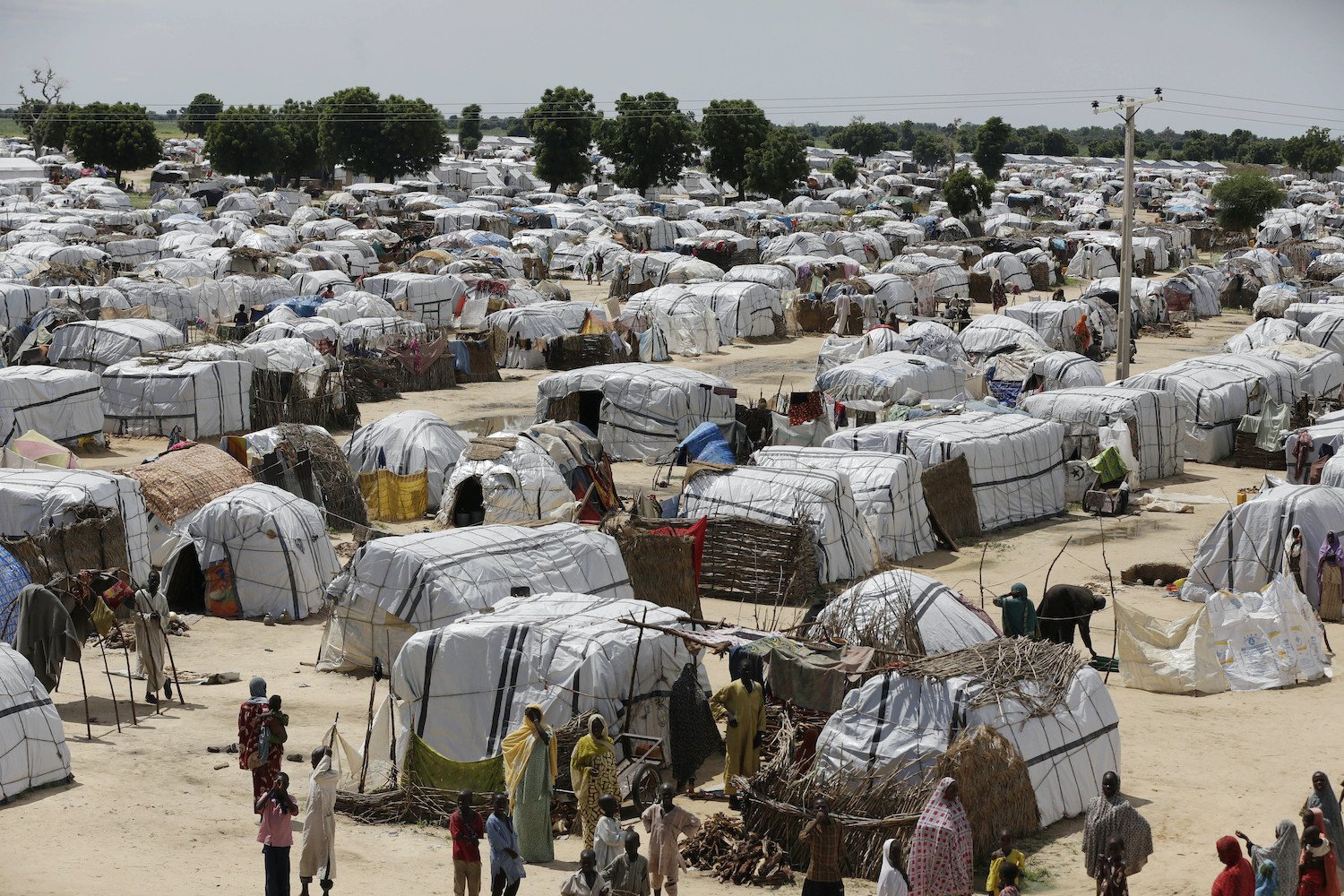
A top view of one of the biggest camp for people displaced by Islamist extremists in Maiduguri, Nigeria on Aug. 28, 2016.

Droughts, flooding and a shrinking Lake Chad caused in part by climate change is fueling conflict and migration in the region and needs to better addressed, a report said Thursday, Jan. 19, 2023.

Armed conflicts and insurgency have remained a major issue in the Sahel region of North Africa for several years, and right now, 6.1 million people in the region are in need of humanitarian aid as a result.

Chad is also experiencing serious blows from the impacts of climate change, as irregular rainfall has impacted agriculture, increasing malnutrition and hunger, and extended rain periods resulting in catastrophic flooding. 

6. Burundi: Economic Crisis & Natural Disaster

Over 70% of Burundi’s people live below the poverty line, and 1.8 million people are in need of humanitarian assistance due to the lack of safe drinking water and inadequate access to health care.

Climate migration has also been a major issue, with 85,000 people being forced to leave their homes following extreme flooding.

6. Burundi: Economic Crisis & Natural Disaster

Over 70% of Burundi’s people live below the poverty line, and 1.8 million people are in need of humanitarian assistance due to the lack of safe drinking water and inadequate access to health care.

Climate migration has also been a major issue, with 85,000 people being forced to leave their homes following extreme flooding.

7. Zimbabwe: Climate Shocks & Increased Poverty Rates

A vendor counts her money after making a sale in Harare, Thursday ,June, 2, 2022. Rampant inflation is making it increasingly difficult for people in Zimbabwe to make ends meet.

Since the start of Russia’s war in Ukraine, official statistics show that Zimbabwe’s inflation rate has shot up from 66% to more than 130%.

The country’s finance minister says the impact of the Ukraine war is heaping problems on the already fragile economy.

High inflation and economic instability mean more than half the Zimbabwean population is living in extreme poverty.

The climate crisis, including intense drought periods followed by heavy rainfall, have impacted food production and food security, resulting in food shortages and insecurity across the country.

8. Mali: Conflict & Climate Crisis

Ongoing violence and two coups in 2020 and 2021 have led to citizens fleeing the country in large numbers resulting in 2.5 million children dropping out of school, and exposing women and girls to the threat of sexual violence.

The climate crisis has also hit Mali hard, with floods and droughts contributing to crop failure and increasing malnutrition and hunger in the country. 

9. Cameroon: Displacement, Conflict & Economic Instability

Cameroon has faced crisis after crisis over the last decade, and currently 3.9 million people are in need of emergency humanitarian assistance that’s around 14% of the country.

There has been ongoing conflict and political unrest since 2016, resulting in 3,000 schools closing down, and citizens becoming internally displaced this despite the fact that there is already a large influx of refugees entering Cameroon to escape violence in the neighboring Central African Republic.

Water and sanitation is also a major issue, with 1.8 million people unable to access clean water. 

10. Niger: Hunger & Lack of Development

“In general, Niger is a country of records: one of the hottest countries, it has the highest fertility rate, and the highest population growth in the world,”

The Report Highlights.

Yet, despite these records, little to no investment has been made into the country’s development and climate adaptation.

Natural disasters such as droughts, together with ongoing conflict and insurgency, have led to food instability 4.4 million people are acutely food insecure, and half the country’s children under the age of 5 are chronically malnourished. 

Now you’re done reading, don’t forget to head to the Global Citizen app and take our “Neglected Crises: Raise Your Voice” challenge to learn more about these crises, quiz yourself on what you’ve learned, and take our pledge to play your part in making sure all the world’s crises get the attention they need and deserve.

Don't Forget To #FollowShareLikeComment 

FB@TRISTANJAMESJR/LIKEHOJBLOG
IG@TRISTANJAMESJR/LIKEHOJB45
LINKEDIN@TRISTANJAMESJR
X@TEEJAE45/LIKEHOJB
WHATSAPP@09068311978
Categories
AI Bill Gates Breaking News China Daily Climate Action Covid19 Currency Digital Marketing E+commerce Exchange GLOBAL CITIZEN 45'MEDIA Global Modernization. IMF Information insidernotes technology UN wordpressmedia

COP28: Everything You Need to Know About the 2023 UN Climate Change Conference

GLOBAL CITIZEN 45’MEDIA

The COP28 climate summit in Dubai, November 2023. Here’s what you should know.

Many countries had their representatives at the COP28, and still yet are with less or zero knowledge about what really went down well, here’s a brief recap if you fall into this category just a two minute read.

The climate crisis has been hard at work throughout 2023. Wildfires in Argentina and Canada.

Flooding in India, Cameroon, and Libya. Extreme heat across the US, Europe, and Asia.

A cyclone in Myanmar. A tropical storm hitting Japan, Guam, the Philippines, and Taiwan. The list goes on.

This is not exactly the kind of sentence you’d expect from a qualified climate expert, a group that prefers the more austere language of hard facts.

Yet, these days, “climate scientists are struggling for words,” writes climate scientist Katharine Hayhoe.

Instead, she’s started replying to questions about the latest extreme weather event or report about how dire things are with: “I am running out of original things to say.” 

This year’s COP is a significant milestone: the first assessment of how countries are faring against emissions cutting commitments made at Paris in 2015 (known as the Paris agreement).

This process is known as the “global stocktake.” 

In case you’re wondering, this global stocktake isn’t going to tell us anything we don’t already know.

We are well off track to make the emissions cuts needed to stay within 1.5 degrees Celsius.

Political leaders continue to back the fossil fuel industry even as forests burn, the ocean heats up, permafrost melts, and lives and livelihoods are lost.

According to the Guardian, a diplomat from one developed country said: “It could not be much worse.” Another said: “You could not make this stuff up.”

The timing couldn’t be more crucial.

Here’s everything you need to know about COP28 and why we can’t afford for it to be a flop.

What is a COP?

COP is an annual climate summit convened by the United Nations Framework Convention on Climate Change (UNFCCC), a climate body of the UN. 

COP stands for Conference of the Parties — meaning a gathering of countries and 2023 will be the 28th time that it’s taken place. Hence: COP28.

When will COP28 take place?

COP28 was held from Nov. 30 to Dec. 12, 2023.

Where will it take place?

In Dubai, United Arab Emirates.

Some have been skeptical of this given that the UAE has the third biggest net-zero-busting plans for oil and gas expansion in the world.

What really goes on at a COP?

It depends. 

When the Paris agreement was signed in 2015, it was agreed that every five years countries would return with more ambitious plans to reduce their greenhouse gas emissions and tackle global warming.

The #COVID19 pandemic caused COP to be canceled in 2020, making COP26 in Glasgow, Scotland, in 2021, one of the “big COPs.”

The “small COPs,” held in the intervening years, tend to focus on laying the groundwork for negotiations.

COPs usually open with a ceremonial opening meeting.

This is then followed by days of world leaders on stage talking about climate change, generally concentrating either on what their countries intend to do about it or on the dire consequences they are experiencing.

The remaining days have themes such as finance and energy and see politicians and business leaders stepping up to announce various new promises, pledges, coalitions, and projects.

But outside the doors, activists usually rage against superficial commitments and rally against political inaction. 

This time, there’s been significant outrage after it was leaked to the Guardian that the UAE’s state oil company has been able to read emails to and from the COP28 climate summit office and was consulted on how to respond to a media inquiry.

Remind me, what was agreed at Paris?

Under the landmark Paris agreement at COP21 in 2015, nations committed to holding global heating to well below 2 degrees Celsius above pre industrial levels, and preferably limiting warming to 1.5 degrees.

Though the deal is legally binding, the commitments that countries have made to cut their emissions are not, unless they are enshrined into national or regional legislation. 

INSIDERNOTES

Who takes part?

The attendees at COP are dignitaries and Heads of State and Government as well as tens of thousands of government delegates and representatives of civil society, intergovernmental organizations, NGOs, and the media.

There are 197 parties which are broadly organized in five regional groups: Africa, Asia, Eastern Europe, Latin America and the Caribbean, and Western Europe and Other States (including Australia, Canada, and the US).

At the cluster of COP side events, climate change leaders, experts, and influencers gather to share their stories and solutions at panel discussions, exhibits, cultural events, and more.

What happened at COP27?

After two weeks of fraught negotiations, a “historic pact” was struck at COP27 in which developed countries, which are historically responsible for the climate emergency, agreed to provide climate finance to help poorer countries experiencing climate-related disasters, known as a loss and damage fund.

Alok Sharma, the UK President of COP26, was more scathing about how the conference fared.

“I said in Glasgow that the pulse of 1.5 degrees was weak. Unfortunately, it remains on life support,” he said.

What do we want to happen at COP28?

An End to Fossil Fuels

That means support for the Fossil Fuel Non-Proliferation Treaty from world leaders to ensure a Just Transition away from fossil fuels, an end to fossil fuel subsidies, and robust taxing of remaining fossil fuel production.

Cough Up the Climate Finance 

Now isn’t the time for baby steps, it’s time to go big: fund a Just Transition in all countries, help countries adapt to climate change, and fund loss and damage.

Protect Climate Activists and Environmental Defenders

Almost 2,000 environmental activists have been killed over the past decade.

We need a human rights approach to all aspects of climate action.

What can Global Citizens do to help?

Head to our climate action headquarters here to see what actions you can take to make a difference whether that’s signing petitions urging world leaders and businesses to do better on the climate crisis, sending emails to G20 ministers, or shooting off messages to European countries to support a green transition for all.

The world belongs to each and everyone of  us, so we must join hands together to fight and protect it as our only hope for inhabitant.

Don’t Forget To #FollowShareLikeComment

  • FB@TRISTANJAMESJR/LIKEHOJBLOG
  • IG@TRISTANJAMESJR/LIKEHOJB45
  • LINKEDIN@TRISTANJAMESJR
  • X@TEEJAE45/LIKEHOJB
  • WHATSAPP@09068311978
Categories
AI Bill Gates China Daily Currency Digital Marketing E+commerce Global Modernization. IMF technology wordpressmedia world health organization

The Road Ahead Teaches A Turning Point In 2024

You Are Not Alone

Bill Gates Inside Notes

January 15, 2024  11 minute read

When you think back on 2023, how will you remember it?

For me, this will always be the year I became a grandparent.

It will be the year I spent a lot of precious time with loved ones whether on the pickleball court or over a rousing game of Settlers of Catan.

And 2023 marked the first time I used artificial intelligence for work and other serious reasons, not just to mess around and create parody song lyrics for my friends.

This year gave us a glimpse of how AI will shape the future, and as 2023 comes to a close, I’m thinking more than ever about the world today’s young people will inherit.

In last year’s letter, I wrote about how the prospect of becoming a grandparent made me reflect on the world my granddaughter will be born into.

Now I’m thinking more about the world she will inherit and what it will be like decades from now, when her generation is in charge.

I can begin to picture it: the tools she will use, the ways she will stay in touch with her loved ones, the problems these innovations will help solve.

We now have a better sense of what types of jobs AI will be able to do by itself and which ones it will serve as a copilot for.

And it’s clearer than ever how AI can be used to improve access to education, mental health, and more.

It motivates me to make sure this technology helps reduce and doesn’t contribute to the awful inequities we see around the world.

I’ve always been a firm believer in the power of innovation to offer every child an equal chance to survive and thrive. AI is no exception.

Of course, AI is far from the only defining feature of 2023.

We are just at the beginning of this transition right now.

This is an exciting and confusing time, and if you haven’t figured out how to make the best use of AI yet, you are not alone.

I thought I would use AI tools for the foundation’s strategy reviews this year, which require reading hundreds of pages of briefing materials that an AI could accurately summarize for me.

But old habits are hard to break, and I ended up preparing for them the same way I always do.

Millions continue to experience unbearable grief as a result of Russia’s war on Ukraine and in the aftermath of the war in Ethiopia.

My heart is broken for the continued suffering of Israelis and Palestinians, as well as for the people of Sudan.

At the same time, more people are being forced to endure hardship as a result of more frequent extreme weather events caused by climate change.

And families around the world continue to be hit hard by rising inflation and slow economic growth.

There’s no question these are challenging times, but I remain optimistic about the future. The speed of innovation has never been faster.

We’re making big strides on tough problems like Alzheimer’s, obesity, and sickle cell disease that will improve the lives of millions of people.

My friend the late Hans Rosling used to say that

“things can be bad and getting better.”

INSIDERNOTES

It’s a good reminder that progress is not only possible but happening every day.

The team at CAPRISA in South Africa is using data to improve treatments for patients infected with both HIV and tuberculosis.

That’s why I remain dedicated to making sure that, even in the face of setbacks, the world continues to do more to help the poorest people.

I do the bulk of this work through the Gates Foundation, where my colleagues remain dedicated to improving global health, education, gender equality, and more.

While I could write a thousand pages about the incredible work they’re doing with our partners, this letter focuses on just a few of the most exciting breakthroughs.

I also write about why I’m optimistic about the world’s climate progress.

Most of my climate and energy work is done through Breakthrough Energy, although the Gates Foundation is helping people in low- and middle income countries adapt to a warming world.

I also continue to privately fund research into other areas like Alzheimer’s disease.

And I still get to advise Microsoft, which gives me insight into what’s coming down the pipeline and how it can be used to make the world a more equitable place.

I’m lucky that my work gives me insight into all the ways the world is getting better.

The challenges we face feel a lot less daunting when you understand what exactly it will take to tackle them.

In this letter, I will share just a few reasons I am optimistic about the year ahead.

I hope they make you as excited about all the progress to come as I am.

AI Is About To Supercharge The Innovation Pipeline.

My work has always been rooted in a core idea: Innovation is the key to progress.

It’s why I started Microsoft, and it’s why Melinda and I started the Gates Foundation more than two decades ago.

Innovation is the reason our lives have improved so much over the last century.

From electricity and cars to medicine and planes, innovation has made the world better.

Today, we are far more productive because of the IT revolution.

The most successful economies are driven by innovative industries that evolve to meet the needs of a changing world.

My favorite innovation story, though, starts with one of my favorite statistics: Since 2000, the world has cut in half the number of children who die before the age of five.

How did we do it? One key reason was innovation.

Scientists came up with new ways to make vaccines that were faster and cheaper but just as safe.

They developed new delivery mechanisms that worked in the world’s most remote places, which made it possible to reach more kids.

And they created new vaccines that protect children from deadly diseases like rotavirus.

In a world with limited resources, you have to find ways to maximize impact. Innovation is the key to getting the most out of every dollar spent.

And artificial intelligence is about to accelerate the rate of new discoveries at a pace we’ve never seen before.

One of the biggest impacts so far is on creating new medicines.

Drug discovery requires combing through massive amounts of data, and AI tools can speed up that process significantly.

Some companies are already working on cancer drugs developed this way.

But a key priority of the Gates Foundation in AI is ensuring these tools also address health issues that disproportionately affect the world’s poorest, like AIDS, TB, and malaria.

“We’re taking a hard look at the wide array of AI innovation in the pipeline right now and working with our partners to use these technologies to improve lives in low- and middle income countries”

Bill Gates

In the fall, I traveled to Senegal to meet with some of the incredible researchers doing this work and to celebrate the 20th anniversary of the foundation’s Grand Challenges initiative.

When we first launched Grand Challenges the Gates Foundation’s flagship innovation program it had a single goal: Identify the biggest problems in health and give grants to local researchers who might solve them.

We asked innovators from developing countries how they would address health challenges in their communities, and then we gave them the support to make it happen.

Many of the people I met in Senegal were taking on the first-ever AI Grand Challenge.

The foundation didn’t have AI projects in mind when we first set that goal back in 2003, but I’m always inspired by how brilliant scientists are able to take advantage of the latest technology to tackle big problems.

It was great to learn from Amrita Mahale about how the team at ARMMAN is developing an AI chatbot to improve health outcomes for pregnant women.

Much of their work is in the earliest stages of development there’s a good chance we won’t see any of them used widely in 2024 or even 2025.

Some might not even pan out at all. The work that will be done over the next year is setting the stage for a massive technology boom later this decade.

Still, it’s impressive to see how much creativity is being brought to the table. Here is a small sample of some of the most ambitious questions currently being explored:

  • Can AI combat antibiotic resistance? Antibiotics are magical in their ability to end infection, but if you use them too often, pathogens can learn how to ignore them. This is called antimicrobial resistance, or AMR, and it is a huge issue around the world especially in Africa, which has the highest mortality rates from AMR. Nana Kofi Quakyi from the Aurum Institute in Ghana is working on an AI-powered tool that helps health workers prescribe antibiotics without contributing to AMR. The tool will comb through all the available information including local clinical guidelines and health surveillance data about which pathogens are currently at risk of developing resistance in the area—and make suggestions for the best drug, dosage, and duration.
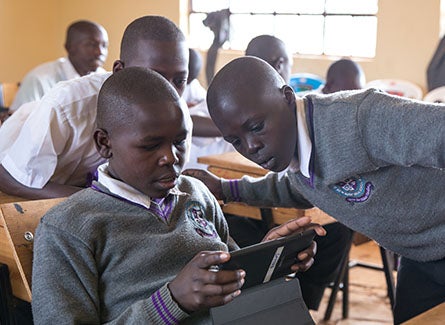
  • Can AI bring personalized tutors to every student? The AI education tools being piloted today are mind-blowing because they are tailored to each individual learner. Some of them like Khanmigo and MATHia are already remarkable, and they’ll only get better in the years ahead. One of the things that excites me the most about this type of technology is the possibility of localizing it to every student, no matter where they live. For example, a team in Nairobi is working on Somanasi, an AI-based tutor that aligns with the curriculum in Kenya. The name means “learn together” in Swahili, and the tutor has been designed with the cultural context in mind so it feels familiar to the students who use it.
Students interact with an AI tutor in a classroom in Nairobi, Kenya.
  • Can AI help treat high-risk pregnancies? A woman dies in childbirth every two minutes. That’s a horrifying statistic, but I’m hopeful that AI can help. Last year, I wrote about how AI-powered ultrasounds could help identify pregnancy risks. This year, I was excited to meet some of the researchers at ARMMAN, who hope to use artificial intelligence to improve the odds for new mothers in India. Their large language model will one day act as a copilot for health workers treating high-risk pregnancies. It can be used in both English and Telugu, and the coolest part is that it automatically adjusts to the experience level of the person using it whether you’re a brand-new nurse or a midwife with decades of experience.
  • Can AI help people assess their risk for HIV? For many people, talking to a doctor or nurse about their sexual history can be uncomfortable. But this information is super important for assessing risk for diseases like HIV and prescribing preventive treatments. A new South African chatbot aims to make HIV risk assessment a lot easier. It acts like an unbiased and nonjudgmental counselor who can provide around-the-clock advice. Sophie Pascoe and her team are developing it specifically with marginalized and vulnerable populations in mind—populations that often face stigma and discrimination when seeking preventive care. Their findings suggest that this innovative approach may help more women understand their own risk and take action to protect themselves.
  • Could AI make medical information easier to access for every health worker? When you’re treating a critical patient, you need quick access to their medical records to know if they’re allergic to a certain drug or have a history of heart problems. In places like Pakistan, where many people don’t have any documented medical history, this is a huge problem. Maryam Mustafa’s team is working on a voice-enabled mobile app that would make it a lot easier for maternal health workers in Pakistan to create medical records. It asks a series of prompts about a patient and uses the responses to fill out a standard medical record. Arming health workers with more data will hopefully improve the country’s pregnancy outcomes, which are among the worst in the world.
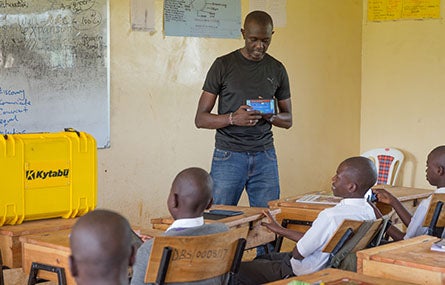
Tonee Ndungu whose team is developing Somanasi shows off the latest version of their personalized education tutor.

We can learn a lot from global health about how to make AI more equitable.

The main lesson is that the product must be tailored to the people who will use it.

The medical information app I mentioned is a great example: It’s common for people in Pakistan to send voice notes to one another instead of sending a text or email.

So, it makes sense to create an app that relies on voice commands rather than typing out long queries.

And the project is being designed in Urdu, which means there won’t be any translation issues.

If we make smart investments now, AI can make the world a more equitable place.

It can reduce or even eliminate the lag time between when the rich world gets an innovation and when the poor world does.

Don’t Forget To #FollowShareLikeComment

FB@TRISTANJAMESJR/LIKEHOJBLOG
IG@TRISTANJAMESJR/LIKEHOJB45
LINKEDIN@TRISTANJAMESJR
X@TEEJAE45/LIKEHOJB
WHATSAPP@09068311978

Categories
3d Adult Covid19 Currency Digital Marketing E+commerce gamers Global Modernization. Netflix Soccer technology Travel wordpressmedia

Global Gamers Challenge (Hackathon 2024)

Global Citizen 45’MEDIA

We know Flutter devs love a good challenge, so just in time for the new year to really get going, we’re super excited to announce the next Flutter challenge!   

The Global Gamers Challenge is an 8-week contest to design, build, and publish sustainable games, sponsored by Flutter and Global Citizen.  Inspired by the mission of the United Nations-facilitated Playing for the Planet Alliance, which Google joined in 2023, international advocacy organization Global Citizen and Flutter, Google’s open-source framework for building multi-platform applications are partnering to host the Global Gamers Challenge. 

What are sustainable games?

Sustainable games use the power of play to inspire positive environmental action. Imagine Candy Crush, but instead of crushing candies, you’re crushing plastic pollution! Or picture a game like Super Dash, but instead of collecting acorns, you’re turning off lights left on. Here are some more ideas inspired by Global Citizen campaigns running right now!

Encourage a reduction in home energy use

  • Data shows that American homes use an average 3x more kwh than the average home across the rest of the globe. Can you build a game that helps to reduce people’s reliance on inefficient energy sources?

Encourage a reduction in use of single-use plastics

  • Southeast Asia has some of the highest levels of plastic pollution in the world. Consider building a game that encourages players to make swaps to reduce reliance on single-use plastics.

Encourage use of public transportation and overland options for longer distances

  • Europe is home to many of the world’s greatest public transportation systems. Effective games can encourage people to use public transit rather than overland transport, like taking the train rather than flying for longer distances.

Just like Global Citizens do every day, we’re confident that games can encourage players to take small actions for the environment that when done collectively, lead to a large impact. 

Tips on Getting Started!

    SUPER DASH

Play Super Dash, a game we built to inspire you for this challenge. Help Dash capture the golden feather and watch nature be restored as she avoids enemies!

  PRIZES

Winners will receive a trip to NYC in September 2024 to meet the Flutter team for a day of workshops and mentorship followed by the opportunity to celebrate their achievements with up to 60,000 other Global Citizens at Global Citizen Festival 2024! 

  GOOGLE WALLET CHALLENGE

If you’re up for extra credit, we’ve partnered with Google Wallet to offer an additional challenge to deploy an innovative integration of the Google Wallet API in your game. For eligible apps that feature Google Wallet, you will have a chance to win up to $30,000! 

Whether you’re a Flutter developer who’s new to games, a game developer who is new to Flutter, or new to both game development and Flutter, you’re bound to learn something new while creating a positive impact on the world!

Categories
3d Adult Covid19 Currency Digital Marketing E+commerce Entertainment Ethnophilosophical etnophilosofical Exchange Global Modernization. horoscope insidernotes kitchen Modern Art music music lyrics Netflix poetry recipe Soccer technology Teen Travel wordpressmedia world health organization

What You Didn’t Know… The Seven Husband Of Evelyn Hugo, *TRUTHS*

Author

The Seven Husbands of Evelyn Hugo is a historical fiction novel by American author Taylor Jenkins Reid and published by Atria Books in 2017. 

The novel tells the story of the fictional Old Hollywood star Evelyn Hugo, who at the age of 79 decides to give a final interview to an unknown journalist, Monique Grant.

“Taylor Jenkins Reid” is an American essayist and author who majors on the genre of fiction. She is the highly acclaimed author of tear jerking, romantic books such as One True Love, Maybe in Another Life, After I Do, and Forever, Interrupted.

“Evelyn reveals she has no interest in giving an interview for Vivant”

INSIDERNOTES

According to Reid, Evelyn Hugo was loosely based in part on actresses Elizabeth Taylor, who was married eight times to seven different men, and Ava Gardner, who revealed the secrets of her life to a journalist which was eventually published as Ava Gardner: The Secret Conversations.

Monique Grant, a reporter for Vivant magazine, has been individually selected to interview Evelyn Hugo, a reclusive former star, who is auctioning some of her famous gowns to raise money for a breast cancer charity.

Monique is confused as to why Evelyn has chosen her, but goes to Evelyn’s apartment to meet her.

“Evelyn is 14 when she marries her first husband, Ernie Diaz, in order to reach Hollywood and escape her abusive father in Hell’s Kitchen”

MONIQUEGRANT

She falls in love with and marries actor Don Adler, but in the following months, Don begins to abuse Evelyn when pressure is placed on his career.

In an adaptation of Little Women, Evelyn, now 21, stars opposite Celia St. James. Evelyn is initially jealous of Celia’s talent, but the two quickly form a bond. At a party, Evelyn is told that Celia is a lesbian.

The novel was nominated for a Goodreads Choice Award for Best Historical Fiction of 2017.[3][4][5] In 2019, Freeform and Fox 21 Television Studios picked up the rights for development. 

Categories
3d Adult Covid19 Currency Digital Marketing E+commerce Entertainment Ethnophilosophical Exchange Global Modernization. hd horoscope insidernotes kitchen Modern Art music music lyrics Netflix poetry recipe Soccer technology Teen Travel wordpressmedia world health organization WWE

Reactions As Davido, Chioma Take Ifeanyi to Church After Birthday, Rock Matching Outfits

Underwritten by Tristan James Jr.

Music star Davido and his former lover, Chioma Rowland, have gotten members of the online community talking as they were spotted again after the festivities of their son’s birthday parties.

A photo making the rounds online captured Davido and Chioma posing together alongside their son inside a church. The parents seemed to have visited a branch of the popular Redeemed Christian Church of God (RCCG).

Davido carried Ifeanyi while Chioma posed just beside him for the photo. As expected, many Nigerians in the online community could not stop talking with some people suggesting that Chioma is still in love with the father of her child.

“The photo sparked reactions from members of the online community with some noting that Chioma still loves the singer”

INSIDERNOTES

Here are some of the highlights from post comments and likes, 👇👇👇

salemchad said: “The way she stood next to him shows she’s still in love with him. And then the color combo.”

bibii___m said: “Chioma still loves Davido….it’s so obvious.” titilayyyo said: “Who else notice chef chi is very happy.”

floxylaah said: “Davido please come back to Chioma I love you both together.”

isaaction4u said: “Be like say them done come back together.”

miss.ifeyinwa said: “It’s the matching orange for me.”

Categories
3d Adult Covid19 Digital Marketing Entertainment Ethnophilosophical Global Modernization. hd horoscope insidernotes kitchen Modern Art music music lyrics Netflix poetry recipe Soccer technology Teen Travel wordpressmedia world health organization WWE

CBN acquits guidelines for eNaira

Underwritten by Tristan James Jr.

This is as the apex bank released regulatory guidelines which stipulate that charges for transactions that originate from the eNaira platform will be free in the first 90 days commencing from October 25.

According to the regulatory and issuance guidelines, banks will automatically be onboarded by the CBN while merchants will be onboarded once they download the app and individuals will have to onboard by themselves.

Following the launch of the enaira by the President, Major General Muhamadu Buhari (retd.), the application for the digital currency introduced by the CBN has become available for download, with more than 5,000 downloads within hours of the launch.

“The eNaira stock wallet belongs solely to the CBN and it shall warehouse all minted eNaira,”

INSIDERNOTES

The eNaira speedwallet app meant for individuals had at 4pm on Tuesday, seen more than 5,000 downloads while the eNaira speed merchant wallet had seen close to 1,000 downloads.

After this period, applicable charges as outlined in the Guide to Charges by Banks, Other Financial and Non-bank Financial Institutions will become effective.

It said that financial institutions were expected to maintain one treasury eNaira wallet to warehouse eNaira received from the CBN eNaira stock wallet.

“The eNaira branch subwallet shall be funded from the treasury eNaira wallet”

INSIDERNOTES

You might also like this. 👇👇👇

https://punchng.com/how-enaira-will-affect-banking-sector-economists/?utm_source=auto-read-also&utm_medium=web

Categories
3d Adult Covid19 Digital Marketing Entertainment Ethnophilosophical Global Modernization. hd horoscope insidernotes kitchen Modern Art music music lyrics Netflix poetry recipe Soccer technology Teen Travel wordpressmedia world health organization WWE

Young Thug Surprises 21 Savage With Custom Truck Worth $150K for His Birthday

Underwritten by Tristan James Jr.

In honor of 21 Savage’s 29th birthday, his good friend Young Thug marked the occasion by gifting the “Bank Account” MC a custom Dodge Hellcat TRX worth $150,000.

As TMZ points out, the Hellcat on its own already ranges between $60K and $70K, but an extensive video demonstrates that 21’s bright red pickup is completely customized to the fullest extent, hence the hefty price tag.

His name “21” is inscribed on the side of the truck along with multiple dagger logos. 21’s face has also been stitched into the truck’s headrests, along with glow-in-the-dark stars and an illuminating “21” stitched into the ceiling of the vehicle. 

“better sit down somewhere.”

21SAVAGE

The party, which 21 named “FreakNik 21,” actually later incurred legal copyright threats from the Atlanta festival company of the same name.

“Sucks we gonna have to sue them when all we asked that they acknowledged us since it was a free event and they declined,” FreakNik’s official Twitter account wrote. 

The truck was bought and designed from Roadshow International, a luxury car dealership located in Atlanta where 21 had a crazy birthday party this past weekend, TMZ reports. A reaction video on Instagram shows 21 smiling as he playfully puts Thugga in a headlock once he reveals his gift.

“Thugga gifted him a glittery and massive custom OVO chain

INSIDERNOTES

So know when you hear them talk about we tried to work it out very easily beforehand.

Read more stories here👇👇👇

@likehoj http://www.likehojb.home.blog

Categories
3d Adult Covid19 Digital Marketing Entertainment Ethnophilosophical Global Modernization. hd horoscope insidernotes kitchen Modern Art music music lyrics Netflix poetry recipe Soccer technology Teen Travel wordpressmedia world health organization

Dasani Drip: Here’s What Happened When Chlöe Bailey Sat Next To Gunna At An Atlanta Hawks Game

Underwritten by Tristan James Jr.

Fans flooded social media to speculate about their suspected somethingship that picked up steam when Gunna shared a clip of Chlöe’s bootylicious VMAs performance with the caption “It’s the [tongue emoji] for me.

What’s most interesting about this link up is that Chlöe and Gunna might actually be cousins according to loud whispers across social media.

Kandi Burruss, Todd Tucker, Miss Lawrence, and several other industry somebodies were on hand to see Lil Nas receive the special honor

“Who would be a good match for Chloe Bailey? Tell us down below and peep the Twitter hysteria over their courtside on the flip”

INSIDERNOTES

By now, you’ve probably seen pics of rising superstar Chloe Bailey and Gunna sitting next to each other while drinking Dasani water at the Atlanta Hawks home opener in a baffling plot twist that sparked hilarious chaos across the internet.

This seemingly innocent night out came during Chlöe’s promo tour in Atlanta where she pulled up at Spelman, stopped by major radio stations, and supported Lil Nas X’s Homecoming event where he received his very own day in the City Of Atlanta.

The award was presented by mayoral candidate and the city’s first Black LGBTQ+ council member Antonio Brown during a special dinner hosted by BMI and sponsored by Compass Initiative and Gilead.

#Who would be a good match for Chloe Bailey? Tell us down below and peep the Twitter hysteria over their courtside on the flip#

INSIDERNOTES

Black woman-owned and operated, Slutty Vegan is a steadily expanding Atlanta staple where you can order drool-worthy sandwiches like the One Night Stand, Fussy Hussy, Sloppy Toppy, Main Chik, and many more along with tasty sides, sauces and desserts.

Read more stories below👇👇👇

@likehoj http://www.likehojb.home.blog

Categories
3d Adult Covid19 Digital Marketing Entertainment Global Modernization. hd horoscope insidernotes Modern Art poetry technology Teen Travel wordpressmedia world health organization

Markle red-faced over US policy plea Potential security threat to Queen Adorable William video

Underwritten by Tristan James Jr.

Kate and William announced the birth of their first child, Prince George on 22 July 2013, making him heir apparent to the throne. 

His younger siblings, Princess Charlotte, 6, and Prince Louis, 3, will be the “spare” siblings, which could lead to them not having a defined role as royals.

Charles has also reportedly been in plans to drastically “slim down” the monarchy to a team of just seven working royals. 

“Royal commentator Angela Mollard spoke to the Australian morning programme Sunrise hosts about the young royals”

INSIDERNOTES

Ms Mollard said: “They’re talking about reducing their kid’s involvement in royal duties.”

It would also mean that less royals would be reliant on the tax-payer-funded Sovereign Grant, and would have to find other means of income

First, it was the ‘Princess Diana Effect’, then it was the ‘Kate Middleton Effect’ and now it’s the royal children’s turn. From gorgeous knitted jumpers to adorable shoes, the royal children have been proclaimed style icons with parents everywhere eager to dress their children just like the Cambridges.

Whether it is Prince George, Princess Charlotte, or Prince Louis, whatever they are seen wearing at an engagement, or in public is guaranteed to be an instant sell-out.

Read more here below👇👇👇

https://www.express.co.uk/life-style/life/1510245/kate-middleton-children-clothes-prince-george-louis-princess-charlotte-high-street-shops

Categories
3d Adult Covid19 Digital Marketing Entertainment Ethnophilosophical Global Modernization. hd horoscope insidernotes kitchen Modern Art technology Teen Travel wordpressmedia

Say goodbye to blurry photos with Face Unblur on the Pixel 6

Underwritten by Tristan James Jr.

It’s common to have photos with a blurry subject. If the lighting isn’t great or if you’ve shaken your hands while capturing the image, you end up with a blurry photo which can be disappointing.

With the Pixel 6, though, you no longer have to be worried about people or faces in your pictures being blurred thanks to the new Tensor chip that has on-device Machine Learning capabilities.

The custom-designed Tensor chip enables Google to run its complex algorithms with ease which has resulted in new features like the Magic Eraser which can remove unwanted objects from your pictures.

Design a site like this with WordPress.com
Get started