
You Are Not Alone
Bill Gates Inside Notes
January 15, 2024 11 minute read
For me, this will always be the year I became a grandparent.
It will be the year I spent a lot of precious time with loved ones whether on the pickleball court or over a rousing game of Settlers of Catan.
And 2023 marked the first time I used artificial intelligence for work and other serious reasons, not just to mess around and create parody song lyrics for my friends.
This year gave us a glimpse of how AI will shape the future, and as 2023 comes to a close, I’m thinking more than ever about the world today’s young people will inherit.
In last year’s letter, I wrote about how the prospect of becoming a grandparent made me reflect on the world my granddaughter will be born into.
Now I’m thinking more about the world she will inherit and what it will be like decades from now, when her generation is in charge.
I can begin to picture it: the tools she will use, the ways she will stay in touch with her loved ones, the problems these innovations will help solve.
We now have a better sense of what types of jobs AI will be able to do by itself and which ones it will serve as a copilot for.
And it’s clearer than ever how AI can be used to improve access to education, mental health, and more.
It motivates me to make sure this technology helps reduce and doesn’t contribute to the awful inequities we see around the world.
I’ve always been a firm believer in the power of innovation to offer every child an equal chance to survive and thrive. AI is no exception.

We are just at the beginning of this transition right now.
This is an exciting and confusing time, and if you haven’t figured out how to make the best use of AI yet, you are not alone.
I thought I would use AI tools for the foundation’s strategy reviews this year, which require reading hundreds of pages of briefing materials that an AI could accurately summarize for me.
But old habits are hard to break, and I ended up preparing for them the same way I always do.
Millions continue to experience unbearable grief as a result of Russia’s war on Ukraine and in the aftermath of the war in Ethiopia.
My heart is broken for the continued suffering of Israelis and Palestinians, as well as for the people of Sudan.
At the same time, more people are being forced to endure hardship as a result of more frequent extreme weather events caused by climate change.
And families around the world continue to be hit hard by rising inflation and slow economic growth.
There’s no question these are challenging times, but I remain optimistic about the future. The speed of innovation has never been faster.
We’re making big strides on tough problems like Alzheimer’s, obesity, and sickle cell disease that will improve the lives of millions of people.
My friend the late Hans Rosling used to say that
“things can be bad and getting better.”
INSIDERNOTES
It’s a good reminder that progress is not only possible but happening every day.

That’s why I remain dedicated to making sure that, even in the face of setbacks, the world continues to do more to help the poorest people.
I do the bulk of this work through the Gates Foundation, where my colleagues remain dedicated to improving global health, education, gender equality, and more.
While I could write a thousand pages about the incredible work they’re doing with our partners, this letter focuses on just a few of the most exciting breakthroughs.
I also write about why I’m optimistic about the world’s climate progress.
Most of my climate and energy work is done through Breakthrough Energy, although the Gates Foundation is helping people in low- and middle income countries adapt to a warming world.
I also continue to privately fund research into other areas like Alzheimer’s disease.
And I still get to advise Microsoft, which gives me insight into what’s coming down the pipeline and how it can be used to make the world a more equitable place.
I’m lucky that my work gives me insight into all the ways the world is getting better.
The challenges we face feel a lot less daunting when you understand what exactly it will take to tackle them.
In this letter, I will share just a few reasons I am optimistic about the year ahead.
I hope they make you as excited about all the progress to come as I am.
AI Is About To Supercharge The Innovation Pipeline.
My work has always been rooted in a core idea: Innovation is the key to progress.
It’s why I started Microsoft, and it’s why Melinda and I started the Gates Foundation more than two decades ago.
Innovation is the reason our lives have improved so much over the last century.
From electricity and cars to medicine and planes, innovation has made the world better.
Today, we are far more productive because of the IT revolution.
The most successful economies are driven by innovative industries that evolve to meet the needs of a changing world.
My favorite innovation story, though, starts with one of my favorite statistics: Since 2000, the world has cut in half the number of children who die before the age of five.
How did we do it? One key reason was innovation.
Scientists came up with new ways to make vaccines that were faster and cheaper but just as safe.
They developed new delivery mechanisms that worked in the world’s most remote places, which made it possible to reach more kids.
And they created new vaccines that protect children from deadly diseases like rotavirus.
In a world with limited resources, you have to find ways to maximize impact. Innovation is the key to getting the most out of every dollar spent.
And artificial intelligence is about to accelerate the rate of new discoveries at a pace we’ve never seen before.
One of the biggest impacts so far is on creating new medicines.
Drug discovery requires combing through massive amounts of data, and AI tools can speed up that process significantly.
Some companies are already working on cancer drugs developed this way.
But a key priority of the Gates Foundation in AI is ensuring these tools also address health issues that disproportionately affect the world’s poorest, like AIDS, TB, and malaria.
“We’re taking a hard look at the wide array of AI innovation in the pipeline right now and working with our partners to use these technologies to improve lives in low- and middle income countries”
Bill Gates
In the fall, I traveled to Senegal to meet with some of the incredible researchers doing this work and to celebrate the 20th anniversary of the foundation’s Grand Challenges initiative.
When we first launched Grand Challenges the Gates Foundation’s flagship innovation program it had a single goal: Identify the biggest problems in health and give grants to local researchers who might solve them.
We asked innovators from developing countries how they would address health challenges in their communities, and then we gave them the support to make it happen.
Many of the people I met in Senegal were taking on the first-ever AI Grand Challenge.
The foundation didn’t have AI projects in mind when we first set that goal back in 2003, but I’m always inspired by how brilliant scientists are able to take advantage of the latest technology to tackle big problems.
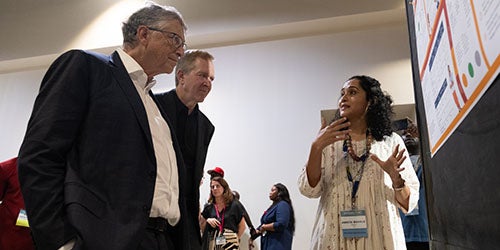
Much of their work is in the earliest stages of development there’s a good chance we won’t see any of them used widely in 2024 or even 2025.
Some might not even pan out at all. The work that will be done over the next year is setting the stage for a massive technology boom later this decade.
Still, it’s impressive to see how much creativity is being brought to the table. Here is a small sample of some of the most ambitious questions currently being explored:
- Can AI combat antibiotic resistance? Antibiotics are magical in their ability to end infection, but if you use them too often, pathogens can learn how to ignore them. This is called antimicrobial resistance, or AMR, and it is a huge issue around the world especially in Africa, which has the highest mortality rates from AMR. Nana Kofi Quakyi from the Aurum Institute in Ghana is working on an AI-powered tool that helps health workers prescribe antibiotics without contributing to AMR. The tool will comb through all the available information including local clinical guidelines and health surveillance data about which pathogens are currently at risk of developing resistance in the area—and make suggestions for the best drug, dosage, and duration.
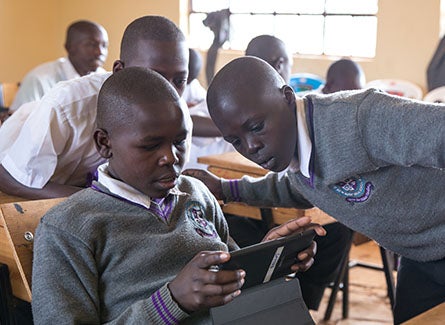
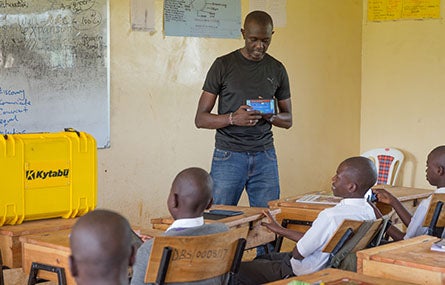
- Can AI bring personalized tutors to every student? The AI education tools being piloted today are mind-blowing because they are tailored to each individual learner. Some of them like Khanmigo and MATHia are already remarkable, and they’ll only get better in the years ahead. One of the things that excites me the most about this type of technology is the possibility of localizing it to every student, no matter where they live. For example, a team in Nairobi is working on Somanasi, an AI-based tutor that aligns with the curriculum in Kenya. The name means “learn together” in Swahili, and the tutor has been designed with the cultural context in mind so it feels familiar to the students who use it.
- Can AI help treat high-risk pregnancies? A woman dies in childbirth every two minutes. That’s a horrifying statistic, but I’m hopeful that AI can help. Last year, I wrote about how AI-powered ultrasounds could help identify pregnancy risks. This year, I was excited to meet some of the researchers at ARMMAN, who hope to use artificial intelligence to improve the odds for new mothers in India. Their large language model will one day act as a copilot for health workers treating high-risk pregnancies. It can be used in both English and Telugu, and the coolest part is that it automatically adjusts to the experience level of the person using it whether you’re a brand-new nurse or a midwife with decades of experience.
- Can AI help people assess their risk for HIV? For many people, talking to a doctor or nurse about their sexual history can be uncomfortable. But this information is super important for assessing risk for diseases like HIV and prescribing preventive treatments. A new South African chatbot aims to make HIV risk assessment a lot easier. It acts like an unbiased and nonjudgmental counselor who can provide around-the-clock advice. Sophie Pascoe and her team are developing it specifically with marginalized and vulnerable populations in mind—populations that often face stigma and discrimination when seeking preventive care. Their findings suggest that this innovative approach may help more women understand their own risk and take action to protect themselves.
- Could AI make medical information easier to access for every health worker? When you’re treating a critical patient, you need quick access to their medical records to know if they’re allergic to a certain drug or have a history of heart problems. In places like Pakistan, where many people don’t have any documented medical history, this is a huge problem. Maryam Mustafa’s team is working on a voice-enabled mobile app that would make it a lot easier for maternal health workers in Pakistan to create medical records. It asks a series of prompts about a patient and uses the responses to fill out a standard medical record. Arming health workers with more data will hopefully improve the country’s pregnancy outcomes, which are among the worst in the world.
We can learn a lot from global health about how to make AI more equitable.
The main lesson is that the product must be tailored to the people who will use it.
The medical information app I mentioned is a great example: It’s common for people in Pakistan to send voice notes to one another instead of sending a text or email.
So, it makes sense to create an app that relies on voice commands rather than typing out long queries.
And the project is being designed in Urdu, which means there won’t be any translation issues.
If we make smart investments now, AI can make the world a more equitable place.
It can reduce or even eliminate the lag time between when the rich world gets an innovation and when the poor world does.
Don’t Forget To #FollowShareLikeComment
FB@TRISTANJAMESJR/LIKEHOJBLOG
IG@TRISTANJAMESJR/LIKEHOJB45
LINKEDIN@TRISTANJAMESJR
X@TEEJAE45/LIKEHOJB
WHATSAPP@09068311978


 45'MEDIA