the unbearable notice is; that you've to make up your mind to be the difference and not the other way round else people will misjudge you even though you're not that person.
Women in various Indigenous communities across the Amazon have kept up the fight against the injustices that face their lands for decades.
In the early 2000s some of these women united in yearly marches known as Marchas das Margaridas, in honour of the late Margarida Maria Alves, which focused on advocating for women’s rights, education, and land reform and this movement is still alive today.
More recent movements such as Mujeres Amazónicas have taken significant steps against governmental and corporate efforts to threaten their ancestral land.
Indigenous women’s leadership has led to successful landmark court rulings that have helped safeguard ancestral territories from oil extractions, such as the women from The Kichwa People of Srayaku, who in 2003 successfully expelled oil industries from their sacred lands.
“Across the Amazon rainforest, the legacy of Indigenous women as fierce protectors of the environment has shaped a powerful movement against exploitation and climate threats”
InsiderNotes
As guardians of the Amazon, Indigenous women cultivate a profound relationship with the land, nurturing medicinal plants, collecting seeds for reforestation efforts, patrolling their lands against illegal mining, and so much more.
Their efforts have helped to enhance biodiversity, increase carbon storage, and foster resilience to climate change in the rainforests they manage.
Today, Indigenous women activists of the Amazon are continuing this legacy, making their voices heard in South and Latin America, and globally.
Here are six Indigenous women activists you should know.
1. Zaya Guarani
Zaya Guarani is a world-renowned Indigenous Brazilian model, activist, speaker and actor who is making strides in the fight to protect the Amazon in the fashion industry and beyond.
Growing up in Rondônia, Brazil, near the Madeira River in the Amazon, Guarani experienced first-hand the devastating impacts of climate change and illegal industrial activities on her community.
Her home state is now included in the Amazonian Arc of Deforestation, an area where tropical forests are vanishing quickly due to logging and mining activities, which forced her family to often move from one area to another.
While currently living in New York City, far from Brazil, Guarani remains vocal about her Indigenous Brazilian roots, advocating for her community and fighting against deforestation in the Amazon.
Throughout her career she has used her platformer to champion Indigenous rights and climate justice.
Guarani joined forces with Indigenous activist Dayana Molina to create Indigenous Creatives Latin America, a collective that champions Indigenous representation in the fashion industry in Brazil and South America.
As an advisor for The Slow Factory and the UN Spotlight Programme, she is intentional when it comes to collaborating with brands and organisations that share her commitment to a socially and environmentally responsible future.
Guarani, understands the important role Indigenous peoples and their cultural teachings play in combating climate change, even as they face its impacts.
“As indigenous people, we serve as guardians of an entire ecosystem, yet some still seek to exploit our land livelihoods.”
In a 2024 interview with Atmos, she said:
2. Helena Gualinga
Helena Gualinga is a passionate Ecuadorian environmental and human rights activist from the Kichwa Sarayuku community in Pastaza, Ecuador.
Coming from a long line of women in her family who were advocates for Indigenous women’s rights and land defenders in the Amazon, Gualinga witnessed the struggles her community faced against oil companies encroaching on their land without consent.At just 10 years old, her journey into activism began when her community achieved a significant victory in 2012, winning a landmark case at the inter-American Court of Human Rights that affirmed Indigenous rights to free, informed consent regarding resource extraction.
At just 10 years old, her journey into activism began when her community achieved a significant victory in 2012, winning a landmark case at the inter-American Court of Human Rights that affirmed Indigenous rights to free, informed consent regarding resource extraction.
Since then, she has emerged as a dynamic spokesperson for her community and co-founded Polluters Out an International youth-led coalition, focused on kicking the fossil fuel industry out of every aspect of society.
At 17 years old she made her mark at the COP25 Climate conference in Madrid, when she called out the Ecuadorian government for continuing to allow oil extraction on Indigenous lands.
Her activism has been recognised in various publications and her inspiring story was captured in the documentary Helena Sarayaku Manta.
Now 23 at the time of publishing, she carries forward her family’s legacy of advocacy, inspiring youth globally to join the fight for the Amazon and our planet’s future.
3. Vanda Witoto
Vanda Oregta Witoto is an Indigenous woman from the Witoto tribe.
She is a nurse, climate activist, and Indigenous community leader from Manaus, Brazil.
For years, she has been advocating for her community’s rights and well-being in Parque das Tribos, also known as Tribes Park which is the first recognized Indigenous neighbourhood in Manaus and has faced historical neglect.
Witoto has worked to address critical issues impacting her neighbourhood of 700 Indigenous families from 35 ethnic groups.
These issues include poor sewage systems and waste management, both of which threaten local health and the Amazon River.
As a nurse working during the peak of the COVID-19 pandemic in 2020, she personally drove sick neighbors to hospitals when ambulances refused to respond, and with the help of her mother volunteered to distribute handmade masks to the community.
Witoto was also among the first to receive the COVID-19 vaccine, which helped to dispel misinformation in Indigenous communities.
Driven by her neighborhood’s struggles and the poor official response to COVID-19, Witoto ran for federal deputy in 2022, at the age of 35.
Her campaign advocated for Indigenous rights, improved education and healthcare, support for underrepresented groups, women’s economic empowerment, and sustainable development in the Amazon.
Though she did not win, she contributed to a historic wave of Indigenous women seeking political representation.
The now 37-year-old continues to advocate for the fundamental rights of Indigenous people and nature through her women-led organisation, The Witoto Institute.
She has also attended international climate summits including the COP27 conference in Egypt, where she spoke about the challenges forcing Indigenous people to leave their ancestral homes and their familes for urban areas in search of work, food, and safe water due to economic and environmental pressures.
4. Nina Gualinga
Nina Gualinga is a prominent activist and leader from the Kichwa community of Sarayaku in the Ecuadorian Amazon.
At 31, she has spent most of her life working to protect the rainforest and its inhabitants against the threats posed by oil and mining companies.
Her activism journey began at just eight years old when she witnessed an oil company’s attempt to exploit her community’s land without their consent.
Inspired by the local women in her community who refused the selling of their land, Gualinga committed to advocating for environmental justice and Indigenous rights.
In 2018, her activism was crucial when she and five hundred Indigenous women from the Indigenous women-led organization Mujeres Amazónicas, also known as Amazon Women, presented a mandate to Ecuadorian President Lenin Moreno.
This mandate included 22 demands addressing land rights, gender-based violence against Indigenous women, and climate change.
This moment was monumental, despite the threats and attacks the activists faced for speaking up.
5. Nemonte Nenquimo
Nemonte Nenquimo is Indigenous Waorani woman dedicated to protecting her ancestral territory, ecosystem, culture, economy, and way of life.
For generations, the Waorani people from the Ecuadorian Amazon rainforest have stood resolutely against outside forces threatening their ancestral land.
In 2015, Nenquimo co-founded the Ceibo Alliance an Indigenous organization, aimed at protecting Indigenous lands from the threats of planned oil concessions.
In 2018, she was elected as the first female president of the Coordinating Council of the Waorani Nationality of Ecuador-Pastaza, an organization that represents the Waorani of the Pastaza province.
Her advocacy work over the years has not gone unnoticed.
Nenquimo has won numerous awards for her activism, including the prestigious Goldman environmental prize.
She has been recognized as one of Time Magazine’s 100 most influential people in the world in 2020, and has been named a United Nations Champion of the Earth.
In a groundbreaking 2019 court case, Nenquimo successfully challenged the Ecuadorian government, which resulted in the protection of 500,000 acres of Amazonian rainforest and Waorani territory from oil extraction.
In 2023, she campaigned in a successful referendum to protect the country’s Yasuní National Park from oil drilling.
6. Txai Suruí
At just 28, Txai Suruí is a notable Brazilian environmental activist known worldwide.
A member of the Paiter Suruí Indigenous community in Brazil, she founded the Indigenous Youth Movement of Rondônia and leads the Associação de Defesa Etnoambiental Kanindé, a community organization that has worked with Indigenous people for over 30 years.
Suruí hails from a family of activists her father is Chief Almir Suruí and her mother is the legendary activist Ivaneide Suruí, both known for their work in combating deforestation in the Amazon.
Following in their footsteps, Suruí has carved her own path as defender of the environment and advocate for Indigenous rights.
Her activism can be seen in governmental halls and climate summits around the world, but also on the ground with Indigenous communities, and on social media where she advocates for her community.
As the first woman in her community to earn a law degree, she used this, along with the support of her peers, to successfully sue the Brazilian government for changing its 2005 carbon baseline to fulfill the Paris Climate Agreement’s carbon reduction objectives.
In her powerful COP26 summit speech addressing world leaders, she said, “Indigenous people are at the forefront of the climate emergency and must be at the center of decision-making.
We have solutions to postpone the end of the world; let’s stop spreading lies and false promises.”
Dun forget to subscribe for the latest upfront updates (24/7 Active)
Contact for paid ads : “9150859095 WhatsApp only! Email@_likehoj.direct@gmail.com
About 2/3 of the world’s population consumes potatoes as its staple food and nearly 50% of potatoes are used as the household staple food or vegetable.
#Potatoes provide accessible and nutritious food and improved livelihoods in rural and other areas where natural resources, especially arable land and water are limited and inputs are opulent.
The crop’s versatility and ability to grow in a variety of conditions make it an advantageous crop choice. Potatoes are also a climate friendly crop, as they produce low levels of greenhouse gas emissions in comparison to other crops.
Potatoes are also a climate friendly crop, as they produce low levels of greenhouse gas emissions in comparison to other crops.
In the past decade, the global production of potatoes has increased by 10%, leading to growth in employment and income, but more work still needs to be done to harness the full potential of the crop to end hunger and malnutrition globally.
There are over 5,000 improved varieties of potatoes many of which are unique to their original location in Latin America
The 150 wild relatives of the cultivated potato show a wide genetic variation with a range of traits, including the ability to adapt to different production environments, resistance to pests and diseases, and different tuber characteristics.
Drop a 🥔, If potato is your favourite vegetable.
Watch this movie and let’s have your opinion expecting all ya’ feedback👍
Watch this another amazing skit coming from one of the OG’s in the industry.
by Sai Educational Rural & Urban Development Society (SERUDS)
This project intends to give skills training in tailoring, embroidery, and fashion design courses for sustainable livelihoods to over 200 women.
With this vocational skills training, women will live with dignity by earning money themselves.
During this training, women will learn and develop skills in tailoring & embroidery to work on sarees and blouse pieces.
We provide sewing machines and tool kits to survive on their own and live with dignity.
Here Are The Challenges
Women are facing atrocities & harassment at work place and have no role in decision making due to lack of financial independence.
They are treated as second class citizens.
They are working as labourers in market yard, cleaners in hospitals, private enterprises & engaged in beedi (tobaaco) making, a hazardous profession.
Women charge lesser in terms of Economic digressions.
They stand a chance to hold the centre for anarchy in obligation.
They are socially & culturally ill-treated. They lack employable skills & sustainable and dignified livelihoods.
This tailoring & embroidery project intends to create economic development of women & break poverty.
Tailoring & embroidery training will provide self employment at their homes, can give them a daily income and can enable them to buy necessary medicines and make them capable to pay school fee for their growing children.
Investment in these women is a proven path to reduce poverty.
They are disadvantaged when it comes to employment, education, and work skills.
What Can We Do;
This tailoring & embroidery project intends to create economic development of #women & break poverty.
Tailoring & embroidery training will provide self employment at their homes, can give them a daily income and can enable them to buy necessary medicines and make them capable to pay school fee for their growing children.
Investment in these women is a proven path to reduce poverty.
INSIDERNOTES
Here Are The Solutions
The income of these women will be enhanced and they will be independent.
They need not depend on any one else.
With this skills training women will be self reliant and live happily.
mompreneurship is another level of independence and a leak to societal development.
The economic development of women will increase and they participate in decision making process.
They will teach these learnt skills to other woman who are in needy position.
Women all over the world not just in #India, deserves to be given the same measure of attention and proficient supplies as due to anyone promoting useful standards in the community, they deserve to be treated with respect & dignity, equity and not trials.
by Sai Educational Rural & Urban Development Society (SERUDS)
This project intends to give skills training in tailoring, embroidery, and fashion design courses for sustainable livelihoods to over 200 women.
With this vocational skills training, women will live with dignity by earning money themselves.
During this training, women will learn and develop skills in tailoring & embroidery to work on sarees and blouse pieces.
We provide sewing machines and tool kits to survive on their own and live with dignity.
Here Are The Challenges
Women are facing atrocities & harassment at work place and have no role in decision making due to lack of financial independence.
They are treated as second class citizens.
They are working as labourers in market yard, cleaners in hospitals, private enterprises & engaged in beedi (tobaaco) making, a hazardous profession.
Women charge lesser in terms of Economic digressions.
They stand a chance to hold the centre for anarchy in obligation.
They are socially & culturally ill-treated. They lack employable skills & sustainable and dignified livelihoods.
This tailoring & embroidery project intends to create economic development of women & break poverty.
Tailoring & embroidery training will provide self employment at their homes, can give them a daily income and can enable them to buy necessary medicines and make them capable to pay school fee for their growing children.
Investment in these women is a proven path to reduce poverty.
They are disadvantaged when it comes to employment, education, and work skills.
What Can We Do;
This tailoring & embroidery project intends to create economic development of #women & break poverty.
Tailoring & embroidery training will provide self employment at their homes, can give them a daily income and can enable them to buy necessary medicines and make them capable to pay school fee for their growing children.
Investment in these women is a proven path to reduce poverty.
INSIDERNOTES
Here Are The Solutions
The income of these women will be enhanced and they will be independent.
They need not depend on any one else.
With this skills training women will be self reliant and live happily.
mompreneurship is another level of independence and a leak to societal development.
The economic development of women will increase and they participate in decision making process.
They will teach these learnt skills to other woman who are in needy position.
Women all over the world not just in #India, deserves to be given the same measure of attention and proficient supplies as due to anyone promoting useful standards in the community, they deserve to be treated with respect & dignity, equity and not trials.
The COP28 climate summit in Dubai, November 2023. Here’s what you should know.
Many countries had their representatives at the COP28, and still yet are with less or zero knowledge about what really went down well, here’s a brief recap if you fall into this category just a two minute read.
Flooding in India, Cameroon, and Libya. Extreme heat across the US, Europe, and Asia.
A cyclone in Myanmar. A tropical storm hitting Japan, Guam, the Philippines, and Taiwan. The list goes on.
This is not exactly the kind of sentence you’d expect from a qualified climate expert, a group that prefers the more austere language of hard facts.
Yet, these days, “climate scientists are struggling for words,” writes climate scientist Katharine Hayhoe.
Instead, she’s started replying to questions about the latest extreme weather event or report about how dire things are with: “I am running out of original things to say.”
This year’s COP is a significant milestone: the first assessment of how countries are faring against emissions cutting commitments made at Paris in 2015 (known as the Paris agreement).
When the Paris agreement was signed in 2015, it was agreed that every five years countries would return with more ambitious plans to reduce their greenhouse gas emissions and tackle global warming.
The #COVID19 pandemic caused COP to be canceled in 2020, making COP26 in Glasgow, Scotland, in 2021, one of the “big COPs.”
The “small COPs,” held in the intervening years, tend to focus on laying the groundwork for negotiations.
COPs usually open with a ceremonial opening meeting.
This is then followed by days of world leaders on stage talking about climate change, generally concentrating either on what their countries intend to do about it or on the dire consequences they are experiencing.
The remaining days have themes such as finance and energy and see politicians and business leaders stepping up to announce various new promises, pledges, coalitions, and projects.
But outside the doors, activists usually rage against superficial commitments and rally against political inaction.
This time, there’s been significant outrage after it was leaked to the Guardian that the UAE’s state oil company has been able to read emails to and from the COP28 climate summit office and was consulted on how to respond to a media inquiry.
Remind me, what was agreed at Paris?
Under the landmark Paris agreement at COP21 in 2015, nations committed to holding global heating to well below 2 degrees Celsius above pre industrial levels, and preferably limiting warming to 1.5 degrees.
Though the deal is legally binding, the commitments that countries have made to cut their emissions are not, unless they are enshrined into national or regional legislation.
INSIDERNOTES
Who takes part?
The attendees at COP are dignitaries and Heads of State and Government as well as tens of thousands of government delegates and representatives of civil society, intergovernmental organizations, NGOs, and the media.
There are 197 parties which are broadly organized in five regional groups: Africa, Asia, Eastern Europe, Latin America and the Caribbean, and Western Europe and Other States (including Australia, Canada, and the US).
At the cluster of COP side events, climate change leaders, experts, and influencers gather to share their stories and solutions at panel discussions, exhibits, cultural events, and more.
What happened at COP27?
After two weeks of fraught negotiations, a “historic pact” was struck at COP27 in which developed countries, which are historically responsible for the climate emergency, agreed to provide climate finance to help poorer countries experiencing climate-related disasters, known as a loss and damage fund.
Alok Sharma, the UK President of COP26, was more scathing about how the conference fared.
“I said in Glasgow that the pulse of 1.5 degrees was weak. Unfortunately, it remains on life support,” he said.
What do we want to happen at COP28?
An End to Fossil Fuels
That means support for the Fossil Fuel Non-Proliferation Treaty from world leaders to ensure a Just Transition away from fossil fuels, an end to fossil fuel subsidies, and robust taxing of remaining fossil fuel production.
Cough Up the Climate Finance
Now isn’t the time for baby steps, it’s time to go big: fund a Just Transition in all countries, help countries adapt to climate change, and fund loss and damage.
Protect Climate Activists and Environmental Defenders
Almost 2,000 environmental activists have been killed over the past decade.
We need a human rights approach to all aspects of climate action.
For me, this will always be the year I became a grandparent.
It will be the year I spent a lot of precious time with loved ones whether on the pickleball court or over a rousing game of Settlers of Catan.
And 2023 marked the first time I used artificial intelligence for work and other serious reasons, not just to mess around and create parody song lyrics for my friends.
This year gave us a glimpse of how AI will shape the future, and as 2023 comes to a close, I’m thinking more than ever about the world today’s young people will inherit.
In last year’s letter, I wrote about how the prospect of becoming a grandparent made me reflect on the world my granddaughter will be born into.
Now I’m thinking more about the world she will inherit and what it will be like decades from now, when her generation is in charge.
I can begin to picture it: the tools she will use, the ways she will stay in touch with her loved ones, the problems these innovations will help solve.
We now have a better sense of what types of jobs AI will be able to do by itself and which ones it will serve as a copilot for.
And it’s clearer than ever how AI can be used to improve access to education, mental health, and more.
It motivates me to make sure this technology helps reduce and doesn’t contribute to the awful inequities we see around the world.
I’ve always been a firm believer in the power of innovation to offer every child an equal chance to survive and thrive. AI is no exception.
Of course, AI is far from the only defining feature of 2023.
We are just at the beginning of this transition right now.
This is an exciting and confusing time, and if you haven’t figured out how to make the best use of AI yet, you are not alone.
I thought I would use AI tools for the foundation’s strategy reviews this year, which require reading hundreds of pages of briefing materials that an AI could accurately summarize for me.
But old habits are hard to break, and I ended up preparing for them the same way I always do.
Millions continue to experience unbearable grief as a result of Russia’s war on Ukraine and in the aftermath of the war in Ethiopia.
My heart is broken for the continued suffering of Israelis and Palestinians, as well as for the people of Sudan.
At the same time, more people are being forced to endure hardship as a result of more frequent extreme weather events caused by climate change.
And families around the world continue to be hit hard by rising inflation and slow economic growth.
There’s no question these are challenging times, but I remain optimistic about the future. The speed of innovation has never been faster.
We’re making big strides on tough problems like Alzheimer’s, obesity, and sickle cell disease that will improve the lives of millions of people.
My friend the late Hans Rosling used to say that
“things can be bad and getting better.”
INSIDERNOTES
It’s a good reminder that progress is not only possible but happening every day.
The team at CAPRISA in South Africa is using data to improve treatments for patients infected with both HIV and tuberculosis.
That’s why I remain dedicated to making sure that, even in the face of setbacks, the world continues to do more to help the poorest people.
I do the bulk of this work through the Gates Foundation, where my colleagues remain dedicated to improving global health, education, gender equality, and more.
While I could write a thousand pages about the incredible work they’re doing with our partners, this letter focuses on just a few of the most exciting breakthroughs.
I also write about why I’m optimistic about the world’s climate progress.
Most of my climate and energy work is done through Breakthrough Energy, although the Gates Foundation is helping people in low- and middle income countries adapt to a warming world.
I also continue to privately fund research into other areas like Alzheimer’s disease.
And I still get to advise Microsoft, which gives me insight into what’s coming down the pipeline and how it can be used to make the world a more equitable place.
I’m lucky that my work gives me insight into all the ways the world is getting better.
The challenges we face feel a lot less daunting when you understand what exactly it will take to tackle them.
In this letter, I will share just a few reasons I am optimistic about the year ahead.
I hope they make you as excited about all the progress to come as I am.
AI Is About To Supercharge The Innovation Pipeline.
My work has always been rooted in a core idea: Innovation is the key to progress.
It’s why I started Microsoft, and it’s why Melinda and I started the Gates Foundation more than two decades ago.
Innovation is the reason our lives have improved so much over the last century.
From electricity and cars to medicine and planes, innovation has made the world better.
Today, we are far more productive because of the IT revolution.
The most successful economies are driven by innovative industries that evolve to meet the needs of a changing world.
My favorite innovation story, though, starts with one of my favorite statistics: Since 2000, the world has cut in half the number of children who die before the age of five.
How did we do it? One key reason was innovation.
Scientists came up with new ways to make vaccines that were faster and cheaper but just as safe.
They developed new delivery mechanisms that worked in the world’s most remote places, which made it possible to reach more kids.
And they created new vaccines that protect children from deadly diseases like rotavirus.
In a world with limited resources, you have to find ways to maximize impact. Innovation is the key to getting the most out of every dollar spent.
And artificial intelligence is about to accelerate the rate of new discoveries at a pace we’ve never seen before.
One of the biggest impacts so far is on creating new medicines.
Drug discovery requires combing through massive amounts of data, and AI tools can speed up that process significantly.
Some companies are already working on cancer drugs developed this way.
But a key priority of the Gates Foundation in AI is ensuring these tools also address health issues that disproportionately affect the world’s poorest, like AIDS, TB, and malaria.
“We’re taking a hard look at the wide array of AI innovation in the pipeline right now and working with our partners to use these technologies to improve lives in low- and middle income countries”
Bill Gates
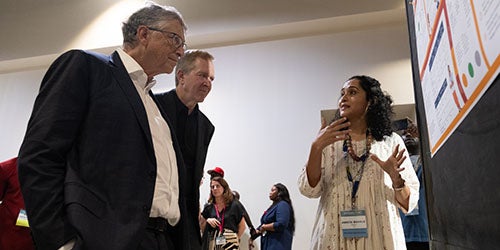
In the fall, I traveled to Senegal to meet with some of the incredible researchers doing this work and to celebrate the 20th anniversary of the foundation’s Grand Challenges initiative.
When we first launched Grand Challenges the Gates Foundation’s flagship innovation program it had a single goal: Identify the biggest problems in health and give grants to local researchers who might solve them.
We asked innovators from developing countries how they would address health challenges in their communities, and then we gave them the support to make it happen.
Many of the people I met in Senegal were taking on the first-ever AI Grand Challenge.
The foundation didn’t have AI projects in mind when we first set that goal back in 2003, but I’m always inspired by how brilliant scientists are able to take advantage of the latest technology to tackle big problems.
It was great to learn from Amrita Mahale about how the team at ARMMAN is developing an AI chatbot to improve health outcomes for pregnant women.
Much of their work is in the earliest stages of development there’s a good chance we won’t see any of them used widely in 2024 or even 2025.
Some might not even pan out at all. The work that will be done over the next year is setting the stage for a massive technology boom later this decade.
Still, it’s impressive to see how much creativity is being brought to the table. Here is a small sample of some of the most ambitious questions currently being explored:
Can AI combat antibiotic resistance? Antibiotics are magical in their ability to end infection, but if you use them too often, pathogens can learn how to ignore them. This is called antimicrobial resistance, or AMR, and it is a huge issue around the world especially in Africa, which has the highest mortality rates from AMR. Nana Kofi Quakyi from the Aurum Institute in Ghana is working on an AI-powered tool that helps health workers prescribe antibiotics without contributing to AMR. The tool will comb through all the available information including local clinical guidelines and health surveillance data about which pathogens are currently at risk of developing resistance in the area—and make suggestions for the best drug, dosage, and duration.
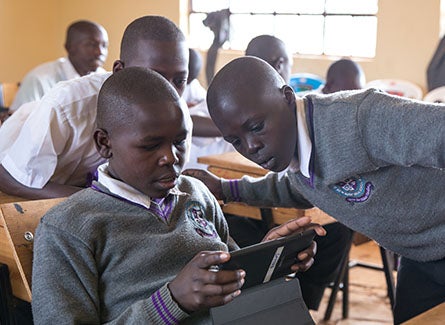
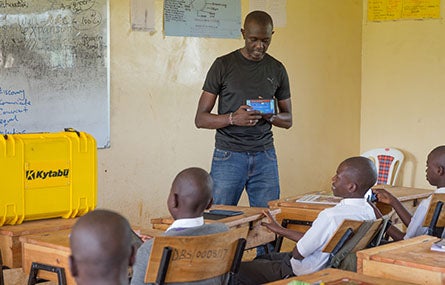
Can AI bring personalized tutors to every student? The AI education tools being piloted today are mind-blowing because they are tailored to each individual learner. Some of them like Khanmigo and MATHia are already remarkable, and they’ll only get better in the years ahead. One of the things that excites me the most about this type of technology is the possibility of localizing it to every student, no matter where they live. For example, a team in Nairobi is working on Somanasi, an AI-based tutor that aligns with the curriculum in Kenya. The name means “learn together” in Swahili, and the tutor has been designed with the cultural context in mind so it feels familiar to the students who use it.
Students interact with an AI tutor in a classroom in Nairobi, Kenya.
Can AI help treat high-risk pregnancies? A woman dies in childbirth every two minutes. That’s a horrifying statistic, but I’m hopeful that AI can help. Last year, I wrote about how AI-powered ultrasounds could help identify pregnancy risks. This year, I was excited to meet some of the researchers at ARMMAN, who hope to use artificial intelligence to improve the odds for new mothers in India. Their large language model will one day act as a copilot for health workers treating high-risk pregnancies. It can be used in both English and Telugu, and the coolest part is that it automatically adjusts to the experience level of the person using it whether you’re a brand-new nurse or a midwife with decades of experience.
Can AI help people assess their risk for HIV? For many people, talking to a doctor or nurse about their sexual history can be uncomfortable. But this information is super important for assessing risk for diseases like HIV and prescribing preventive treatments. A new South African chatbot aims to make HIV risk assessment a lot easier. It acts like an unbiased and nonjudgmental counselor who can provide around-the-clock advice. Sophie Pascoe and her team are developing it specifically with marginalized and vulnerable populations in mind—populations that often face stigma and discrimination when seeking preventive care. Their findings suggest that this innovative approach may help more women understand their own risk and take action to protect themselves.
Could AI make medical information easier to access for every health worker? When you’re treating a critical patient, you need quick access to their medical records to know if they’re allergic to a certain drug or have a history of heart problems. In places like Pakistan, where many people don’t have any documented medical history, this is a huge problem. Maryam Mustafa’s team is working on a voice-enabled mobile app that would make it a lot easier for maternal health workers in Pakistan to create medical records. It asks a series of prompts about a patient and uses the responses to fill out a standard medical record. Arming health workers with more data will hopefully improve the country’s pregnancy outcomes, which are among the worst in the world.
Tonee Ndungu whose team is developing Somanasi shows off the latest version of their personalized education tutor.
We can learn a lot from global health about how to make AI more equitable.
The main lesson is that the product must be tailored to the people who will use it.
The medical information app I mentioned is a great example: It’s common for people in Pakistan to send voice notes to one another instead of sending a text or email.
So, it makes sense to create an app that relies on voice commands rather than typing out long queries.
And the project is being designed in Urdu, which means there won’t be any translation issues.
If we make smart investments now, AI can make the world a more equitable place.
It can reduce or even eliminate the lag time between when the rich world gets an innovation and when the poor world does.
Zimbabwe | 61-year-old Esther is a married grandmother of two young grandchildren (Rudo and Munashe), and also looks after two nieces (Faith and Nicole). She struggles to feed her family and worries a great deal about where she will find food to feed them all. She has very little food supplies left, and her granddaughter Rudo needs to go out and collect termites for their family to eat. She makes a living supervising other farmers’ livestock, and is usually paid in food. | John Hewat/CARE International
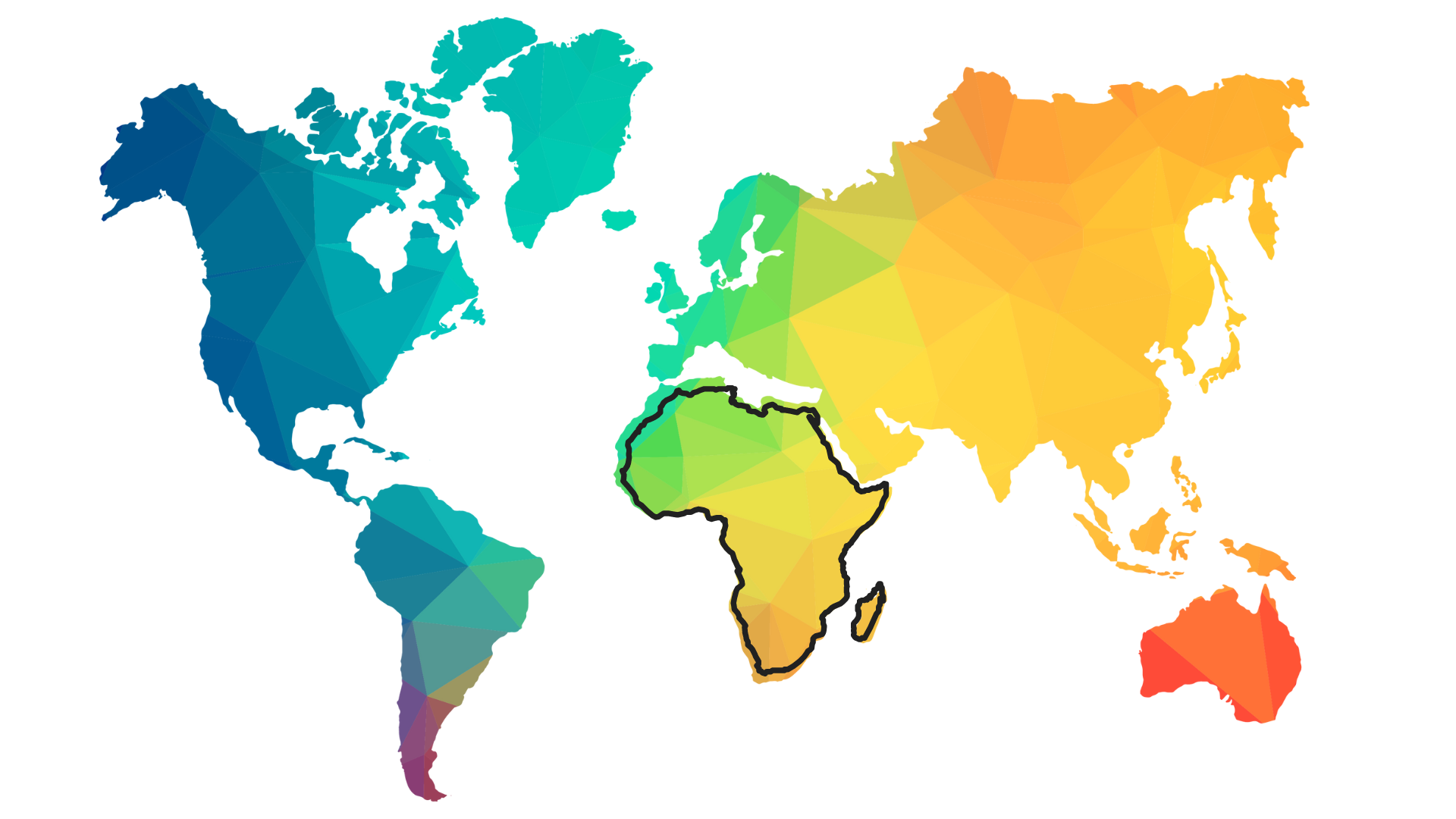
Picture the map of the world. If you’re having trouble remembering the details, we’ll provide a visual aid. Have a look at this map of the world.
Graphic by Darnelle Fortune.
Situated right in the center, and taking up the second-most amount of space is Africa.
It’s a continent that, when you consider it next to the others, is almost impossible to overlook.
You’d have to be trying really hard not to see the continent at all. But that is what happens, isn’t it?
Africa and her issues go unseen by so much of the world and a major reason for this is mainstream media not creating the space to cover Africa and her crises.
At the beginning of every year, the humanitarian organization CARE International releases a report that lists 10 of the world’s most underreported crises from the previous year.
This is not to say that other continents and the countries within them don’t have crises, or that one crisis is more harmful than another, it’s to highlight that there is a great deal of need that is going unnoticed and the longer need goes unnoticed, the longer it takes to resolve.
For virtual events it allows a meeting place where all those attending individual sessions, panels, tracks or exhibit booths in a Shindig-enabled event, to navigate to a single shared experience and meet up, just as they might if the event were in person.
One of the key additional differentiators of this feature is that all the private conversations can go on while the participants are also able to peruse and interact with the conference program directory, discussing with friends and colleagues what session, panel, track, or booth they might attend together next while jointly exploring the full conference guide.
Addressing the clamoring need for better virtual and hybrid event networking, Shindig today introduces a patented virtual lobby functionality; a virtual experience where event attendees can mingle, network and conduct private business on the platform.
“The innovation is designed for both virtual events and hybrid events”
TRUSTANJAMESJR
For hybrid events the function adds two critical new elements.
First, it provides a venue for in-person guests to engage with online participants freely on their mobile phones, critically uniting both audiences together for purposes of private conversation.
Second, it helps event hosts avoid “dead air” in their livestreams and provides opportunities for the online audience to engage during breaks required between the in-person sessions, which otherwise would cause the online audience to be lost and otherwise leave the event.
In the 2021 Event Tech Innovation Report, the EventMB publication cited ‘the biggest challenge for planners in virtual events is how to keep attendees engaged’.
Virtual events also promise to play a significant role in hybrid events, as they can allow in-person attendees to take advantage of the opportunity to engage with the potentially larger audience attending online, and vice versa.
In response to this need, Steve Gottlieb, CEO & Founder of Shindig, Inc. said, “while many platforms claim that one-on-one appointments, speed dating or text interactions are the same as networking, those just don’t compare to real life behavior people want
“And just like an in-person event lobby, the Shindig lobby is perfect for sponsor messaging, video displays, dynamic CTA’s and other activities that can be facilitated in a conference reception space”
Where to start is to download the e-Naira app from google store place or apple.
Note that after requesting the app, you may be asked to verify your identity by entering your passcode or by using Touch ID or Face ID.
From the Home screen, tap the App store. If the e-Naira Speed Wallet app isn’t available on your home screen, swipe left to access the App Library.
“33 banks fully integrated and live on the platform”
CBN
To install apps, you must sign in with your Apple ID or create one.
To browse the App Store, tap Apps. To search for apps by name, tap search (at the bottom) then type e-Naira Speed Wallet’s app.
When the app appears, tap the app. Tap GET, then tap INSTALL. Once successful downloaded, launch the e-Naira Speed Wallet.
“Over 120 merchants successfully registered”
CBN
Click on “Signup” to originate the onboarding process. Select your Relationship bank/e-Naira Partner. Enter mobile number and create password.
Enter the following: First name, Surname, Date of birth, State of Origin, Account number tied to your Bank, and BVN.
On successful validation, of the above details, a wallet activation mail is sent to the email address tied to your BVN.
“Tax base’ll increase as more businesses move to formal sector, Buhari enthuses”
INSIDERNOTES
Go to registered mailbox and confirm receipt of email. Click on “Active Wallet” to confirm your email and activate your speed e-Naira Wallet.
Enter your surname and password to login to the e-Naira Speed Wallet. To Fund the e-Naira Wallet, log in to your bank Mobile/Internet Banking platform and initiate the transfer to your wallet.
And your wallet will be credited with the amount requested from your account to your wallet.
Big Brother Naija (BBNaija) Shine Ya Eye finalist, Liquorose attended a public function with the mother of her lover in the house, Emmanuel.
Liquorose got special attention at the event. She appeared in a beautiful green gown as she exchanged pleasantries with other guests at the party.
A couple of fans have reacted to the video with some of them suggesting that Liquorose was mingling with her future mother-in-law. Legit.ng captured some of their reactions below:
However, Luno disclosed that the withdrawal and depositing of funds for Nigerian users will be done through a third-party platform.
“We believe that this is the safest and easiest-to-use solution currently available to our customers in Nigeria and look forward to you experiencing it for yourselves.”
INSIDERNOTES
Luno warns users that it “does not set the price of bitcoin or any cryptocurrencies, we only facilitate transactions between customers.
The return of Naira deposits and withdrawals may cause significant price volatility, with the release of pent-up customer demand to buy and sell cryptocurrency causing unusual market behaviour that could last for several weeks,” Luno said.
You will be able to deposit and withdraw funds to and from the Luno platform using vouchers purchased and redeemed through a trusted third party provider.
“Representation of cryptocurrency Bitcoin is placed on PC motherboard in this illustration taken, June 29, 2021. Representation of cryptocurrency Bitcoin is placed on PC motherboard in this illustration taken, June 29, 2021.”
This is as the apex bank released regulatory guidelines which stipulate that charges for transactions that originate from the eNaira platform will be free in the first 90 days commencing from October 25.
According to the regulatory and issuance guidelines, banks will automatically be onboarded by the CBN while merchants will be onboarded once they download the app and individuals will have to onboard by themselves.
Following the launch of the enaira by the President, Major General Muhamadu Buhari (retd.), the application for the digital currency introduced by the CBN has become available for download, with more than 5,000 downloads within hours of the launch.
“The eNaira stock wallet belongs solely to the CBN and it shall warehouse all minted eNaira,”
INSIDERNOTES
The eNaira speedwallet app meant for individuals had at 4pm on Tuesday, seen more than 5,000 downloads while the eNaira speed merchant wallet had seen close to 1,000 downloads.
After this period, applicable charges as outlined in the Guide to Charges by Banks, Other Financial and Non-bank Financial Institutions will become effective.
It said that financial institutions were expected to maintain one treasury eNaira wallet to warehouse eNaira received from the CBN eNaira stock wallet.
“The eNaira branch subwallet shall be funded from the treasury eNaira wallet”
Comedian Hannah Gadsby unleashed the wrath of Dave Chappelle after she criticized his Netflix special The Closer. Now people are coming to her defense.
The jab at Gadsby—who has Netflix specials of her own in Nanette and Douglas—come after the comedian responded to Netflix co-CEO Ted Sarandos, after he defended Chappelle’s special using her own work as an example.
“does dave chappelle not get that he is hannah gadsby for guys”
INSIDERNOTES
“Now I have to deal with even more of the hate and anger that Dave Chappelle’s fans like to unleash on me every time Dave gets 20 million dollars to process his emotionally stunted partial world view,”
Dave Chappelle told a “joke” about assaulting a lesbian in his stand up special and now demands that trans people “admit that Hannah Gadsby isn’t funny” in case any cis lesbians are confused, people who hate trans people hate you too. They do not make a distinction.
Hannah Gadsby is living rent free in the heads of every male comedian is existence—and absolutely EATING THEM UP inside—and for that (among other things) I love her very much.
“Hannah Gadsby is funny af, also brilliant, also I am desperate to take an art history class from her”
INSIDERNOTES
Hannah Gadsby is HILARIOUS and smart as hell. She is also a lesbian and neurodivergent so I see Dave Chappelle is still punching down on people I love. What a waste of his talents.
First of all, you cannot come if you have not watched my special from beginning to end,” Chappelle said. “You must come to a place of my choosing at a time of my choosing, and thirdly, you must admit that Hannah Gadsby is not funny.”
In honor of 21 Savage’s 29th birthday, his good friend Young Thug marked the occasion by gifting the “Bank Account” MC a custom Dodge Hellcat TRX worth $150,000.
As TMZ points out, the Hellcat on its own already ranges between $60K and $70K, but an extensive video demonstrates that 21’s bright red pickup is completely customized to the fullest extent, hence the hefty price tag.
His name “21” is inscribed on the side of the truck along with multiple dagger logos. 21’s face has also been stitched into the truck’s headrests, along with glow-in-the-dark stars and an illuminating “21” stitched into the ceiling of the vehicle.
“better sit down somewhere.”
21SAVAGE
The party, which 21 named “FreakNik 21,” actually later incurred legal copyright threats from the Atlanta festival company of the same name.
“Sucks we gonna have to sue them when all we asked that they acknowledged us since it was a free event and they declined,” FreakNik’s official Twitter account wrote.
The truck was bought and designed from Roadshow International, a luxury car dealership located in Atlanta where 21 had a crazy birthday party this past weekend, TMZ reports. A reaction video on Instagram shows 21 smiling as he playfully puts Thugga in a headlock once he reveals his gift.
The 20-track Punk boasts an array of guest stars, including A$AP Rocky, J. Cole, Doja Cat, Drake, Future, Gunna, Juice WRLD, Post Malone, Mac Miller, Nate Ruess and Travis Scott.
Young Thug achieves his third No. 1 on the Billboard 200 albums chart (dated Oct. 30) as his latest release, Punk, debuts in the top slot. The set earned 90,000 equivalent album units earned in the U.S. in the week ending Oct. 21, according to MRC Data.
The Billboard 200 chart ranks the most popular albums of the week in the U.S. based on multi-metric consumption as measured in equivalent album units.
“My Universe, with BTS, debuted at No. 1 on the all-genre Billboard Hot 100, marking the second leader for Coldplay”
INSIDERNOTES
Units comprise album sales, track equivalent albums (TEA) and streaming equivalent albums (SEA).
Each unit equals one album sale, or 10 individual tracks sold from an album, or 3,750 ad-supported or 1,250 paid/subscription on-demand official audio and video streams generated by songs from an album.
The new Oct. 30, 2021-dated chart (where Punk debuts to No. 1) will be posted in full on Billboard‘s website on Oct. 26.
“All versions of the album, old and new, are combined for tracking and charting purposes”
INSIDERNOTES
3,899%). Of that sum, album sales comprise 48,000 (up 11,570%; making it the top-selling album of the week), SEA units comprise 6,000 (up 589%; equaling 8.34 million on-demand streams of the set’s tracks) and TEA units comprise 1,000 (up 1,180%).
Let It Be was first released in 1970 as the final studio effort from the band. It spent four weeks atop the chart (June 13-July 4, 1970-dated charts).
For its special edition, the album was reintroduced in a variety of expanded formats and editions, including many with previously unreleased tracks.
For all chart news, follow @billboard and @billboardcharts on both Twitter and Instagram.
Kate and William announced the birth of their first child, Prince George on 22 July 2013, making him heir apparent to the throne.
His younger siblings, Princess Charlotte, 6, and Prince Louis, 3, will be the “spare” siblings, which could lead to them not having a defined role as royals.
Charles has also reportedly been in plans to drastically “slim down” the monarchy to a team of just seven working royals.
“Royal commentator Angela Mollard spoke to the Australian morning programme Sunrise hosts about the young royals”
INSIDERNOTES
Ms Mollard said: “They’re talking about reducing their kid’s involvement in royal duties.”
It would also mean that less royals would be reliant on the tax-payer-funded Sovereign Grant, and would have to find other means of income
First, it was the ‘Princess Diana Effect’, then it was the ‘Kate Middleton Effect’ and now it’s the royal children’s turn. From gorgeous knitted jumpers to adorable shoes, the royal children have been proclaimed style icons with parents everywhere eager to dress their children just like the Cambridges.
Millions of people across the world rely on the popular messaging app, WhatsApp, to communicate with their friends, loved ones, and colleagues on a daily basis.
But many of them will not be able to use the app anymore because of the model of their phones.
According to a report by UK-based publication, The Sun, the app will stop working on several models of smartphones starting from November 2021.
“People pose with smartphones in front of the displayed Whatsapp logo in this illustration on September 14, 2017”
INSIDERNOTES
Per the publication, the app will not be supported on both iPhone and Android models, therefore, affected users will either have to buy a new phone or update the software of their smartphones.
The publication says that more than 40 different smartphone models will not be able to support WhatsApp, and the deadline for updating the software is November 1.
Here’s the list of phones which will not be able to support WhatsApp from November.
iPhone
iPhone 5
iPhone 6S Plus
iPhone SE
Samsung
Galaxy Trend Lite
Galaxy Trend II
Galaxy SIII
Galaxy S3 Mini
Galaxy Xcover 2
Galaxy Core
Galaxy Ace 2
ZTE
ZTE V956
Grand X Quad V987
Grand Memo
Sony
Xperia Miro
Xperia Neo L
Xperia Arc S
LG
Lucid 2
Optimus F7
Optimus F5
Optimus L2 II Dual
Optimus L5
Best L5 II
Optimus L5 Dual
Best L3 II
Optimus L7
Optimus L7 II Dual
Best L7 II
Optimus F6, Enact
Optimus L4 II Dual
Optimus F3
Best L4 II
Best L2 II
Optimus Nitro HD
Optimus 4X HD
Optimus F3Q
Huawei
Ascend G740
Ascend Mate
Ascend D Quad XL
Ascend D1 Quad XL
Ascend P1 S
Ascend D2
Other smartphones
Alcatel
Archos 53 Platinum
HTC Desire 500
Caterpillar Cat B15
Wiko Cink Five
Wiko Darknight
Lenovo A820
UMi X2
Run Fl1
THL W8
In order to use WhatsApp, Android users will need to be using Android 4.1 or later, while iPhone users will need to be on iOS 10 or later, the publication said.
According to the data at the FMDQ Security Exchange where forex is traded officially, exchange rate between the naira and the US dollar opened at ₦414.18/$1 on Wednesday October 20, after it closed at ₦414.73 to a $1 on Monday, 18 October 2021.
No Forex rate was shown for Tuesday, October 19, 2021, due to the public holiday declared by the federal government.
The exchange rate for a dollar to naira at Lagos Parallel Market (Black Market) for today, Wednesday, October 20, opened N575.00 to a $1, according to sources at Bureau De Change (BDC).
“The official rate today, Wednesday October 20, for $1 dollar to naira = ₦414.18/$1″
INSIDERNOTES
The exchange rate between the naira and the US dollar opened at ₦₦414.18/$1 on 20th October 2021 as against how it closed at ₦414.46/$1 on Monday 18th October 2021, showing a decline at -0.07.
Please note that the Central Bank of Nigeria (CBN) does not recognise the parallel market (black market), as it has directed individuals who want to engage in Forex to approach their respective banks.
IT’S NO SECRET that two-factor authentication (2FA) is one of the best ways to keep your various digital accounts secure—that’s why everyone from Google to Microsoft to Apple to Twitter gives you 2FA as an option.
The “two factor” in the name refers to using a second code alongside your password to log in on a new device. This means that even if someone gets ahold of your username and password, they won’t be able to access your data.
That extra 2FA code is typically provided by an app on your phone, and a lot of us rely on Google Authenticator for Android and iOS. The app is simple and straightforward, comes from a well-known company, and gets the job done.
“There’s nothing wrong with Google Authenticator—but other options are available”
INSIDERNOTES
For the purposes of this guide, we’re going to show you how to make the jump from Google Authenticator to Twilio Authy (available for Android and iOS).
Authy runs on multiple accounts, offers desktop access support, prevents in-app screenshots, uses encrypted recovery backups, and more—it’s an excellent all-around 2FA app and very intuitive to use.
There’s nothing wrong with Google Authenticator, but more feature-rich alternatives are available, which is where this guide comes in.
The good news is that it’s possible to transfer all your 2FA login information to another app without getting locked out of your accounts along the way.
“There’s no automatic or speedy process here”
GOOGLE
If you’re ready and determined to make the switch from Google Authenticator to Twilio Authy, you first need to make sure you’ve got both apps installed on your phone. Then you can begin switching your accounts over, one by one.
Remember that the codes you’re generating with Google Authenticator are key to gaining access to all of your digital accounts. If you lose access to those codes, you’re going to have to switch to a backup access method—in the case of Google accounts, that might mean entering one of the backup codes provided when you set up 2FA.
It’s common to have photos with a blurry subject. If the lighting isn’t great or if you’ve shaken your hands while capturing the image, you end up with a blurry photo which can be disappointing.
With the Pixel 6, though, you no longer have to be worried about people or faces in your pictures being blurred thanks to the new Tensor chip that has on-device Machine Learning capabilities.
The custom-designed Tensor chip enables Google to run its complex algorithms with ease which has resulted in new features like the Magic Eraser which can remove unwanted objects from your pictures.
Fresh off the release of his new album Punk and a pair of Travis Barker-backed Saturday Night Live performances, Young Thug dropped by the Breakfast Club headquarters for an hour-long discussion that opened with a reflection on his previous issues with Charlamagne.
Asked what kept him “away from the Breakfast Club all these years,” Thug initially said he didn’t know before pointing to his and Charlamagne’s “misunderstanding.”
From there, Thugger noted his previous comments against CTG—which were spurred by Birdman’s infamous appearance on the show in 2016—were “all talk” at the time.
“That was all talk,”
YUNGTHUG
Thug said. “I never understood, like, how could it go so, how could it seem so far. We all just talking shit. … I was kinda young back then.
I ain’t understand blogging back then. You know, I was so young and fresh in the game to the point that I didn’t understand this shit and how important it is.”
About three minutes into the interview, Thug—who’s 30—said he’s “pretty old now” and has since grown out of “arguing on the internet,” among other things.








 45'MEDIA