the unbearable notice is; that you've to make up your mind to be the difference and not the other way round else people will misjudge you even though you're not that person.
It’s been an uphill battle over centuries for women to have the right to say and do as they please, and to make decisions over their own bodies, lives, and futures.
When it comes to gender equality, one thing the whole world can agree on is that we’ve not yet achieved it and not one country in the world has reached the milestone of viewing and treating women equally, and acknowledging them as autonomous beings who have a say over their decisions, movements, and bodies.
Few things in this world have been fought over as extensively as women’s bodies.
You’d think by now, in 2023, women would be free to make choices over their bodies and their futures; that we’d have reached a collective understanding that all human beings have the right to do what they want with their own bodies.
Alas, we’re not there yet instead, women’s sexual and reproductive health, their safety, and their rights are at risk the world over.
But to map out our journey to an equitable future, it’s important to know how far we’ve come.
Here are some of the most pivotal moments in recent history that have shaped the fight for women’s bodily autonomy.
This was a huge win after women had fought for it for decades, and scientists had to work around laws that prohibited contraceptive research at the time.
“The ability for women to control their reproductive cycle ushered in a transformation in women’s engagement in society, the economy, and politics in the US”
INSIDERNOTES
1969
The United Nations Population Fund (UNFPA) is created.
The UN’s sexual and reproductive health agency has been hard at work for 50 years building knowledge, awareness, and capacity on the importance of bodily autonomy, reproductive health and family planning, and to promote strategies and solutions for developing countries that are based on gender equality and human rights.
1984
The US institutes the “global gag rule”.
A.k.a. the Mexico City Policy, this dangerous policy prevents US aid and support for international organizations and partners whose work involves abortion.
These organizations are often prohibited from sourcing funding elsewhere for this purpose.
Between 1984 and 2022, the rule has been enacted and reversed by Republican and Democratic administrations respectively.
1993-1995
World leaders met at pivotal human rights conferences during this time, in Vienna, Beijing, and Cairo.
Recognizing the world was falling behind on progress towards gender equality, leaders united different agencies and offices to create a new organ of the UN system focused exclusively on gender equality and the empowerment of women.
Over the last decade, UN Women has made sure women’s rights stay on world leader’s agenda while supporting feminist movements and women leaders around the world.
Roe v. Wade was implemented in 1973 to safeguard the constitutional right to abortion across the US.
In 2022, the US Supreme Court overturned this 50 year decision, putting the question of women’s bodily autonomy and rights up for debate once again and putting millions of women’s lives, health, and futures in the balance.
When it was overturned, women in the country and around the world united in protest. The fight continues.
The COP28 climate summit in Dubai, November 2023. Here’s what you should know.
Many countries had their representatives at the COP28, and still yet are with less or zero knowledge about what really went down well, here’s a brief recap if you fall into this category just a two minute read.
Flooding in India, Cameroon, and Libya. Extreme heat across the US, Europe, and Asia.
A cyclone in Myanmar. A tropical storm hitting Japan, Guam, the Philippines, and Taiwan. The list goes on.
This is not exactly the kind of sentence you’d expect from a qualified climate expert, a group that prefers the more austere language of hard facts.
Yet, these days, “climate scientists are struggling for words,” writes climate scientist Katharine Hayhoe.
Instead, she’s started replying to questions about the latest extreme weather event or report about how dire things are with: “I am running out of original things to say.”
This year’s COP is a significant milestone: the first assessment of how countries are faring against emissions cutting commitments made at Paris in 2015 (known as the Paris agreement).
When the Paris agreement was signed in 2015, it was agreed that every five years countries would return with more ambitious plans to reduce their greenhouse gas emissions and tackle global warming.
The #COVID19 pandemic caused COP to be canceled in 2020, making COP26 in Glasgow, Scotland, in 2021, one of the “big COPs.”
The “small COPs,” held in the intervening years, tend to focus on laying the groundwork for negotiations.
COPs usually open with a ceremonial opening meeting.
This is then followed by days of world leaders on stage talking about climate change, generally concentrating either on what their countries intend to do about it or on the dire consequences they are experiencing.
The remaining days have themes such as finance and energy and see politicians and business leaders stepping up to announce various new promises, pledges, coalitions, and projects.
But outside the doors, activists usually rage against superficial commitments and rally against political inaction.
This time, there’s been significant outrage after it was leaked to the Guardian that the UAE’s state oil company has been able to read emails to and from the COP28 climate summit office and was consulted on how to respond to a media inquiry.
Remind me, what was agreed at Paris?
Under the landmark Paris agreement at COP21 in 2015, nations committed to holding global heating to well below 2 degrees Celsius above pre industrial levels, and preferably limiting warming to 1.5 degrees.
Though the deal is legally binding, the commitments that countries have made to cut their emissions are not, unless they are enshrined into national or regional legislation.
INSIDERNOTES
Who takes part?
The attendees at COP are dignitaries and Heads of State and Government as well as tens of thousands of government delegates and representatives of civil society, intergovernmental organizations, NGOs, and the media.
There are 197 parties which are broadly organized in five regional groups: Africa, Asia, Eastern Europe, Latin America and the Caribbean, and Western Europe and Other States (including Australia, Canada, and the US).
At the cluster of COP side events, climate change leaders, experts, and influencers gather to share their stories and solutions at panel discussions, exhibits, cultural events, and more.
What happened at COP27?
After two weeks of fraught negotiations, a “historic pact” was struck at COP27 in which developed countries, which are historically responsible for the climate emergency, agreed to provide climate finance to help poorer countries experiencing climate-related disasters, known as a loss and damage fund.
Alok Sharma, the UK President of COP26, was more scathing about how the conference fared.
“I said in Glasgow that the pulse of 1.5 degrees was weak. Unfortunately, it remains on life support,” he said.
What do we want to happen at COP28?
An End to Fossil Fuels
That means support for the Fossil Fuel Non-Proliferation Treaty from world leaders to ensure a Just Transition away from fossil fuels, an end to fossil fuel subsidies, and robust taxing of remaining fossil fuel production.
Cough Up the Climate Finance
Now isn’t the time for baby steps, it’s time to go big: fund a Just Transition in all countries, help countries adapt to climate change, and fund loss and damage.
Protect Climate Activists and Environmental Defenders
Almost 2,000 environmental activists have been killed over the past decade.
We need a human rights approach to all aspects of climate action.
For me, this will always be the year I became a grandparent.
It will be the year I spent a lot of precious time with loved ones whether on the pickleball court or over a rousing game of Settlers of Catan.
And 2023 marked the first time I used artificial intelligence for work and other serious reasons, not just to mess around and create parody song lyrics for my friends.
This year gave us a glimpse of how AI will shape the future, and as 2023 comes to a close, I’m thinking more than ever about the world today’s young people will inherit.
In last year’s letter, I wrote about how the prospect of becoming a grandparent made me reflect on the world my granddaughter will be born into.
Now I’m thinking more about the world she will inherit and what it will be like decades from now, when her generation is in charge.
I can begin to picture it: the tools she will use, the ways she will stay in touch with her loved ones, the problems these innovations will help solve.
We now have a better sense of what types of jobs AI will be able to do by itself and which ones it will serve as a copilot for.
And it’s clearer than ever how AI can be used to improve access to education, mental health, and more.
It motivates me to make sure this technology helps reduce and doesn’t contribute to the awful inequities we see around the world.
I’ve always been a firm believer in the power of innovation to offer every child an equal chance to survive and thrive. AI is no exception.
Of course, AI is far from the only defining feature of 2023.
We are just at the beginning of this transition right now.
This is an exciting and confusing time, and if you haven’t figured out how to make the best use of AI yet, you are not alone.
I thought I would use AI tools for the foundation’s strategy reviews this year, which require reading hundreds of pages of briefing materials that an AI could accurately summarize for me.
But old habits are hard to break, and I ended up preparing for them the same way I always do.
Millions continue to experience unbearable grief as a result of Russia’s war on Ukraine and in the aftermath of the war in Ethiopia.
My heart is broken for the continued suffering of Israelis and Palestinians, as well as for the people of Sudan.
At the same time, more people are being forced to endure hardship as a result of more frequent extreme weather events caused by climate change.
And families around the world continue to be hit hard by rising inflation and slow economic growth.
There’s no question these are challenging times, but I remain optimistic about the future. The speed of innovation has never been faster.
We’re making big strides on tough problems like Alzheimer’s, obesity, and sickle cell disease that will improve the lives of millions of people.
My friend the late Hans Rosling used to say that
“things can be bad and getting better.”
INSIDERNOTES
It’s a good reminder that progress is not only possible but happening every day.
The team at CAPRISA in South Africa is using data to improve treatments for patients infected with both HIV and tuberculosis.
That’s why I remain dedicated to making sure that, even in the face of setbacks, the world continues to do more to help the poorest people.
I do the bulk of this work through the Gates Foundation, where my colleagues remain dedicated to improving global health, education, gender equality, and more.
While I could write a thousand pages about the incredible work they’re doing with our partners, this letter focuses on just a few of the most exciting breakthroughs.
I also write about why I’m optimistic about the world’s climate progress.
Most of my climate and energy work is done through Breakthrough Energy, although the Gates Foundation is helping people in low- and middle income countries adapt to a warming world.
I also continue to privately fund research into other areas like Alzheimer’s disease.
And I still get to advise Microsoft, which gives me insight into what’s coming down the pipeline and how it can be used to make the world a more equitable place.
I’m lucky that my work gives me insight into all the ways the world is getting better.
The challenges we face feel a lot less daunting when you understand what exactly it will take to tackle them.
In this letter, I will share just a few reasons I am optimistic about the year ahead.
I hope they make you as excited about all the progress to come as I am.
AI Is About To Supercharge The Innovation Pipeline.
My work has always been rooted in a core idea: Innovation is the key to progress.
It’s why I started Microsoft, and it’s why Melinda and I started the Gates Foundation more than two decades ago.
Innovation is the reason our lives have improved so much over the last century.
From electricity and cars to medicine and planes, innovation has made the world better.
Today, we are far more productive because of the IT revolution.
The most successful economies are driven by innovative industries that evolve to meet the needs of a changing world.
My favorite innovation story, though, starts with one of my favorite statistics: Since 2000, the world has cut in half the number of children who die before the age of five.
How did we do it? One key reason was innovation.
Scientists came up with new ways to make vaccines that were faster and cheaper but just as safe.
They developed new delivery mechanisms that worked in the world’s most remote places, which made it possible to reach more kids.
And they created new vaccines that protect children from deadly diseases like rotavirus.
In a world with limited resources, you have to find ways to maximize impact. Innovation is the key to getting the most out of every dollar spent.
And artificial intelligence is about to accelerate the rate of new discoveries at a pace we’ve never seen before.
One of the biggest impacts so far is on creating new medicines.
Drug discovery requires combing through massive amounts of data, and AI tools can speed up that process significantly.
Some companies are already working on cancer drugs developed this way.
But a key priority of the Gates Foundation in AI is ensuring these tools also address health issues that disproportionately affect the world’s poorest, like AIDS, TB, and malaria.
“We’re taking a hard look at the wide array of AI innovation in the pipeline right now and working with our partners to use these technologies to improve lives in low- and middle income countries”
Bill Gates
In the fall, I traveled to Senegal to meet with some of the incredible researchers doing this work and to celebrate the 20th anniversary of the foundation’s Grand Challenges initiative.
When we first launched Grand Challenges the Gates Foundation’s flagship innovation program it had a single goal: Identify the biggest problems in health and give grants to local researchers who might solve them.
We asked innovators from developing countries how they would address health challenges in their communities, and then we gave them the support to make it happen.
Many of the people I met in Senegal were taking on the first-ever AI Grand Challenge.
The foundation didn’t have AI projects in mind when we first set that goal back in 2003, but I’m always inspired by how brilliant scientists are able to take advantage of the latest technology to tackle big problems.
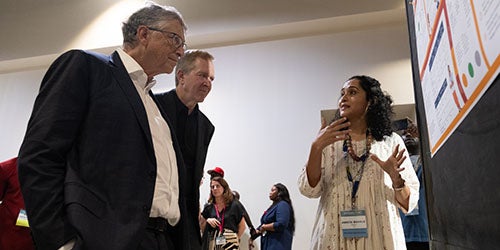
It was great to learn from Amrita Mahale about how the team at ARMMAN is developing an AI chatbot to improve health outcomes for pregnant women.
Much of their work is in the earliest stages of development there’s a good chance we won’t see any of them used widely in 2024 or even 2025.
Some might not even pan out at all. The work that will be done over the next year is setting the stage for a massive technology boom later this decade.
Still, it’s impressive to see how much creativity is being brought to the table. Here is a small sample of some of the most ambitious questions currently being explored:
Can AI combat antibiotic resistance? Antibiotics are magical in their ability to end infection, but if you use them too often, pathogens can learn how to ignore them. This is called antimicrobial resistance, or AMR, and it is a huge issue around the world especially in Africa, which has the highest mortality rates from AMR. Nana Kofi Quakyi from the Aurum Institute in Ghana is working on an AI-powered tool that helps health workers prescribe antibiotics without contributing to AMR. The tool will comb through all the available information including local clinical guidelines and health surveillance data about which pathogens are currently at risk of developing resistance in the area—and make suggestions for the best drug, dosage, and duration.
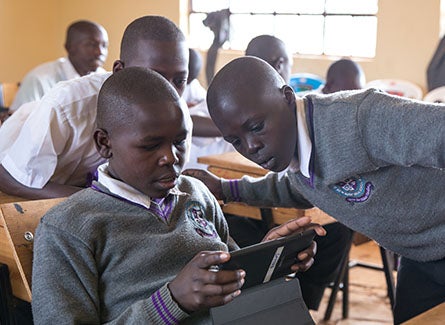
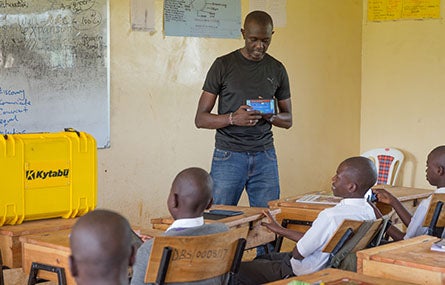
Can AI bring personalized tutors to every student? The AI education tools being piloted today are mind-blowing because they are tailored to each individual learner. Some of them like Khanmigo and MATHia are already remarkable, and they’ll only get better in the years ahead. One of the things that excites me the most about this type of technology is the possibility of localizing it to every student, no matter where they live. For example, a team in Nairobi is working on Somanasi, an AI-based tutor that aligns with the curriculum in Kenya. The name means “learn together” in Swahili, and the tutor has been designed with the cultural context in mind so it feels familiar to the students who use it.
Students interact with an AI tutor in a classroom in Nairobi, Kenya.
Can AI help treat high-risk pregnancies? A woman dies in childbirth every two minutes. That’s a horrifying statistic, but I’m hopeful that AI can help. Last year, I wrote about how AI-powered ultrasounds could help identify pregnancy risks. This year, I was excited to meet some of the researchers at ARMMAN, who hope to use artificial intelligence to improve the odds for new mothers in India. Their large language model will one day act as a copilot for health workers treating high-risk pregnancies. It can be used in both English and Telugu, and the coolest part is that it automatically adjusts to the experience level of the person using it whether you’re a brand-new nurse or a midwife with decades of experience.
Can AI help people assess their risk for HIV? For many people, talking to a doctor or nurse about their sexual history can be uncomfortable. But this information is super important for assessing risk for diseases like HIV and prescribing preventive treatments. A new South African chatbot aims to make HIV risk assessment a lot easier. It acts like an unbiased and nonjudgmental counselor who can provide around-the-clock advice. Sophie Pascoe and her team are developing it specifically with marginalized and vulnerable populations in mind—populations that often face stigma and discrimination when seeking preventive care. Their findings suggest that this innovative approach may help more women understand their own risk and take action to protect themselves.
Could AI make medical information easier to access for every health worker? When you’re treating a critical patient, you need quick access to their medical records to know if they’re allergic to a certain drug or have a history of heart problems. In places like Pakistan, where many people don’t have any documented medical history, this is a huge problem. Maryam Mustafa’s team is working on a voice-enabled mobile app that would make it a lot easier for maternal health workers in Pakistan to create medical records. It asks a series of prompts about a patient and uses the responses to fill out a standard medical record. Arming health workers with more data will hopefully improve the country’s pregnancy outcomes, which are among the worst in the world.
Tonee Ndungu whose team is developing Somanasi shows off the latest version of their personalized education tutor.
We can learn a lot from global health about how to make AI more equitable.
The main lesson is that the product must be tailored to the people who will use it.
The medical information app I mentioned is a great example: It’s common for people in Pakistan to send voice notes to one another instead of sending a text or email.
So, it makes sense to create an app that relies on voice commands rather than typing out long queries.
And the project is being designed in Urdu, which means there won’t be any translation issues.
If we make smart investments now, AI can make the world a more equitable place.
It can reduce or even eliminate the lag time between when the rich world gets an innovation and when the poor world does.
Zimbabwe | 61-year-old Esther is a married grandmother of two young grandchildren (Rudo and Munashe), and also looks after two nieces (Faith and Nicole). She struggles to feed her family and worries a great deal about where she will find food to feed them all. She has very little food supplies left, and her granddaughter Rudo needs to go out and collect termites for their family to eat. She makes a living supervising other farmers’ livestock, and is usually paid in food. | John Hewat/CARE International
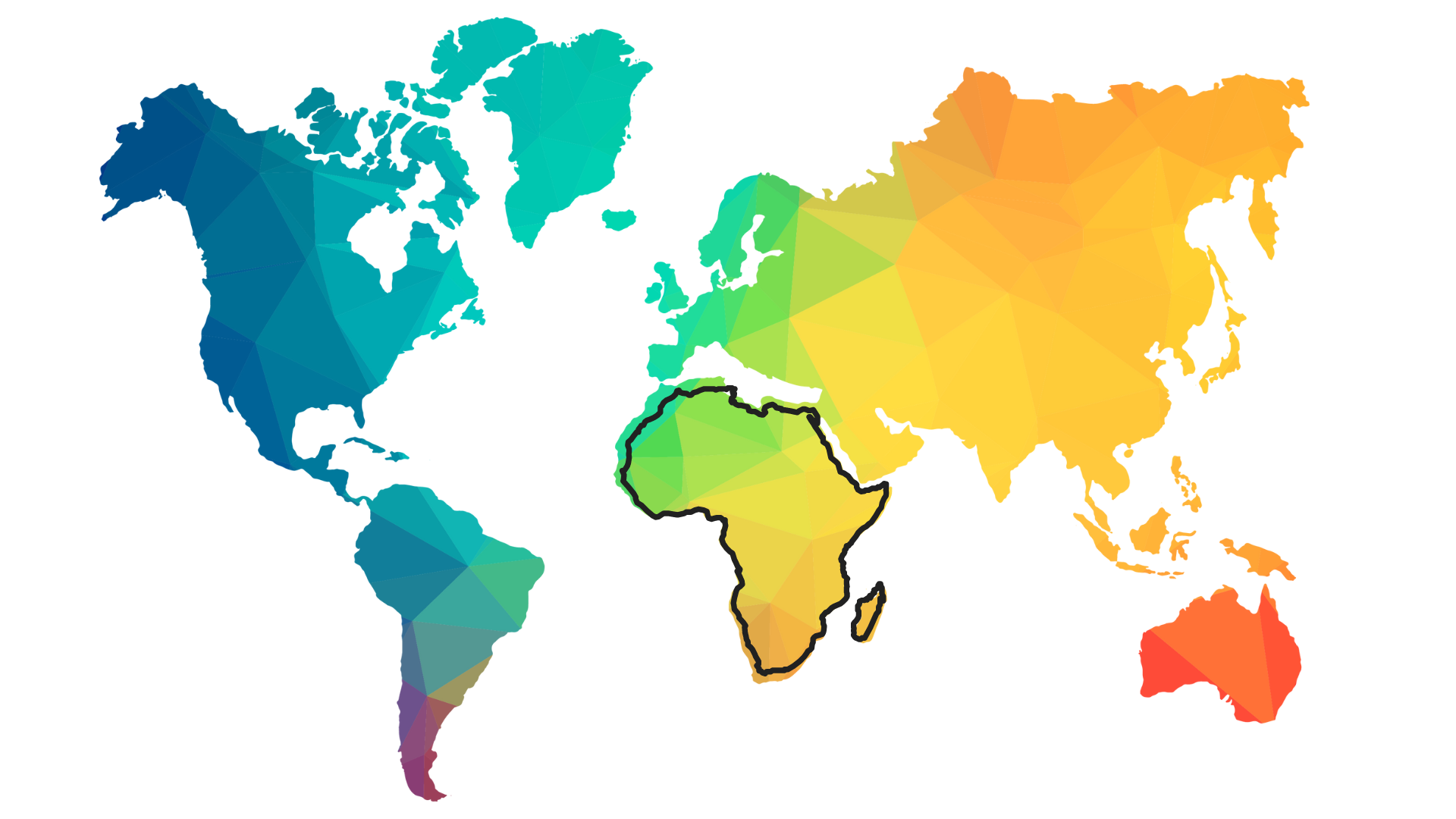
Picture the map of the world. If you’re having trouble remembering the details, we’ll provide a visual aid. Have a look at this map of the world.
Graphic by Darnelle Fortune.
Situated right in the center, and taking up the second-most amount of space is Africa.
It’s a continent that, when you consider it next to the others, is almost impossible to overlook.
You’d have to be trying really hard not to see the continent at all. But that is what happens, isn’t it?
Africa and her issues go unseen by so much of the world and a major reason for this is mainstream media not creating the space to cover Africa and her crises.
At the beginning of every year, the humanitarian organization CARE International releases a report that lists 10 of the world’s most underreported crises from the previous year.
This is not to say that other continents and the countries within them don’t have crises, or that one crisis is more harmful than another, it’s to highlight that there is a great deal of need that is going unnoticed and the longer need goes unnoticed, the longer it takes to resolve.
The easiest pick for Metro was his frequent collaborator, Future. Metro said he has “got to be” in his top five. His Savage Mode II partner, 21 Savage, was also an easy selection for the producer.
Metro did add that Savage “don’t give a fuck about being considered, like, the top five artists from Atlanta.”
Metro Boomin listed his top five artists from Atlanta on the Million Dollaz Worth of Game podcast, Sunday. The legendary producer named 21 Savage, Future, T.I., Gucci Mane, and Young Thug as the best to do it, but admitted it was a difficult choice.
“don’t give a fuck about being considered, like, the top five artists from Atlanta.”
Earlier in the podcast, Metro spoke about his chemistry with Savage, explaining, “The way me and Savage work, it’s easy…but at the same time it’s challenging.
Not challenging in a bad way, it’s just I feel like we challenge each other so much.”
He added: “I feel like with him, it’s always easy for us as a whole, but at the same time he challenges me. But I need that, though, so that’s a blessing$.
Almost surreal, the rain continued even as the sun peeked out like a shy little girl. Buttoning up my rain coat, I left the safety of my front door and raced toward the car. “Can’t you see where you’re going?” a tiny voice asked. Darn, I tripped over something that seemed more stump than human, […]
available on Amazon here Woman: Splendor and Sorrow: | Love Poems and Poetic Prose in Manhattan Book Review In Woman: Splendor and Sorrow: Love Poems and Poetic Prose, Gabriela Milton, presents an assorted collection that’s intended to invigorate the soul and speak to the depths of human understanding. She delineates her views on feminism, misogyny, passion, […]
According to Instagram’s official website, verification “is a tool to help people find the real accounts of public figures and brands, and it means we verified this is a notable and authentic Instagram account.”
It was never intended to become a status symbol in society, but the fact that the culture views it as such means that it carries much more weight than letting people know a particular account is authentic.
Not long ago, I asked a friend a question. “When you see a blue check on somebody’s profile, even if you have never heard of them before, what’s the first thing that comes to your mind?” Without hesitation, my friend answered that the person “must be famous” or “at least the real deal at whatever they do.” And in this simple response lies the answer to why getting verified on Instagram matters.
“When you see a blue check on somebody’s profile, even if you have never heard of them before, what’s the first thing that comes to your mind?”
INSIDERNOTES
I spent a great amount of time building relationships with journalists and today have the contacts of thousands of writers at the world’s biggest publications like Forbes, The New York Times, Success Magazine and more.
Throughout the early months of 2021, I focused heavily on getting myself featured in top publications instead of just focusing on clients. After countless emails, pitch rejections and pitch acceptances, I built a strong line up of news articles for myself to add to my Instagram verification application.
Before submitting, however, I made the decision to do something I don’t see many people talk about when it comes to getting verified on Instagram: I pursued getting verified on other platforms first so that I could show Instagram that I’ve already been recognized as a noteworthy person.
“A blue verification badge gives you instant credibility with absolute strangers even when they don’t know exactly what you do”.
TRISTANJAMESJR
If you have a brand or business, people buy from you and want to work with you when they know you, like you or trust you. A blue verification badge gives you instant credibility with absolute strangers even when they don’t know exactly what you do.
You become looked at as an authority in whatever space you’re in and gain power that needs to be handled responsibly because people tend to take you at your word.
I spent most of the last few years building businesses, traveling as a speaker and making content on social media.
“And in this simple responses lies the answer to why getting verified on Instagram matters”.
INSIDERNOTES
Every once in a while, small publications would reach out and write a story about me. Whenever I applied for verification, however, I always got rejected.
It was around this time that I started my PR agency and in the process of helping others land major news articles, I started doing the same for myself.
After getting verified on Facebook and TikTok, I applied for Instagram verification by submitting these social-media links along with three news articles.
The UK government is on course for a diplomatic collision with Brussels as Brexit minister Lord Frost warned it would be a “historic misjudgement” for the bloc not to rewrite key parts of the agreement.
Accusing the EU of being “disrespectful” to Britain, Lord Frost demanded leaders effectively tear up the Northern Ireland protocol he negotiated alongside Boris Johnson just two years ago and replace it with a new treaty.
Delivering a speech in Lisbon, he risked inflaming tensions, claiming the bloc was attempting to “encourage UK political forces to reverse the referendum result or least keep us closely aligned with the EU”.
“Brexit minister blasts ‘disrespectful’ opposition to Brexit as he demands new Northern Ireland protocol”
JAMESTRISTAN
“The EU and we have got into a low-equilibrium somewhat fractious relationship,” he said.
“Fixing the very serious problem we have in the Northern Ireland protocol is a prerequisite for getting to a better place.”
Meanwhile, UK businesses urged Boris Johnson to pull back from the brink, warning that his threat to tear up the protocol could trigger punitive tariffs on British products – including 10 per cent on car exports to the EU.
“Christmas showdown looms as Brussels sets out plans to resolve Northern Ireland crisis by end of year”
INSIDERNOTES
The scene was set for a Christmas showdown, with observers unsure whether Mr Sefcovic’s initiative had provided enough “wriggle room” for Mr Frost and Mr Johnson to back down from their hardline stance.
In an eagerly-anticipated press conference at the European Commission HQ, Mr Sefcovic set out what he described as “a robust package of creative and practical solutions” to the bureaucracy and shortages that have bedevilled Northern Ireland since the full implementation of Brexit at the start of 2021.








 45'MEDIA